KI-Beratung Beta

Gutscheinbedingungen

**Gültig vom 23.11. bis 30.11.2026 | Gültig für nicht preisgebundene fremdsprachige Bücher | Einzelne Artikel können ausgeschlossen sein | Online auf www.bücher.de einlösbar | Click & Collect nur mit Online-Zahlung (Paypal/Kreditkarte) vorab | Nicht kombinierbar mit anderen Gutscheinen oder Preisaktionen | Nur einmal pro Einkauf einlösbar | Gutschein wird auf max. 500€ Bestellwert angerechnet | Keine Barauszahlung | Nicht gültig für Versandkosten und Services

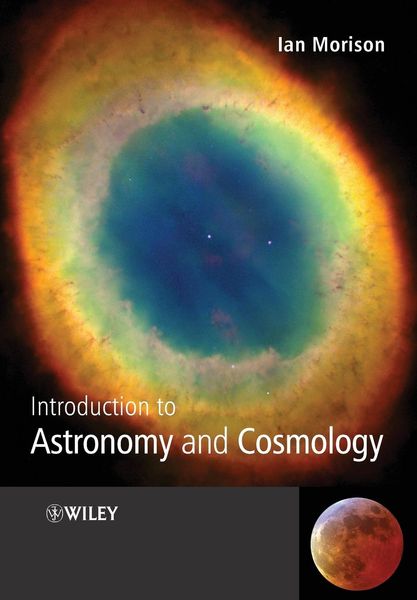
Produktbild: Introduction to Astronomy and Cosmology

Introduction to Astronomy and Cosmology

Aus der Reihe Manchester Physics

59,99 €

inkl. gesetzl. MwSt., Versandkostenfrei


Beschreibung

Introduction to Astronomy & Cosmology is based on a successful course given by the author to give first year university students a thorough grounding in modern astronomy and to describe the techniques that have given rise to many exciting discoveries. The book also aims to show that astronomy is a wonderful...

Beschreibung

Introduction to Astronomy & Cosmology is based on a successful course given by the author to give first year university students a thorough grounding in modern astronomy and to describe the techniques that have given rise to many exciting discoveries. The book also aims to show that astronomy is a wonderful showcase for fundamental physics and how it determines the fabric of the Universe.
 
The Chapters are Organised as Follows:
* Astronomy, an observational science
* Our Solar System I - the Sun
* Our Solar System II - the Planets
* Extra-solar Planets
* Observing the Universe
* The Properties of Stars
* Stellar Evolution - the life and death of stars
* Galaxies and the Large Scale Structure of the Universe
* Cosmology - the origin and evolution of the universe
 
Every concept is accompanied by worked examples including problems at the end of each chapters. Complex mathematics are not required to use this book.
 
This highly illustrated textbook, including numerous colour images, though primarily written for undergraduates, will also be of interest to amateur astronomers and students studying astronomy in senior school.

Rezension

"The book is beautifully produced and illustrated, and notable for the care that has gone into the choice of appropriate and unusual illustrations. Recommended." ( SSR , December 2009) "This is an up to date, well written, first year undergraduate textbook ... .Many people will enjoy reading it." ( The Observatory Magazine , August 2009) "A very well thought out book that lucidly covers a comprehensive range of topics in an attractive format ... .Bang up to date, and all cut up into convenient, self contained sections that can be read in a dip in, dip out sort of way." ( Astronomy Now , January 2009)

Produktdetails

Einband

Taschenbuch

Erscheinungsdatum

24.10.2008

Abbildungen

w. numerous col. ills.

Verlag John Wiley & Sons Inc

Produktdetails

Einband

Taschenbuch

Erscheinungsdatum

24.10.2008

Abbildungen

w. numerous col. ills.

Verlag John Wiley & Sons Inc
Seitenzahl

368

Maße (L/B/H)

24,4/17/1,9 cm

Gewicht

621 g

Auflage

1. Auflage

Sprache

Englisch

ISBN

978-0-470-03334-0

Herstelleradresse

Libri GmbH
Europaallee 1
36244 Bad Hersfeld
DE

Email: gpsr@libri.de

Noch keine Bewertungen vorhanden

Verfassen Sie die erste Bewertung zu diesem Artikel

Helfen Sie anderen Kundinnen und Kunden durch Ihre Meinung.

Kundinnen und Kunden meinen

Bewertungen (0)

Die Leseprobe wird geladen.
  • Produktbild: Introduction to Astronomy and Cosmology
  • Preface.

    Bibliography.

    Chapter 1: Astronomy, an Observational Science.

    1.1 Introduction.

    1.2 Galileo Galilel's proof of the Copernican theory of the solar system.

    1.3 The celestial sphere and stellar magnitudes.

    1.4 The celestial coordinate system.

    1.5 Precession.

    1.6 Time.

    1.7 A second major observational triumph: the laws of planetary motion.

    1.8 Measuring the astronomical unit.

    1.9 Isaac Newton and his Universal law of Gravity.

    1.10 Experimental measurements of G, the Universal constant of gravitation.

    1.11 Gravity today: Einstein's special and general theories of relativity.

    1.12 Conclusion.

    1.13 Questions.

    Chapter 2: Our Solar System 1 - The Sun.

    2.1 The formation of the solar system.

    2.2 The Sun.

    2.3 Nuclear fusion.

    2.4 The solar neutrino problem.

    2.5 The solar atmosphere: photosphere, chromosphere and corona.

    2.6 The solar wind.

    2.7 The sun's magnetic field and the sunspot cycle.

    2.8 Prominences, flares and the interaction of the solar wind with the earth's atmosphere.

    2.9 Solar eclipses.

    2.10 Questions.

    Chapter 3: Our Solar System 2 - The Planets.

    3.1 What is a planet?

    3.2 Planetary orbits.

    3.3 Planetary properties.

    3.4 Planetary atmospheres.

    3.5 The planets of the solar systems.

    3.6 Comets.

    3.7 Questions.

    Chapter 4: Extra-solar Planets.

    4.1 The radial velocity (Doppler wobble) method of planetary detection.

    4.2 Planetary transits.

    4.3 Gravitational microlensing.

    4.4 Astrometry.

    4.5 Discovery space.

    4.6 Selection effects and the likelihood of finding solar systems like ours.

    4.7 Questions.

    Chapter 5: Observing the Universe.

    5.1 Thinking about optics in terms of waves rather than rays.

    5.2 The human eye.

    5.3 The use of a telescope or pair of binoculars to see fainter objects.

    5.4 Using a telescope to see more detail in an image.

    5.5 The magnification of a telescope.

    5.6 Image Contrast.

    5.7 The classic Newtonian telescope.

    5.8 The Cassegrain telescope.

    5.9 Catadioptric telescopes.

    5.10 Active and adaptive optics.

    5.11 Some significant optical telescopes.

    5.12 Radio telescopes.

    5.13 Observing in other wavebands.

    5.14 Observing the universe without using electromagnetic radiation.

    5.15 Questions.

    Chapter 6: The Properties of Stars.

    6.1 Stellar luminosity.

    6.2 Stellar distances.

    6.3 Proper motion.

    6.4 The absolute magnitude scale.

    6.5 Colour and surface temperature.

    6.6 Stellar photometry.

    6.7 Stellar spectra.

    6.8 Spectroscopic parallax.

    6.9 The Hertzsprung-Russell Diagram.

    6.10 The size of stars.

    6.11 The masses and densities of stars.

    6.12 The stellar mass-luminosity relationship.

    6.13 Stellar lifetimes.

    6.14 Questions.

    Chapter 7: Stellar Evolution - The Life and Death of Stars.

    7.1 Low mass stars: 0.05-0.5 solar masses.

    7.2 Mid mass stars: 0.5-8 solar masses.

    7.3 Variable stars.

    7.4 Planetary nebula.

    7.5 White dwarfs.

    7.6 The evolution of a sun-like star.

    7.7 Evolution in close binary systems - the Algol paradox.

    >8 solar masses.

    7.9 Type II supernova.

    7.10 Neutron stars and black holes.

    7.11 The discovery of pulsars.

    7.12 Pulsars as tests for general relativity.

    7.13 Black holes.

    7.14 Questions.

    Chapter 8: Galaxies and the Large Scale Structure of the Universe.

    8.1 The Milky Way.

    8.2 Other galaxies.

    8.3 The universe.

    8.4 Questions.

    Chapter 9: Cosmology - the Origin and Evolution of the Universe.

    9.1 Einstein's blunder?

    9.2 Big Bang models of the universe.

    9.3 The blueshifts and redshifts observed in the spectra of galaxies.

    9.4 The expansion of the universe.

    9.5 The steady state model of the universe.

    9.6 Big Bang or Steady State?

    9.7 The cosmic microwave background.

    9.8 Inflation.

    9.9 The Big Bang and the formation of the primeval elements.

    9.10 The 'ripples' in the Cosmic Microwave Background.

    9.11 How dark matter effects the cosmic microwave background.

    9.12 The hidden universe: dark matter and dark energy.

    9.13 The makeup of the universe.

    9.14 A universe fir for intelligent life.

    9.15 Intelligent life in the universe.

    9.16 The future of the universe.

    Index.