Gutscheinbedingungen

**Gültig bis 10.06.2026 / Gültig für gebrauchte Bücher / Mindestbestellwert 20,00 € / Einzelne Artikel können ausgeschlossen sein / Online auf www.bücher.de.de / Nicht kombinierbar mit anderen Gutscheinen oder Preisaktionen / Nur einmal pro Einkauf einlösbar / Gutschein wird auf max. 500€ Bestellwert angerechnet / Keine Barauszahlung / Nicht gültig für Versandkosten und Services

  • Produktbild: Clostridium difficile
  • Produktbild: Clostridium difficile
Band 646 - 13%

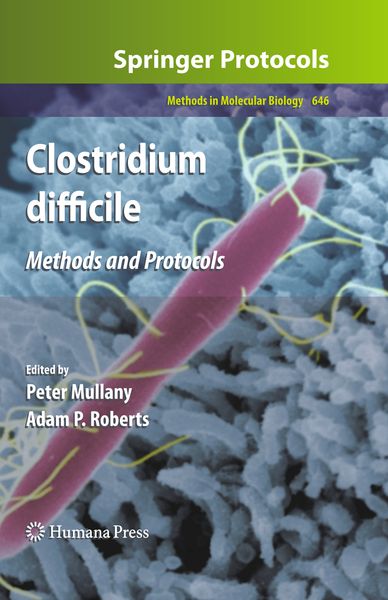
Clostridium difficile Methods and Protocols

13% sparen

92,99 € UVP 106,99 €

inkl. gesetzl. MwSt., Versandkostenfrei

Lieferung nach Hause

Beschreibung

Produktdetails

Einband

Gebundene Ausgabe

Erscheinungsdatum

08.06.2010

Herausgeber

Peter Mullany + weitere

Verlag

Humana Press

Seitenzahl

241

Maße (L/B/H)

26,4/18,7/2,5 cm

Gewicht

607 g

Auflage

2010 edition

Sprache

Englisch

ISBN

978-1-60327-364-0

Beschreibung

Rezension

From the reviews:

“This book describes a variety of research methods used to investigate the pathogenic properties of Clostridium difficile, a major nosocomial pathogen that causes a severe diarrhea after prolonged antibiotic treatment. … This book would be useful to scientists working with bacteria such as C. difficile that cause toxin-mediated diseases in the colon of their host. … This is a technical book that provides essential methods and techniques to study devastating diseases due to Clostridium difficile.” (Rebecca T. Horvat, Doody’s Review Service, October, 2010)

Produktdetails

Einband

Gebundene Ausgabe

Erscheinungsdatum

08.06.2010

Herausgeber

Verlag

Humana Press

Seitenzahl

241

Maße (L/B/H)

26,4/18,7/2,5 cm

Gewicht

607 g

Auflage

2010 edition

Sprache

Englisch

ISBN

978-1-60327-364-0

Herstelleradresse

Libri GmbH
Europaallee 1
36244 Bad Hersfeld
DE

Email: gpsr@libri.de

Kundinnen und Kunden meinen

0 Bewertungen

Informationen zu Bewertungen

Zur Abgabe einer Bewertung ist eine Anmeldung im Konto notwendig. Die Authentizität der Bewertungen wird von uns nicht überprüft. Wir behalten uns vor, Bewertungstexte, die unseren Richtlinien widersprechen, entsprechend zu kürzen oder zu löschen.

Die Bewertungen sind nach Format, Anzahl Sterne und Datum sortiert.

Verfassen Sie die erste Bewertung zu diesem Artikel

Helfen Sie anderen Kund*innen durch Ihre Meinung

Kundinnen und Kunden meinen

0 Bewertungen filtern

  • Produktbild: Clostridium difficile
  • Produktbild: Clostridium difficile
  • Part I: Introduction to C. difficile and the Disease It Causes

    1. Clostridium difficile: No Longer an Enigmatic Pathogen?
    Adam P. Roberts and Peter Mullany

    2. Clostridium difficile and the Disease It Causes
    Torbjörn Norén

    Part II: Isolation and Culture Techniques

    3. Clostridium difficile Isolation and Culture Techniques
    Mike Wren

    Part III: Methods for Typing and Epidemiological Studies

    4. Molecular Typing Methods for C. difficile: Pulsed-Field Gel Electrophoresis and PCR Ribotyping
    Sandra Janezic and Maja Rupnik

    5. Clostridium difficile Toxinotyping
    Maja Rupnik

    6. Multilocus Sequence Typing for Clostridium difficile
    Ludovic Lemée and Jean-Louis Pons

    Part IV: Biochemistry of the Organism

    7. Molecular Methods to Study Transcriptional Regulation of Clostridium difficile Toxin Genes
    Ana Antunes and Bruno Dupuy

    8. Dissecting the Cell Surface
    Robert Fagan and Neil Fairweather

    9. Human Intestinal Epithelial Response(s) to Clostridium difficile
    Nazila V. Jafari, Elaine Allan, and Mona Bajaj-Elliott

    Part V: Genomics

    10. Comparative Genome Analysis of Clostridium difficile Using DNA Microarrays
    Richard Stabler, Lisa Dawson, and Brendan Wren

    Part VI: Development of Systems for Genetic Analysis of the Organism

    11. ClosTron-Targeted Mutagenesis
    John T. Heap, Stephen T. Cartman, Sarah A. Kuehne, Clare Cooksley, and Nigel P. Minton

    12. Methods for Gene Cloning and Targeted Mutagenesis
    Glen P. Carter, Dena Lyras, Rachael Poon, Pauline M. Howarth, and Julian I. Rood

    13. Transposon Mutagenesis in C. difficile
    Haitham A. Hussain, Adam P. Roberts, Rachael Whalan, and Peter Mullany

    Part VII: Animal Models ofDisease

    14. Refinement of the Hamster Model of Clostridium difficile Disease
    Gillian Douce and David Gouding

    15. Methods for Working with the Mouse Model
    Anne Collignon