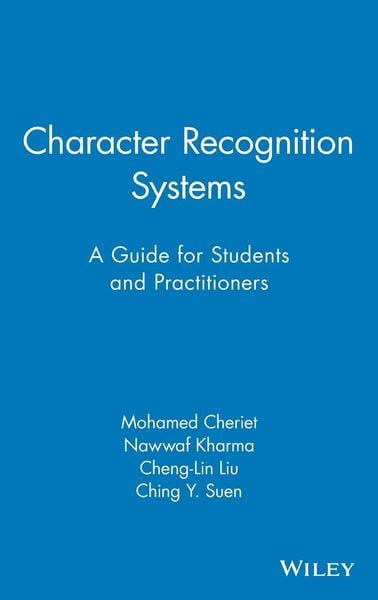
Character Recognition Systems A Guide for Students and Practitioners
192,99 €
inkl. gesetzl. MwSt.,
Lieferung nach Hause
Beschreibung
Produktdetails
Einband
Gebundene Ausgabe
Erscheinungsdatum
01.10.2007
Verlag
John Wiley & SonsSeitenzahl
360
Maße (L/B/H)
24/16,1/2,4 cm
Gewicht
707 g
Auflage
1. Auflage
Sprache
Englisch
ISBN
978-0-471-41570-1
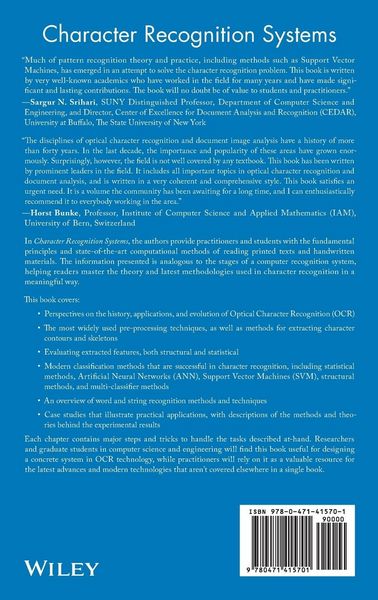
"Much of pattern recognition theory and practice, including methods such as Support Vector Machines, has emerged in an attempt to solve the character recognition problem. This book is written by very well-known academics who have worked in the field for many years and have made significant and lasting contributions. The book will no doubt be of value to students and practitioners."
-Sargur N. Srihari, SUNY Distinguished Professor, Department of Computer Science and Engineering, and Director, Center of Excellence for Document Analysis and Recognition (CEDAR), University at Buffalo, The State University of New York
"The disciplines of optical character recognition and document image analysis have a history of more than forty years. In the last decade, the importance and popularity of these areas have grown enormously. Surprisingly, however, the field is not well covered by any textbook. This book has been written by prominent leaders in the field. It includes all important topics in optical character recognition and document analysis, and is written in a very coherent and comprehensive style. This book satisfies an urgent need. It is a volume the community has been awaiting for a long time, and I can enthusiastically recommend it to everybody working in the area."
-Horst Bunke, Professor, Institute of Computer Science and Applied Mathematics (IAM), University of Bern, Switzerland
In Character Recognition Systems, the authors provide practitioners and students with the fundamental principles and state-of-the-art computational methods of reading printed texts and handwritten materials. The information presented is analogous to the stages of a computer recognition system, helping readers master the theory and latest methodologies used in character recognition in a meaningful way.
This book covers:
*
Perspectives on the history, applications, and evolution of Optical Character Recognition (OCR)
*
The most widely used pre-processing techniques, as well as methods for extracting character contours and skeletons
*
Evaluating extracted features, both structural and statistical
*
Modern classification methods that are successful in character recognition, including statistical methods, Artificial Neural Networks (ANN), Support Vector Machines (SVM), structural methods, and multi-classifier methods
*
An overview of word and string recognition methods and techniques
*
Case studies that illustrate practical applications, with descriptions of the methods and theories behind the experimental results
Each chapter contains major steps and tricks to handle the tasks described at-hand. Researchers and graduate students in computer science and engineering will find this book useful for designing a concrete system in OCR technology, while practitioners will rely on it as a valuable resource for the latest advances and modern technologies that aren't covered elsewhere in a single book.
-Sargur N. Srihari, SUNY Distinguished Professor, Department of Computer Science and Engineering, and Director, Center of Excellence for Document Analysis and Recognition (CEDAR), University at Buffalo, The State University of New York
"The disciplines of optical character recognition and document image analysis have a history of more than forty years. In the last decade, the importance and popularity of these areas have grown enormously. Surprisingly, however, the field is not well covered by any textbook. This book has been written by prominent leaders in the field. It includes all important topics in optical character recognition and document analysis, and is written in a very coherent and comprehensive style. This book satisfies an urgent need. It is a volume the community has been awaiting for a long time, and I can enthusiastically recommend it to everybody working in the area."
-Horst Bunke, Professor, Institute of Computer Science and Applied Mathematics (IAM), University of Bern, Switzerland
In Character Recognition Systems, the authors provide practitioners and students with the fundamental principles and state-of-the-art computational methods of reading printed texts and handwritten materials. The information presented is analogous to the stages of a computer recognition system, helping readers master the theory and latest methodologies used in character recognition in a meaningful way.
This book covers:
*
Perspectives on the history, applications, and evolution of Optical Character Recognition (OCR)
*
The most widely used pre-processing techniques, as well as methods for extracting character contours and skeletons
*
Evaluating extracted features, both structural and statistical
*
Modern classification methods that are successful in character recognition, including statistical methods, Artificial Neural Networks (ANN), Support Vector Machines (SVM), structural methods, and multi-classifier methods
*
An overview of word and string recognition methods and techniques
*
Case studies that illustrate practical applications, with descriptions of the methods and theories behind the experimental results
Each chapter contains major steps and tricks to handle the tasks described at-hand. Researchers and graduate students in computer science and engineering will find this book useful for designing a concrete system in OCR technology, while practitioners will rely on it as a valuable resource for the latest advances and modern technologies that aren't covered elsewhere in a single book.
Kundinnen und Kunden meinen
Verfassen Sie die erste Bewertung zu diesem Artikel
Helfen Sie anderen Kund*innen durch Ihre Meinung
Kurze Frage zu unserer Seite
Vielen Dank für dein Feedback
Wir nutzen dein Feedback, um unsere Produktseiten zu verbessern. Bitte habe Verständnis, dass wir dir keine Rückmeldung geben können. Falls du Kontakt mit uns aufnehmen möchtest, kannst du dich aber gerne an unseren Kund*innenservice wenden.
zum Kundenservice