Statistical Arbitrage Algorithmic Trading Insights and Techniques
105,99 €
inkl. gesetzl. MwSt.,
Lieferung nach Hause
Beschreibung
Produktdetails
Einband
Gebundene Ausgabe
Erscheinungsdatum
01.10.2007
Verlag
John Wiley & Sons IncSeitenzahl
256
Maße (L/B/H)
24/16,1/1,8 cm
Gewicht
554 g
Auflage
1. Auflage
Sprache
Englisch
ISBN
978-0-470-13844-1
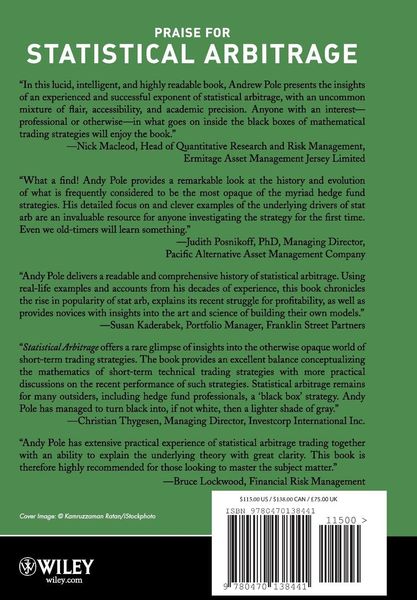
"In this lucid, intelligent, and highly readable book, Andrew Pole presents the insights of an experienced and successful exponent of statistical arbitrage, with an uncommon mixture of flair, accessibility, and academic precision. Anyone with an interest-professional or otherwise-in what goes on inside the black boxes of mathematical trading strategies will enjoy the book."
-Nick Macleod, Head of Quantitative Research and Risk Management Ermitage Asset Management Jersey Limited
"What a find! Andy Pole provides a remarkable look at the history and evolution of what is frequently considered to be the most opaque of the myriad hedge fund strategies. His detailed focus on and clever examples of the underlying drivers of stat arb are an invaluable resource for anyone investigating the strategy for the first time. Even we old-timers will learn something."
-Judith Posnikoff, PhD, Managing Director Pacific Alternative Asset Management Company
"Andy Pole delivers a readable and comprehensive history of statistical arbitrage. Using real-life examples and accounts from his decades of experience, this book chronicles the rise in popularity of stat arb, explains its recent struggle for profitability, as well as provides novices with insights into the art and science of building their own models."
-Susan Kaderabek, Portfolio Manager, Franklin Street Partners
"Statistical Arbitrage offers a rare glimpse of insights into the otherwise opaque world of short-term trading strategies. The book provides an excellent balance conceptualizing the mathematics of short-term technical trading strategies with more practical discussions on the recent performance of such strategies. Statistical arbitrage remains for many outsiders, including hedge fund professionals, a 'black box' strategy. Andy Pole has managed to turn black into, if not white, then a lighter shade of gray."
-Christian Thygesen, Managing Director, Investcorp International Inc.
"Andy Pole has extensive practical experience of statistical arbitrage trading together with an ability to explain the underlying theory with great clarity. This book is therefore highly recommended for those looking to master the subject matter."
-Bruce Lockwood, Financial Risk Management
Noch keine Bewertungen vorhanden
Verfassen Sie die erste Bewertung zu diesem Artikel
Helfen Sie anderen Kundinnen und Kunden durch Ihre Meinung.
Kurze Frage zu unserer Seite
Vielen Dank für dein Feedback
Wir nutzen dein Feedback, um unsere Produktseiten zu verbessern. Bitte habe Verständnis, dass wir dir keine Rückmeldung geben können. Falls du Kontakt mit uns aufnehmen möchtest, kannst du dich aber gerne an unseren Kund*innenservice wenden.
zum Kundenservice