KI-Beratung Beta

Gutscheinbedingungen

**Gültig vom 23.11. bis 30.11.2026 | Gültig für nicht preisgebundene fremdsprachige Bücher | Einzelne Artikel können ausgeschlossen sein | Online auf www.bücher.de einlösbar | Click & Collect nur mit Online-Zahlung (Paypal/Kreditkarte) vorab | Nicht kombinierbar mit anderen Gutscheinen oder Preisaktionen | Nur einmal pro Einkauf einlösbar | Gutschein wird auf max. 500€ Bestellwert angerechnet | Keine Barauszahlung | Nicht gültig für Versandkosten und Services

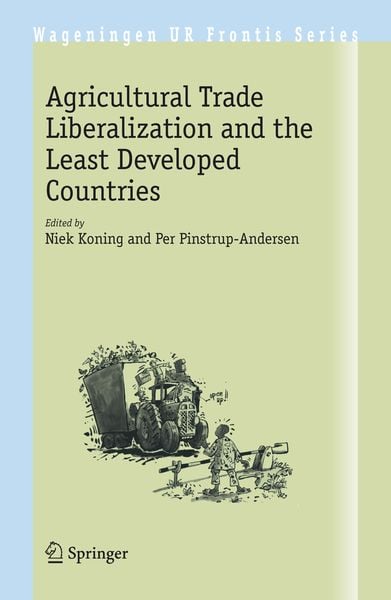
Produktbild: Agricultural Trade Liberalization and the Least Developed Countries
Band 19

Agricultural Trade Liberalization and the Least Developed Countries

213,99 €

inkl. gesetzl. MwSt., Versandkostenfrei


Beschreibung

Although the current round of international trade negotiations was called a ‘Development Round’, very little was accomplished before the negotiations stalled in mid-2006. Developing countries as a group stand to gain very substantially from trade reform in agricultural commodities. It is less clear how...

Beschreibung

Although the current round of international trade negotiations was called a ‘Development Round’, very little was accomplished before the negotiations stalled in mid-2006. Developing countries as a group stand to gain very substantially from trade reform in agricultural commodities. It is less clear how the 50 countries identified by the United Nations as the ‘Least Developed Countries’ (LDCs), which have been subject to special consideration in international trade negotiations, would fare. Would they lose their preferential trade access to the OECD markets and, if so, would these losses exceed the potential gains from liberalized trade? Or would low-income countries that currently receive high prices for commodities such as sugar in some OECD-country markets be out-competed by countries such as Brazil in a liberalized market? More generally, would any benefits from liberalized agricultural trade be captured by middle-income countries with good domestic infrastructure and well-functioning markets, leaving few or no economic benefits to the LDCs? How should the LDCs prepare for multilateral reform of agricultural trade, and should they take policy action now in response to the continuation of the trade-distorting agricultural policies pursued by the OECD countries? To what extent do the LDCs and the middle-income developing countries have common interests with respect to the desired outcomes of the trade round? Are the LDCs well represented by the Group of 21, which consists primarily of middle-income countries with strong export potential in agriculture, or should they pursue a different set of goals in future negotiations? In this book, several experts on international trade and development address these and related questions.

Rezension

From the reviews:

“Book correctly identify much of the debate about agricultural trade reform as a dialogue of the deaf. Their response—of commissioning a set of studies and promoting dialogue between respected participants from both sides of the debate and seeking a consensus—has much to commend it. The volume offers many important insights. … well worth reading for scholars interested in the implications of the Doha agenda for the least-developed countries. Much of the book is tightly argued and presents interesting and important analysis.” (William Martin, Economic Development and Cultural Change, Vol. 58 (4), 2010)

“Offers a wide-ranging and detailed examination of the issue of agricultural trade liberalisation and its likely impact on least developed countries (LDCs). The book’s content laudably covers a broad range of themes, including analysis of ‘pro-poor’ agricultural reform … . welcomed by those already familiar with the debates as to agricultural liberalisation and the LDCs … . offers insightful analysis of the potential strategies that could be pursued in order to make trade work better for the developing countries currently marginalised in global agricultural markets.” (Mark Langan, Journal of Modern African Studies, Vol. 47 (2), 2009)

Produktdetails

Einband

Taschenbuch

Erscheinungsdatum

07.05.2007

Abbildungen

VIII, 250 p.

Herausgeber Niek Koning + weitere

Produktdetails

Einband

Taschenbuch

Erscheinungsdatum

07.05.2007

Abbildungen

VIII, 250 p.

Herausgeber
Verlag Springer Netherland
Seitenzahl

250

Maße (L/B/H)

23,5/15,5/1,5 cm

Gewicht

400 g

Sprache

Englisch

ISBN

978-1-4020-6085-4

Herstelleradresse

Springer-Verlag KG
Sachsenplatz 4-6
1201 Wien
AT

Email: ProductSafety@springernature.com

Noch keine Bewertungen vorhanden

Verfassen Sie die erste Bewertung zu diesem Artikel

Helfen Sie anderen Kundinnen und Kunden durch Ihre Meinung.

Kundinnen und Kunden meinen

Bewertungen (0)

  • Produktbild: Agricultural Trade Liberalization and the Least Developed Countries
  • Agricultural Trade Liberalization and the Least Developed Countries.- Agricultural Trade, Development Problems and Poverty in the Least Developed Countries.- Making Agricultural Trade Reform Work for the Poor.- Price Intervention in Sub-Saharan African Agriculture.- Poverty, Land Conservation and Intergenerational Equity.- Trade Liberalization in Cotton and Sugar.- How to Increase the Benefits of the Doha Development Round for the Least Developed Countries.- Improving Market Access in Agriculture for the African Least Developed Countries.- Agricultural Trade Liberalization Under Doha.- The Practical Experience with Agricultural Trade Liberalization in Asia.- What can be Learned from the History of Developed Countries?.- How U.S. Farm Policies in the Mid-1990s Affected International Crop Prices.- The WTO Agricultural Negotiations and the Least Developed Countries.