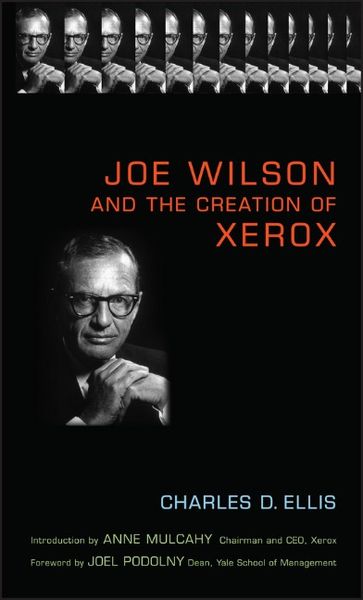
"An inspiring biography" (The Economist, November 2006)
If you run a business and aspire to make it great, you owe it to yourself to read Joe Wilson and the Creation of Xerox by Charles D. Ellis. Despite occasionally pedestrian writing, the book rewards the reader with dramatic accounts of how one great leader managed to influence change rather than just react to it.
Wilson knew little about technology, yet he--not the brilliant techies with whom he surrounded himself--created the modern copier industry. Xerox was an old Rochester, N.Y., company that was small, obscure and unambitious until Wilson took over from his dad in the late 1940s. In a sense, his takeover kicked off the technology revolution that shook American industry out of its somnolence. Early investors with small stakes in Xerox became multimillionaires. Later investors lost billions looking for the "next Xerox." They would have done better searching for the next Joe Wilson.
His tact and lack of ego held together a necessarily diverse bunch of people. Sol Linowitz, the company lawyer, upstaged him by letting it be said on national television that he, not Wilson, was the father of Xerox. Wilson ignored it: Linowitz was important to the company, and Wilson wanted success, not an ego massage. He grasped the importance of image. He pioneered new and novel ways to get public attention for Xerox, including backing public-service TV shows at a time when the company could barely afford the expense in order to convey an image of quality for a little-known brand.
When a leading consulting firm told Xerox there was no real market for its proposed 412 xerography machine, Wilson and his aides took the report apart and discovered that the questions asked and the methodology were faulty. He plowed on.
The 412, Xerox's first truly competitive product, would have to sell for $47,000 and was far too big for salespeople to lug around. Who would, or could, write a check of this size for a mere copying machine? But hey, someone suggested, who wouldn't pay a nickel to get rid of the messy carbon copy that was the curse of every office at the time? Wilson didn't hesitate: a nickel a copy it would be. Customers loved the seemingly cheap price, and orders mounted and remounted for the 412. To the customer's surprise and Xerox's delight, users were making far more copies of things than they did before the 412. The machine was so clean, fast and precise, it was an easy way to expand internal communication in the days before e-mail. In a year, some customers were spending more for copies than the machine would have cost. Xerox became a cash jackpot machine.
Ellis's generally upbeat book has a sad ending. On his retirement in the mid-1960s, an ailing and tired Wilson made two horrible mistakes: He picked an incompetent successor and then failed to bequeath a strong board that could have reined in his successor's blunders. His successor threw away the chance to own the coming personal computer revolution and made disastrous billion-dollar investments in old industries. He lacked his predecessor's knack for embracing change. By then, Wilson was too ill to retake the reins. Xerox shriveled, and its bonds sank to junk status. Rescued by the present CEO, Ann Mulcahy, Xerox is doing well again, but it is no longer the shining symbol Wilson created.
The author, Charley Ellis, is retired head of the consulting firm Greenwich Associates and serves as a Yale trustee and a director of the Vanguard funds. He knows a lot about business leadership, having consulted for and worked with many of the best practitioners. Among all of the business leaders he's known, and he's known hundreds, he puts Joe Wilson--whom he never met--over them all.
Transforming family-owned Haloid Corp., which struggled in the shadow of hometown behemoth Eastman Kodak, into the globally recognized Xerox is an amazing accomplishment. But as Ellis's biography of Joe Wilson attests, Wilson's achievements ranged more widely and went much deeper than many gave him credit for. Ellis, author of 11 books and former financial industry consultant offers a heartfelt, if not artful, telling of the CEO's life story. He contends that Wilson embodied all of the qualities that leadership management books celebrate: integrity, foresight and the ability to inspire people to perform. He credits these attributes to helping Wilson so spectacularly realize his vision for his company; its employees; his alma mater, the University of Rochester; and the city and people of Rochester, N.Y. Ellis's telling starts off slow and is initially quite repetitive. But once Xerox is finally born, after years of setbacks, the story picks up. The real purpose for the detailed buildup appears toward the end, when credit for the last 20-odd years of corporate strife and ultimate success is given to the wrong person, Wilson's best friend and the company's corporate counsel. At that point, it becomes clear why Ellis was compelled to write this book so long after the company's rise and its true founder's demise.(Sept.) (Publishers Weekly, July 17, 2006)