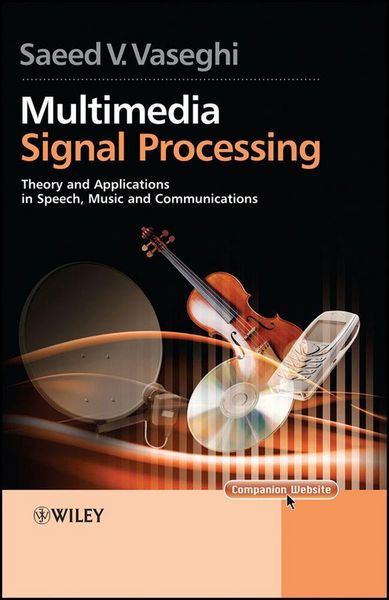
Multimedia Signal Processing Theory and Applications in Speech, Music and Communications
159,99 €
inkl. gesetzl. MwSt.,
Beschreibung
Produktdetails
Einband
Gebundene Ausgabe
Erscheinungsdatum
01.11.2007
Verlag
John Wiley & Sons IncSeitenzahl
674
Maße (L/B/H)
25,5/17,7/4,5 cm
Gewicht
1295 g
Auflage
1. Auflage
Sprache
Englisch
ISBN
978-0-470-06201-2
This book is organised in to three major parts making it a coherent and structured presentation of the theory and applications of digital signal processing. A range of important topics are covered in basic signal processing, model-based statistical signal processing and their applications.
Part 1: Basic Digital Signal Processing gives an introduction to the topic, discussing sampling and quantization, Fourier analysis and synthesis, Z-transform, and digital filters.
Part 2: Model-based Signal Processing covers probability and information models, Bayesian inference, Wiener filter, adaptive filters, linear prediction hidden Markov models and independent component analysis.
Part 3: Applications of Signal Processing in Speech, Music and Telecommunications explains the topics of speech and music processing, echo cancellation, deconvolution and channel equalization, and mobile communication signal processing.
* Covers music signal processing, explains the anatomy and psychoacoustics of hearing and the design of MP3 music coder
* Examines speech processing technology including speech models, speech coding for mobile phones and speech recognition
* Covers single-input and multiple-inputs denoising methods, bandwidth extension and the recovery of lost speech packets in applications such as voice over IP (VoIP)
* Illustrated throughout, including numerous solved problems, Matlab experiments and demonstrations
* Companion website features Matlab and C++ programs with electronic copies of all figures.
This book is ideal for researchers, postgraduates and senior undergraduates in the fields of digital signal processing, telecommunications and statistical data analysis. It will also be a valuable text to professional engineers in telecommunications and audio and signal processing industries.
Noch keine Bewertungen vorhanden
Verfassen Sie die erste Bewertung zu diesem Artikel
Helfen Sie anderen Kundinnen und Kunden durch Ihre Meinung.
Kurze Frage zu unserer Seite
Vielen Dank für dein Feedback
Wir nutzen dein Feedback, um unsere Produktseiten zu verbessern. Bitte habe Verständnis, dass wir dir keine Rückmeldung geben können. Falls du Kontakt mit uns aufnehmen möchtest, kannst du dich aber gerne an unseren Kund*innenservice wenden.
zum Kundenservice