Beschreibung
Produktdetails
Einband
Gebundene Ausgabe
Erscheinungsdatum
21.07.2006
Verlag
John Wiley & Sons IncSeitenzahl
526
Maße (L/B/H)
26/18,3/3,4 cm
Gewicht
1170 g
Auflage
1. Auflage
Sprache
Englisch
ISBN
978-0-471-70858-2
A bottom-up approach that enables readers to master and apply the latest techniques in state estimation
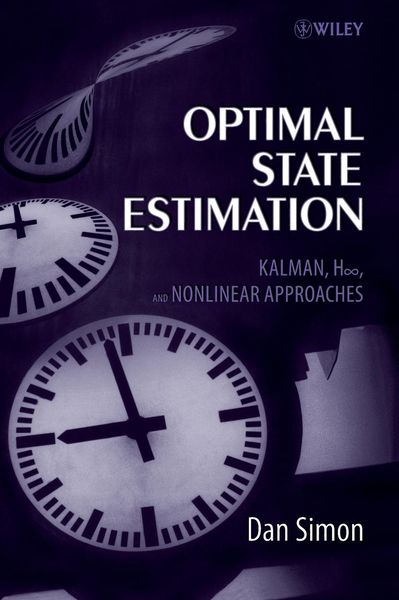
This book offers the best mathematical approaches to estimating the state of a general system. The author presents state estimation theory clearly and rigorously, providing the right amount of advanced material, recent research results, and references to enable the reader to apply state estimation techniques confidently across a variety of fields in science and engineering.
While there are other textbooks that treat state estimation, this one offers special features and a unique perspective and pedagogical approach that speed learning:
* Straightforward, bottom-up approach begins with basic concepts and then builds step by step to more advanced topics for a clear understanding of state estimation
* Simple examples and problems that require only paper and pen to solve lead to an intuitive understanding of how theory works in practice
* MATLAB(r)-based source code that corresponds to examples in the book, available on the author's Web site, enables readers to recreate results and experiment with other simulation setups and parameters
Armed with a solid foundation in the basics, readers are presented with a careful treatment of advanced topics, including unscented filtering, high order nonlinear filtering, particle filtering, constrained state estimation, reduced order filtering, robust Kalman filtering, and mixed Kalman/H? filtering.
Problems at the end of each chapter include both written exercises and computer exercises. Written exercises focus on improving the reader's understanding of theory and key concepts, whereas computer exercises help readers apply theory to problems similar to ones they are likely to encounter in industry. A solutions manual is available for instructors.
With its expert blend of theory and practice, coupled with its presentation of recent research results, Optimal State Estimation is strongly recommended for undergraduate and graduate-level courses in optimal control and state estimation theory. It also serves as a reference for engineers and science professionals across a wide array of industries.
This book offers the best mathematical approaches to estimating the state of a general system. The author presents state estimation theory clearly and rigorously, providing the right amount of advanced material, recent research results, and references to enable the reader to apply state estimation techniques confidently across a variety of fields in science and engineering.
While there are other textbooks that treat state estimation, this one offers special features and a unique perspective and pedagogical approach that speed learning:
* Straightforward, bottom-up approach begins with basic concepts and then builds step by step to more advanced topics for a clear understanding of state estimation
* Simple examples and problems that require only paper and pen to solve lead to an intuitive understanding of how theory works in practice
* MATLAB(r)-based source code that corresponds to examples in the book, available on the author's Web site, enables readers to recreate results and experiment with other simulation setups and parameters
Armed with a solid foundation in the basics, readers are presented with a careful treatment of advanced topics, including unscented filtering, high order nonlinear filtering, particle filtering, constrained state estimation, reduced order filtering, robust Kalman filtering, and mixed Kalman/H? filtering.
Problems at the end of each chapter include both written exercises and computer exercises. Written exercises focus on improving the reader's understanding of theory and key concepts, whereas computer exercises help readers apply theory to problems similar to ones they are likely to encounter in industry. A solutions manual is available for instructors.
With its expert blend of theory and practice, coupled with its presentation of recent research results, Optimal State Estimation is strongly recommended for undergraduate and graduate-level courses in optimal control and state estimation theory. It also serves as a reference for engineers and science professionals across a wide array of industries.
Kundinnen und Kunden meinen
Verfassen Sie die erste Bewertung zu diesem Artikel
Helfen Sie anderen Kund*innen durch Ihre Meinung
Kurze Frage zu unserer Seite
Vielen Dank für dein Feedback
Wir nutzen dein Feedback, um unsere Produktseiten zu verbessern. Bitte habe Verständnis, dass wir dir keine Rückmeldung geben können. Falls du Kontakt mit uns aufnehmen möchtest, kannst du dich aber gerne an unseren Kund*innenservice wenden.
zum Kundenservice