KI-Beratung Beta

Gutscheinbedingungen

**Gültig vom 23.11. bis 30.11.2026 | Gültig für nicht preisgebundene fremdsprachige Bücher | Einzelne Artikel können ausgeschlossen sein | Online auf www.bücher.de einlösbar | Click & Collect nur mit Online-Zahlung (Paypal/Kreditkarte) vorab | Nicht kombinierbar mit anderen Gutscheinen oder Preisaktionen | Nur einmal pro Einkauf einlösbar | Gutschein wird auf max. 500€ Bestellwert angerechnet | Keine Barauszahlung | Nicht gültig für Versandkosten und Services

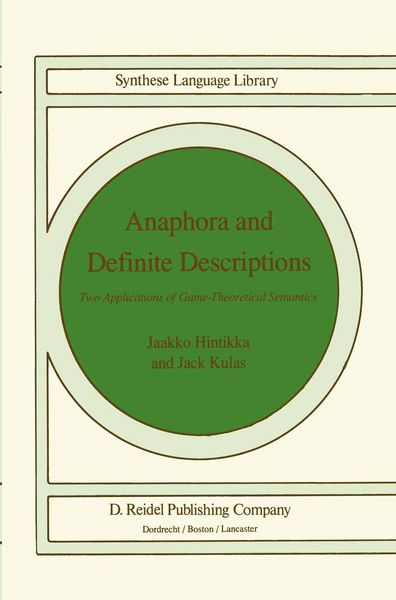
  • Produktbild: Anaphora and Definite Descriptions
  • Produktbild: Anaphora and Definite Descriptions
Band 26

Anaphora and Definite Descriptions Two Applications of Game-Theoretical Semantics

106,99 €

inkl. gesetzl. MwSt., Versandkostenfrei


Beschreibung

I n order to appreciate properly what we are doing in this book it is necessary to realize that our approach to linguistic theorizing differs from the prevailing views. Our approach can be described by indicating what distinguishes it from the methodological ideas current in theoretical linguistics,...

Beschreibung

I n order to appreciate properly what we are doing in this book it is necessary to realize that our approach to linguistic theorizing differs from the prevailing views. Our approach can be described by indicating what distinguishes it from the methodological ideas current in theoretical linguistics, which I consider seriously misguided. Linguists typically construe their task in these days as that of making exceptionless generalizations from particular examples. This explanatory strategy is wrong in several different ways. It presupposes that we can have "intuitions" about particular examples, usually examples invented by the linguist himself or herself, reliable and sharp enough to serve as a basis of sharp generalizations. It also presupposes that we cannot have equally reliable direct access to general linguistic regularities. Both assumptions appear to me extremely dubious, and the first of them has in effect been challenged by linguists like Dwight Bol inger. There is also some evidence that the degree of unanimity among linguists is fairly low when it comes to less clear cases, even in connection with such relatively simple questions as grammaticality (acceptability). For this reason we have tried to rely more on quotations from contemporary fiction, newspapers and magazines than on linguists' and philosophers' ad hoc examples. I also find it strange that some of the same linguists as believe that we all possess innate ideas about general characteristics of humanly possible grammars assume that we can have access to them only via their particular consequences.

Rezension

`
Unlike previous work, (Hintikka and Kulas') theory offers a unified account of intrasentential and discourse anaphora, including deictic uses of anaphoric elements. Further, it deals with the well-studied syntactic constraints on anaphora while at the same time providing a precise truth-conditional semantics. In terms of comprehensiveness and theoretical elegance, this work sets a new standard for the study of anaphora.
'
Tom Wasow, Center for the Study of Language and Information, Stanford
University

Produktdetails

Einband

Gebundene Ausgabe

Erscheinungsdatum

31.08.1985

Abbildungen

XIV, 250 p.

Verlag Springer Netherland

Produktdetails

Einband

Gebundene Ausgabe

Erscheinungsdatum

31.08.1985

Abbildungen

XIV, 250 p.

Verlag Springer Netherland
Seitenzahl

250

Maße (L/B/H)

24,1/16/2 cm

Gewicht

519 g

Auflage

1985

Sprache

Englisch

ISBN

978-90-277-2055-9

Herstelleradresse

Springer-Verlag GmbH
Europaplatz 3
69115 Heidelberg
DE

Email: ProductSafety@springernature.com

Noch keine Bewertungen vorhanden

Verfassen Sie die erste Bewertung zu diesem Artikel

Helfen Sie anderen Kundinnen und Kunden durch Ihre Meinung.

Kundinnen und Kunden meinen

Bewertungen (0)

  • Produktbild: Anaphora and Definite Descriptions
  • Produktbild: Anaphora and Definite Descriptions
  • I: Introduction to Game-Theoretical Semantics.- 1. General.- 2. Formal first-order languages.- 3. Equivalence with Tarski-type truth-definitions.- 4. Translation to higher-order languages.- 5. Partially ordered quantifiers.- 6. Subgames and functional interpretations.- 7. Extension to natural languages.- 8. Similarities and differences between formal and natural languages.- 9. Competing ordering principles.- 10. Atomic sentences.- 11. Further rules for natural languages.- 12. Explanatory strategies.- Notes to Part I.- II: Definite Descriptions.- 1. Russell on definite descriptions.- 2. Prima facie difficulties with Russell’s theory.- 3. Can we localize Russell’s theory?.- 4. Game-theoretical solution to the localization problem.- 5. Anaphoric “the” in formal languages.- 6. Applications.- 7. Epithetic and counterepithetic the-phrases.- 8. Vagaries of the alleged head-anaphor relation.- 9. The anaphoric use of definite descriptions as a semantical phenomenon.- 10. The quantifier-exclusion phenomenon in natural languages.- 11. Inductive choice sets.- 12. Other uses of “the”.- 13. The Russellian use.- 14. The generic use motivated.- 15. Conclusions from the “pragmatic deduction”.- Notes to Part II.- III: Towards a Semantical Theory of Pronominal Anaphora.- I: Different Approaches to Anaphora.- II: A Game-Theoretical Approach to Anaphora.- III: The Exclusion Principle.- IV: General Theoretical Issues.- V: GTS expalains Coreference Restrictions.- VI: Comparisons with Other Treatments.- Notes to Part III.- Name Index.