
Gutscheinbedingungen

**Gültig vom 07.09.2026 bis 09.09.2026 | Gültig für nicht preisgebundene fremdsprachige Bücher | Einzelne Artikel können ausgeschlossen sein | Online auf www.bücher.de einlösbar | Click & Collect nur mit Online-Zahlung (Paypal/Kreditkarte) vorab | Nicht kombinierbar mit anderen Gutscheinen oder Preisaktionen | Nur einmal pro Einkauf einlösbar | Gutschein wird auf max. 500€ Bestellwert angerechnet | Keine Barauszahlung | Nicht gültig für Versandkosten und Services

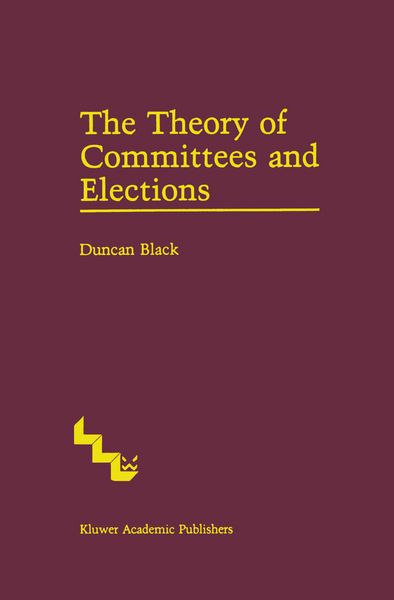
  • Produktbild: The Theory of Committees and Elections
  • Produktbild: The Theory of Committees and Elections
- 13%

The Theory of Committees and Elections

13% sparen

138,99 € UVP 160,49 €

inkl. gesetzl. MwSt., Versandkostenfrei


Beschreibung

Produktdetails

Einband

Gebundene Ausgabe

Erscheinungsdatum

31.12.1986

Abbildungen

XIV, 242 p.

Verlag

Springer Netherland

Seitenzahl

242

Maße (L/B/H)

23,4/15,6/1,6 cm

Gewicht

540 g

Auflage

1987 edition

Sprache

Englisch

ISBN

978-0-89838-189-4

Beschreibung

Produktdetails

Einband

Gebundene Ausgabe

Erscheinungsdatum

31.12.1986

Abbildungen

XIV, 242 p.

Verlag

Springer Netherland

Seitenzahl

242

Maße (L/B/H)

23,4/15,6/1,6 cm

Gewicht

540 g

Auflage

1987 edition

Sprache

Englisch

ISBN

978-0-89838-189-4

Herstelleradresse

Libri GmbH
Europaallee 1
36244 Bad Hersfeld
DE

Email: gpsr@libri.de

Noch keine Bewertungen vorhanden

Verfassen Sie die erste Bewertung zu diesem Artikel

Helfen Sie anderen Kundinnen und Kunden durch Ihre Meinung.

Kundinnen und Kunden meinen

Bewertungen (0)

  • Produktbild: The Theory of Committees and Elections
  • Produktbild: The Theory of Committees and Elections
  • I The Theory of Committees and Elections.- I. A Committee and Motions.- II. Independent Valuation.- III. Can a Motion be Represented by the same Symbol on Different Schedules?.- IV. A Committee using a Simple Majority: Single-peaked Preference Curves.- V. A Committee using a Simple Majority: other Shapes of Preference Curves.- VI. A Committee using a Simple Majority: any Shapes of Preference Curves, Number of Motions Finite.- VII. Cyclical Majorities.- VIII. When the Ordinary Committee Procedure is in use the Members’ Scales of Valuation may be Incomplete.- IX. Which Candidate ought to be Elected?.- X. Examination of some Methods of Election in Single-member Constituencies.- XI. Proportional Representation.- XII. The Decisions of a Committee using a Special Majority.- XIII. The Elasticity of Committee Decisions with an Altering Size of Majority.- XIV. The Elasticity of Committee Decisions with Alterations in the Members’ Preference Schedules.- XV. The Converse Problem: the Group of Schedules to Correspond to a Given Voting Matrix.- XVI. A Committee using a Simple Majority: Complementary Motions.- XVII. International Agreements, Sovereignty and the Cabinet.- II History of the Mathematical Theory of Committees and Elections (Excluding Proportional Representation).- XVIII. Borda, Condorcet and Laplace.- XIX. E. J. Nanson and Francis Galton.- XX. The Circumstances in which Rev. C. L. Dodgson (Lewis Carroll) wrote his Three Pamphlets.- Appendix. Text of Dodgson’s Three Pamphlets and of ‘The Cyclostyled Sheet’.- A Discussion of the Various Methods of Procedure in Conducting Elections (1873).- Suggestions as to the Best Method of Taking Votes, Where More than Two Issues are to be Voted on (1874).- A Method of Taking Votes on More than Two Issues (1876) ‘TheCyclostyled Sheet’ (7 Dec. 1877).- Notes on Dodgson’s Third Pamphlet ‘A Method…’ (1876).