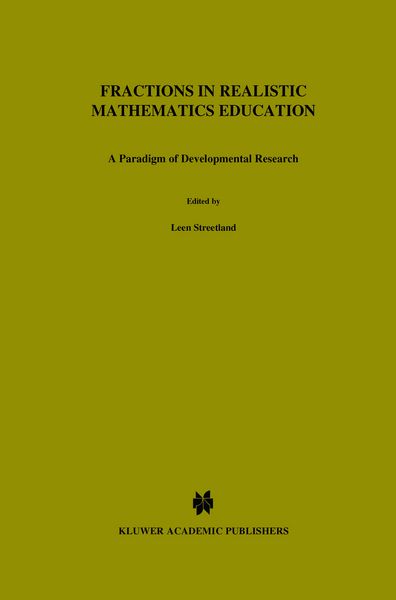

Fractions in Realistic Mathematics Education A Paradigm of Developmental Research
-
- Hardcover ausgewählt
- Taschenbuch
-
Sprache:Englisch
187,99 €
UVP
213,99 €
inkl. gesetzl. MwSt.,
Beschreibung
Produktdetails
Einband
Gebundene Ausgabe
Erscheinungsdatum
30.06.1991
Abbildungen
IX, 355 p.
Verlag
Springer NetherlandSeitenzahl
355
Maße (L/B/H)
24,1/16/2,5 cm
Gewicht
717 g
Auflage
1991
Sprache
Englisch
ISBN
978-0-7923-1282-6
and overview.- Notes Introduction.- 1 Description of the fraction problem.- 1.1 Introduction and overview.- 1.2 Pointing out the problem.- 1.3 Description of the problem.- 1.4 Overview and outlook.- Notes chapter 1.- 2 Currents-standpoint-proposal.- 2.1 Introduction and overview.- 2.2 Currents.- 2.3 Standpoint.- 2.4 Proposal.- 2.5 Review and outlook.- Notes chapter 2.- 3 The context of the research.- 3.1 Introduction and overview.- 3.2 Starting from the construction principle.- 3.3 Development research.- 3.4 Design and method.- 3.5 The research group.- 3.6 The researcher's position.- 3.7 Conclusion.- Notes chapter 3.- 4 The course in theory and practice.- 4.1 Introduction and overview.- 4.2 Global outline of the fraction course.- 4.3 Producing fractions: the teaching experiment.- 4.4 In view of mathematization.- 4.5 Review and outlook.- Notes chapter 4.- 5 Individual portraits of the fraction researchers.- 5.1 Introduction and overview.- 5.2 Indicators for the (improvement in) quality of the individual learning processes.- 5.3 The student portraits.- 5.4 Review and outlook.- Notes chapter 5.- 6 Internal evaluation of the learning process.- 6.1 Introduction and overview.- 6.2 Yielding to and building up resistance to IN-distractors.- 6.3 Progression in schematizating through abbreviations.- 6.4 Models and diagrams.- 6.5 Acquiring representations fitting formally posed problems.- 6.6 Constructions and productions on a symbolic level.- 6.7 The framework of the level-theory and the course construction.- 6.8 Review and outlook.- Notes chapter 6.- 7 External or summative evaluation.- 7.1 Introduction and overview.- 7.2 Weighing the groups.- 7.3 Comparing and characterizing the programs.- 7.4 The tests.- 7.5 Results.- 7.6 Summary and conclusions.- 7.7 Realistic andmechanistic: a difference in effects?.- 7.8 A look ahead.- Notes chapter 7.- 8 Theoretical review.- 8.1 Introduction and overview.- 8.2 Teaching and learning fractions.- 8.3 Conclusion.- Notes chapter 8.- Epilogue: Sketch of a new course -fractions, an integrated perspective-.
Noch keine Bewertungen vorhanden
Verfassen Sie die erste Bewertung zu diesem Artikel
Helfen Sie anderen Kundinnen und Kunden durch Ihre Meinung.
Kurze Frage zu unserer Seite
Vielen Dank für dein Feedback
Wir nutzen dein Feedback, um unsere Produktseiten zu verbessern. Bitte habe Verständnis, dass wir dir keine Rückmeldung geben können. Falls du Kontakt mit uns aufnehmen möchtest, kannst du dich aber gerne an unseren Kund*innenservice wenden.
zum Kundenservice