• Produktbild: Enhanced Methods in Computer Security, Biometric and Artificial Intelligence Systems
  • Produktbild: Enhanced Methods in Computer Security, Biometric and Artificial Intelligence Systems

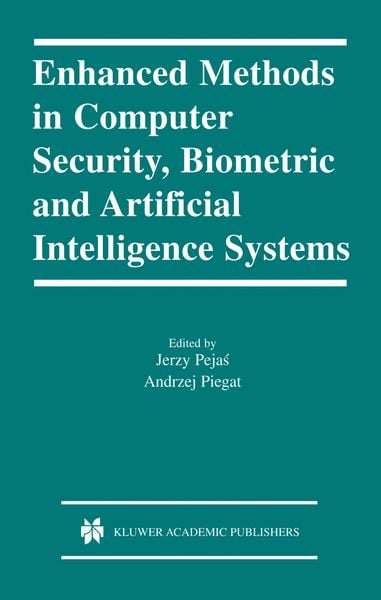
Enhanced Methods in Computer Security, Biometric and Artificial Intelligence Systems

187,99 €

inkl. gesetzl. MwSt., Versandkostenfrei

Lieferung nach Hause

Beschreibung

Produktdetails

Einband

Gebundene Ausgabe

Erscheinungsdatum

02.11.2004

Abbildungen

XII, w. mit 125 Illustrationen

Herausgeber

Jerzy Pejas + weitere

Verlag

Springer Us

Seitenzahl

396

Maße (L/B/H)

24,1/16/2,7 cm

Gewicht

1660 g

Auflage

2005

Sprache

Englisch

ISBN

978-1-4020-7776-0

Beschreibung

Produktdetails

Einband

Gebundene Ausgabe

Erscheinungsdatum

02.11.2004

Abbildungen

XII, w. mit 125 Illustrationen

Herausgeber

Verlag

Springer Us

Seitenzahl

396

Maße (L/B/H)

24,1/16/2,7 cm

Gewicht

1660 g

Auflage

2005

Sprache

Englisch

ISBN

978-1-4020-7776-0

Herstelleradresse

Springer-Verlag KG
Sachsenplatz 4-6
1201 Wien
AT

Email: GPSR Kontakt

Noch keine Bewertungen vorhanden

Verfassen Sie die erste Bewertung zu diesem Artikel

Helfen Sie anderen Kundinnen und Kunden durch Ihre Meinung.

Kundinnen und Kunden meinen

Bewertungen (0)

  • Produktbild: Enhanced Methods in Computer Security, Biometric and Artificial Intelligence Systems
  • Produktbild: Enhanced Methods in Computer Security, Biometric and Artificial Intelligence Systems
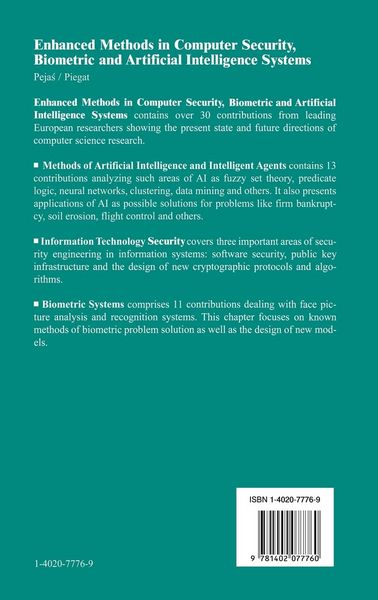
  • Information Technology Security.- How can we justify trust in software based systems?.- The capacity of ciphers fulfilling the accessibility of cryptograms.- Parallelization of the Data Encryption Standard (DES) algorithm.- Linked authenticated dictionaries for certificate status verification.- Integrated Payment System for Public Key Infrastructure Services.- Some methods of the analysis and risk assessment in the PKI system services providers.- VAST: Versatile Anonymous System for Web Users.- Cryptography and Steganography: teaching experience.- Analysis of non-linear pseudo-noise sequences.- Tool support for detecting defects in object-oriented models.- The Proposal of Protocol for Electronic Signature Creation in Public Environment.- On Arithmetic Subtraction Linear Approximation.- Secure Data Transmission via Modulation of the Chaotic Sequence Parameters.- Biometric Systems.- Some Advances and Challenges in Live Biometrics, Personnel Management, and Other “Human Being” Applications.- An environment for recognition systems modeling.- Modified Gradient Method for Face Localization.- Three stage face recognition algorithm for visitor identification system.- A New Approach for Hand-Palm Recognition.- An Experimental Criterion for Face Classification.- Contour Objects Recognition Based On UNL-Fourier Descriptors.- Sonar Image Simulation by Means of Ray Tracing and Image Processing.- The PCA Reconstruction Based Approach for Extending Facial Image Databases for Face Recognition Systems.- Investigation of fingerprint verification algorithm based on local centers method.- Czestochowa’s Precise Model of a Face Based on the Facial Asymmetry, Ophthalmogeometry, and Brain Asymmetry Phenomena: the Idea and Algorithm Sketch.- Methods of Artificial Intelligence and Intelligent Agents.- A fuzzy expert approach for comparing alternative end uses for requalification of contaminated sites.- Training assisting program with hybrid decision supporting system.- Numerical problems with evaluating the fractal dimension of real data.- Multi-stage ship control in a fuzzy environment.- Informative value of the possibilistic extension principle.- Intelligent Marine Control Systems.- How to deal with the data in a bankruptcy modelling.- Dependency Mining in Large Sets of Stock Market Trading Rules.- Choosing representative data items: Kohonen, Neural Gas or Mixture Model?.- Application of the Ant Colony Algorithm for the Path Planning.- Application of fuzzy logic for track corrector formation into flight simulator.- Algorithm for Automatic Definition of Validated and Non-Validated Region in Multi-Dimensional Space.- Adaptive simulation of separable dynamical systems in the neural network basis.- Improvement of the processors operating ratio in task scheduling using the deadline method.