
Accelerator Data-Path Synthesis for High-Throughput Signal Processing Applications
-
- Hardcover ausgewählt
- Taschenbuch
- eBook
-
Sprache:Englisch
139,99 €
UVP
160,49 €
inkl. gesetzl. MwSt.,
Beschreibung
Produktdetails
Einband
Gebundene Ausgabe
Erscheinungsdatum
30.11.1996
Abbildungen
XIV, 263 p.
Verlag
Springer UsSeitenzahl
263
Maße (L/B/H)
24,1/16/2 cm
Gewicht
594 g
Auflage
1997
Sprache
Englisch
ISBN
978-0-7923-9820-2
Accelerator Data-Path Synthesis for High-Throughput Signal Processing
Applications
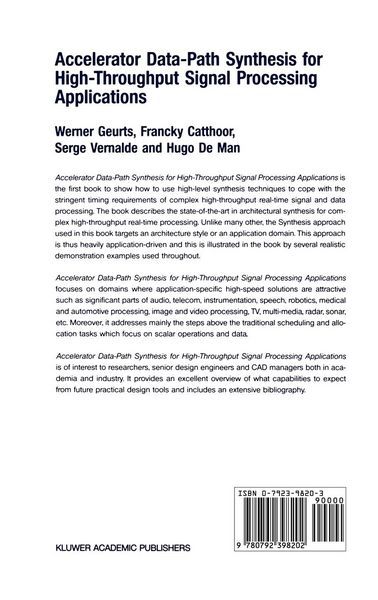
is the first book to show how to use high-level synthesis techniques to cope with the stringent timing requirements of complex high-throughput real-time signal and data processing. The book describes the state-of-the-art in architectural synthesis for complex high-throughput real-time processing. Unlike many other, the Synthesis approach used in this book targets an architecture style or an application domain. This approach is thus heavily application-driven and this is illustrated in the book by several realistic demonstration examples used throughout.
Accelerator Data-Path Synthesis for High-Throughput Signal Processing
Applications
focuses on domains where application-specific high-speed solutions are attractive such as significant parts of audio, telecom, instrumentation, speech, robotics, medical and automotive processing, image and video processing, TV, multi-media, radar, sonar, etc. Moreover, it addresses mainly the steps above the traditional scheduling and allocation tasks which focus on scalar operations and data.
Accelerator Data-Path Synthesis for High-Throughput Signal Processing
Applications
is of interest to researchers, senior design engineers and CAD managers both in academia and industry. It provides an excellent overview of what capabilities to expect from future practical design tools and includes an extensive bibliography.
Noch keine Bewertungen vorhanden
Verfassen Sie die erste Bewertung zu diesem Artikel
Helfen Sie anderen Kundinnen und Kunden durch Ihre Meinung.
Kurze Frage zu unserer Seite
Vielen Dank für dein Feedback
Wir nutzen dein Feedback, um unsere Produktseiten zu verbessern. Bitte habe Verständnis, dass wir dir keine Rückmeldung geben können. Falls du Kontakt mit uns aufnehmen möchtest, kannst du dich aber gerne an unseren Kund*innenservice wenden.
zum Kundenservice