• Produktbild: Motion Understanding
  • Produktbild: Motion Understanding
Band 44 - 13%

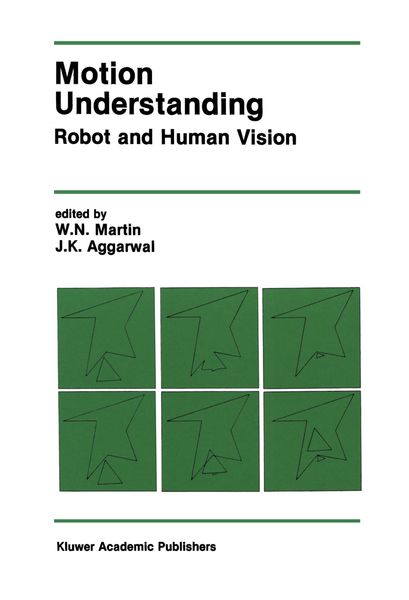
Motion Understanding Robot and Human Vision

13% sparen

185,99 € UVP 213,99 €

inkl. gesetzl. MwSt., Versandkostenfrei

Lieferung nach Hause

Beschreibung

Produktdetails

Einband

Gebundene Ausgabe

Erscheinungsdatum

29.02.1988

Herausgeber

W. Bach + weitere

Verlag

Springer Us

Seitenzahl

432

Maße (L/B/H)

23,4/15,6/2,5 cm

Gewicht

816 g

Auflage

1988 edition

Sprache

Englisch

ISBN

978-0-89838-258-7

Beschreibung

Produktdetails

Einband

Gebundene Ausgabe

Erscheinungsdatum

29.02.1988

Herausgeber

Verlag

Springer Us

Seitenzahl

432

Maße (L/B/H)

23,4/15,6/2,5 cm

Gewicht

816 g

Auflage

1988 edition

Sprache

Englisch

ISBN

978-0-89838-258-7

Herstelleradresse

Libri GmbH
Europaallee 1
36244 Bad Hersfeld
DE

Email: [email protected]

Kundinnen und Kunden meinen

0 Bewertungen

Informationen zu Bewertungen

Zur Abgabe einer Bewertung ist eine Anmeldung im Konto notwendig. Die Authentizität der Bewertungen wird von uns nicht überprüft. Wir behalten uns vor, Bewertungstexte, die unseren Richtlinien widersprechen, entsprechend zu kürzen oder zu löschen.

Die Bewertungen sind nach Format, Anzahl Sterne und Datum sortiert.

Verfassen Sie die erste Bewertung zu diesem Artikel

Helfen Sie anderen Kund*innen durch Ihre Meinung

Kundinnen und Kunden meinen

0 Bewertungen filtern

  • Produktbild: Motion Understanding
  • Produktbild: Motion Understanding
  • 1 Bounding Constraint Propagation for Optical Flow Estimation.- 1.1 Introduction.- 1.2 The Gradient Constraint Equation.- 1.3 Gradient-Based Algorithms.- 1.4 Coping with Smoothness Violations.- 1.4.1 Thresholding for Smoothness.- 1.4.2 Continuous Adaptation to Errors.- 1.5 Results.- 1.6 Discussion.- 2 Image Flow: Fundamentals and Algorithms.- 2.1 Introduction.- 2.1.1 Background.- 2.1.2 Applications for Image Flow.- 2.1.3 Summary.- 2.2 Simple Image Flows.- 2.2.1 Image Flow Equation for Simple Flows.- 2.2.2 Algorithms for Simple Image Flows.- 2.2.3 Summary of Simple Image Flows.- 2.3 Discontinuous Image Flow.- 2.3.1 Surfaces and Projections.- 2.3.2 Image Irradiance Discontinuities.- 2.3.3 Velocity Field Discontinuities.- 2.3.4 Validity of the Image Flow Equation.- 2.3.5 Related Work.- 2.4 Analysis of Discontinuous Image Flows.- 2.4.1 Discontinuities in Continuous Image Functions.- 2.4.2 Sampling of Discontinuous Image Flows.- 2.4.3 Directional Selectivity.- 2.4.4 Summary of Discontinuous Image Flows.- 2.5 Algorithms for Discontinuous Image Flows.- 2.5.1 Background.- 2.5.2 Problem Statement.- 2.5.3 Constraint Line Clustering.- 2.5.4 Summary.- 2.6 Smoothing Discontinuous Image Flows.- 2.6.1 Motion Boundary Detection.- 2.6.2 Velocity Field Smoothing.- 2.6.3 Interleaved Detection and Smoothing.- 2.7 Summary and Conclusions.- 3 A Computational Approach to the Fusion of Stereopsis and Kineopsis.- 3.1 Introduction.- 3.2 Integrating Optical Flow to Stereopsis for Motion.- 3.3 Perception of Rigid Objects in Motion.- 3.4 Examples.- 3.5 Summary.- 4 The Empirical Study of Structure from Motion.- 4.1 Introduction.- 4.2 Viewer-Centered vs. Object-Centered Depth.- 4.2.1 Orthographic Projections of Rotation in Depth.- 4.2.2 Recovery of Structure from Velocity Gradients.- 4.3 The Correspondence Problem.- 4.3.1 Point Configurations.- 4.3.2 Contour Deformation.- 4.3.3 Texture Deformation.- 4.4 Rigidity.- 4.5 Perception of Self Motion.- 4.6 A Theory of Observers.- 4.7 An Empirical Test of Constraints.- 4.8 Summary and Conclusions.- 5 Motion Estimation Using More Than Two Images.- 5.1 Introduction.- 5.2 General Description of the Method.- 5.2.1 Establishing the Equations.- 5.2.2 Simplifying the Equations.- 5.2.3 Solving the Equations.- 5.2.4 Calculating the Motion Parameters.- 5.2.5 Advantages of this Approach.- 5.2.6 Limitations of Our Approach.- 5.3 Results.- 5.3.1 Synthetic Test Data.- 5.3.2 Real Test Data.- 5.4 Comparison with Other Methods.- 5.4.1 Error Analysis.- 5.5 Conclusions.- 6 An Experimental Investigation of Estimation Approaches for Optical Flow Fields.- 6.1 Introduction.- 6.2 Feature Based Estimation.- 6.2.1 The Monotonicity Operator.- 6.2.2 From Feature Positions to Optical Flow Vectors.- 6.2.3 Test Sequence.- 6.2.4 Moving Object Detection.- 6.2.5 Performance Analysis of the Monotonicity Operator.- 6.2.6 Robustness of the Monotonicity Operator Against Parameter Changes.- 6.2.7 Reduction to Two Classes.- 6.3 Analytical Approach for the Estimation of Optical Flow Vector Fields.- 6.3.1 The “Oriented Smoothness” Constraint.- 6.3.2 Evaluation at Local Extrema of the Picture Function.- 6.4 Discussion.- 7 The Incremental Rigidity Scheme and Long-Range Motion Correspondence.- 7.1 The Rigidity-Based Recovery of Structure from Motion.- 7.1.1 The Perception of Structure from Motion by Human Observers.- 7.1.2 Computational Studies of the Recovery of Structure from Motion.- 7.1.3 Additional Requirements for the Recovery of Structure from Motion.- 7.1.4 A Hypothesis: Maximizing Rigidity Relative to the Current Internal Model.- 7.2 The Incremental Rigidity Scheme.- 7.2.1 The Basic Scheme.- 7.2.2 Possible Modifications.- 7.2.3 Implementation.- 7.3 Experimental Results.- 7.3.1 Rigid Motion.- 7.3.2 Non-Rigid Motion.- 7.4 Additional Properties of the Incremental Rigidity Scheme.- 7.4.1 Orthographic and Perspective Projections.- 7.4.2 The Effect of the Number of Points.- 7.4.3 On Multiple Objects.- 7.4.4 Convergence to the Local Minimum.- 7.5 Possible Implications to the Long-Range Motion Correspondence Process.- 7.6 Summary.- 8 Some Problems with Correspondence.- 8.1 Introduction.- 8.2 Determining Correspondence.- 8.3 Correspondence in Computer Vision.- 8.3.1 Correspondence in Stereopsis Algorithms.- 8.3.2 Correspondence in Temporal Matching Algorithms.- 8.4 An Experiment on Correspondence.- 8.5 Conclusions.- 9 Recovering Connectivity from Moving Point-Light Displays.- 9.1 Introduction.- 9.2 Motion Information is a Minimal Stimulus Condition for the Perception of Form.- 9.3 Processing Models for Recovering Form from Motion.- 9.4 Do Fixed-Axis Models Predict Human Performance?.- 9.5 Human Implementation of Additional Processing Constraints.- 9.5.1 Centers of Moment.- 9.5.2 Occlusion’s Effect on Depth Order and Implicit Form.- 9.5.3 Common Motion as Grouping Factor.- 9.5.4 Proximity.- 9.5.5 Familiarity.- 9.6 Incompatibilities Between Human Performance and Models Seeking Local Rigidity.- 9.6.1 Human Capabilities That Exceed Fixed-Axis Models: The Local Rigidity Assumption.- 9.6.2 Human Performance Limitations.- 9.7 Conclusion.- 10 Algorithms for Motion Estimation Based on Three-Dimensional Correspondences.- 10.1 Introduction.- 10.2 Direct Linear Method.- 10.3 Method Based on Translation Invariants.- 10.4 Axis-Angle Method.- 10.5 The Screw Decomposition Method.- 10.6 Improved Motion Estimation Algorithms.- 10.7 Comparing the Linear and Nonlinear Methods.- 10.8 Simulation Results for Three-Point Methods.- 10.9 Some Recent Related Results.- 11 Towards a Theory of Motion Understanding in Man and Machine.- 11.1 Introduction.- 11.2 The Time Complexity of Visual Perception.- 11.2.1 The Role of Time in Vision.- 11.2.2 The Nature of the Computational Problem.- 11.2.3 Implications.- 11.3 Measurement and Hierarchical Representations in Early Vision.- 11.3.1 What is Measurement?.- 11.3.2 Directional Information and its Measurement.- 11.3.3 Hierarchical Processing.- 11.3.4 Construction of Orientation or Velocity Selective Filters.- 11.4 Biological Research.- 11.5 Machine Research.- Author Index.