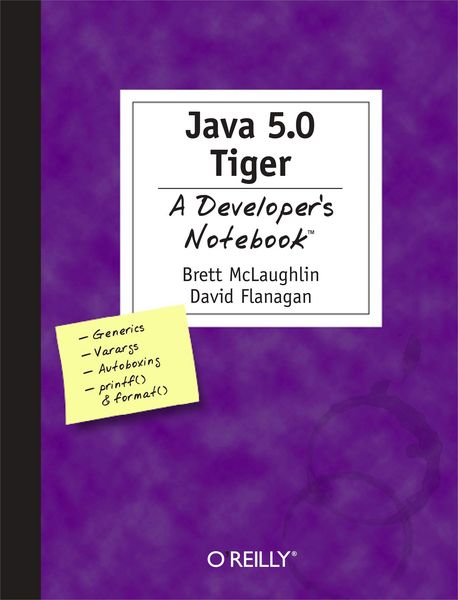
Produktbild: Java 5.0 Tiger

Java 5.0 Tiger

31,99 €

inkl. gesetzl. MwSt., Versandkostenfrei

Lieferung nach Hause

Beschreibung

Produktdetails

Einband

Taschenbuch

Erscheinungsdatum

03.08.2004

Verlag

O'Reilly Media

Seitenzahl

177

Maße (L/B/H)

24,7/16,5/1,3 cm

Gewicht

331 g

Sprache

Englisch

ISBN

978-0-596-00738-6

Beschreibung

Produktdetails

Einband

Taschenbuch

Erscheinungsdatum

03.08.2004

Verlag

O'Reilly Media

Seitenzahl

177

Maße (L/B/H)

24,7/16,5/1,3 cm

Gewicht

331 g

Sprache

Englisch

ISBN

978-0-596-00738-6

Herstelleradresse

Libri GmbH
Europaallee 1
36244 Bad Hersfeld
DE

Email: GPSR Kontakt

Noch keine Bewertungen vorhanden

Verfassen Sie die erste Bewertung zu diesem Artikel

Helfen Sie anderen Kundinnen und Kunden durch Ihre Meinung.

Kundinnen und Kunden meinen

Bewertungen (0)

  • Produktbild: Java 5.0 Tiger
  • Copyright;
    The Developer's Notebook Series;
    Notebooks Are...;
    Notebooks Aren't...;
    Organization;
    Preface;
    Organization;
    How This Book Was Written;
    About the Examples;
    Conventions Used in This Book;
    How to Contact Us;
    Acknowledgments from Brett;
    Acknowledgments from David;
    Chapter 1: What's New?;
    1.1 Working with Arrays;
    1.2 Using Queues;
    1.3 Ordering Queues Using Comparators;
    1.4 Overriding Return Types;
    1.5 Taking Advantage of Better Unicode;
    1.6 Adding StringBuilder to the Mix;
    Chapter 2: Generics;
    2.1 Using Type-Safe Lists;
    2.2 Using Type-Safe Maps;
    2.3 Iterating Over Parameterized Types;
    2.4 Accepting Parameterized Types as Arguments;
    2.5 Returning Parameterized Types;
    2.6 Using Parameterized Types as Type Parameters;
    2.7 Checking for Lint;
    2.8 Generics and Type Conversions;
    2.9 Using Type Wildcards;
    2.10 Writing Generic Types;
    2.11 Restricting Type Parameters;
    Chapter 3: Enumerated Types;
    3.1 Creating an Enum;
    3.2 Declaring Enums Inline;
    3.3 Iterating Over Enums;
    3.4 Switching on Enums;
    3.5 Maps of Enums;
    3.6 Sets of Enums;
    3.7 Adding Methods to an Enum;
    3.8 Implementing Interfaces with Enums;
    3.9 Value-Specific Class Bodies;
    3.10 Manually Defining an Enum;
    3.11 Extending an Enum;
    Chapter 4: Autoboxing and Unboxing;
    4.1 Converting Primitives to Wrapper Types;
    4.2 Converting Wrapper Types to Primitives;
    4.3 Incrementing and Decrementing Wrapper Types;
    4.4 Boolean Versus boolean;
    4.5 Conditionals and Unboxing;
    4.6 Control Statements and Unboxing;
    4.7 Method Overload Resolution;
    Chapter 5: varargs;
    5.1 Creating a Variable-Length Argument List;
    5.2 Iterating Over Variable-Length Argument Lists;
    5.3 Allowing Zero-Length Argument Lists;
    5.4 Specify Object Arguments Over Primitives;
    5.5 Avoiding Automatic Array Conversion;
    Chapter 6: Annotations;
    6.1 Using Standard Annotation Types;
    6.2 Annotating an Overriding Method;
    6.3 Annotating a Deprecated Method;
    6.4 Suppressing Warnings;
    6.5 Creating Custom Annotation Types;
    6.6 Annotating Annotations;
    6.7 Defining an Annotation Type's Target;
    6.8 Setting the Retention of an Annotation Type;
    6.9 Documenting Annotation Types;
    6.10 Setting Up Inheritance in Annotations;
    6.11 Reflecting on Annotations;
    Chapter 7: The for/in Statement;
    7.1 Ditching Iterators;
    7.2 Iterating over Arrays;
    7.3 Iterating over Collections;
    7.4 Avoiding Unnecessary Typecasts;
    7.5 Making Your Classes Work with for/in;
    7.6 Determining List Position and Variable Value;
    7.7 Removing List Items in a for/in Loop;
    Chapter 8: Static Imports;
    8.1 Importing Static Members;
    8.2 Using Wildcards in Static Imports;
    8.3 Importing Enumerated Type Values;
    8.4 Importing Multiple Members with the Same Name;
    8.5 Shadowing Static Imports;
    Chapter 9: Formatting;
    9.1 Creating a Formatter;
    9.2 Writing Formatted Output;
    9.3 Using the format( ) Convenience Method;
    9.4 Using the printf( ) Convenience Method;
    Chapter 10: Threading;
    10.1 Handling Uncaught Exceptions in Threads;
    10.2 Using Thread-Safe Collections;
    10.3 Using Blocking Queues;
    10.4 Specifying Timeouts for Blocking;
    10.5 Separating Thread Logic from Execution Logic;
    10.6 Using Executor as a Service;
    10.7 Using Callable Objects;
    10.8 Executing Tasks Without an ExecutorService;
    10.9 Scheduling Tasks;
    10.10 Advanced Synchronizing;
    10.11 Using Atomic Types;
    10.12 Locking Versus Synchronization;
    Colophon;