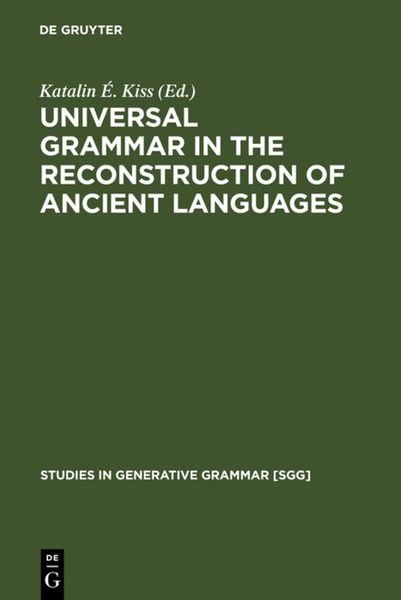

Universal Grammar in the Reconstruction of Ancient Languages
145,99 €
inkl. gesetzl. MwSt.,
Beschreibung
Produktdetails
Einband
Gebundene Ausgabe
Erscheinungsdatum
16.11.2005
Herausgeber
Katalin É. KissVerlag
De Gruyter OldenbourgSeitenzahl
526
Maße (L/B/H)
23,6/16/3,3 cm
Gewicht
932 g
Auflage
Reprint 2011
Sprache
Englisch
ISBN
978-3-11-018550-8
Philologists aiming to reconstruct the grammar of ancient languages face the problem that the available data always underdetermine grammar, and in the case of gaps, possible mistakes, and idiosyncracies there are no native speakers to consult. The authors of this volume overcome this difficulty by adopting the methodology that a child uses in the course of language acquisition: they interpret the data they have access to in terms of Universal Grammar (more precisely, in terms of a hypothetical model of UG). Their studies, discussing syntactic and morphosyntactic questions of Older Egyptian, Coptic, Sumerian, Akkadian, Biblical Hebrew, Classical Greek, Latin, and Classical Sanskrit, demonstrate that descriptive problems which have proved unsolvable for the traditional, inductive approach can be reduced to the interaction of regular operations and constraints of UG. The proposed analyses also bear on linguistic theory. They provide crucial new data and new generalizations concerning such basic questions of generative syntax as discourse-motivated movement operations, the correlation of movement and agreement, a shift from lexical case marking to structural case marking, the licensing of structural case in infinitival constructions, the structure of coordinate phrases, possessive constructions with an external possessor, and the role of event structure in syntax. In addition to confirming or refuting certain specific hypotheses, they also provide empirical evidence of the perhaps most basic tenet of generative theory, according to which UG is part of the genetic endowment of the human species - i.e., human languages do not "develop" parallel with the development of human civilization. Some of the languages examined in this volume were spoken as much as 5000 years old, still their grammars do not differ in any relevant respect from the grammars of languages spoken today.
Noch keine Bewertungen vorhanden
Verfassen Sie die erste Bewertung zu diesem Artikel
Helfen Sie anderen Kundinnen und Kunden durch Ihre Meinung.
Kurze Frage zu unserer Seite
Vielen Dank für dein Feedback
Wir nutzen dein Feedback, um unsere Produktseiten zu verbessern. Bitte habe Verständnis, dass wir dir keine Rückmeldung geben können. Falls du Kontakt mit uns aufnehmen möchtest, kannst du dich aber gerne an unseren Kund*innenservice wenden.
zum Kundenservice