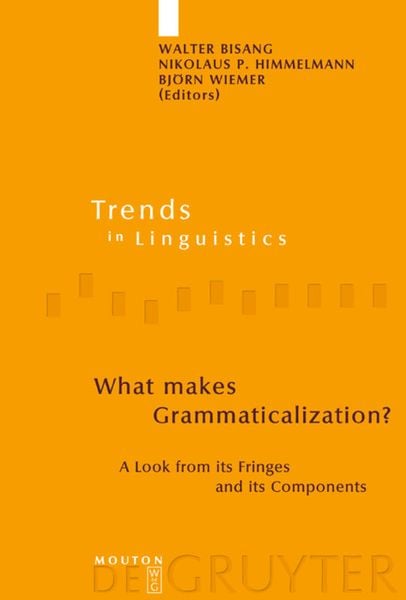

What makes Grammaticalization? A Look from its Fringes and its Components
232,99 €
inkl. gesetzl. MwSt.,
Lieferung nach Hause
Beschreibung
Produktdetails
Einband
Gebundene Ausgabe
Erscheinungsdatum
16.12.2004
Herausgeber
Walter Bisang + weitereVerlag
De Gruyter OldenbourgSeitenzahl
354
Maße (L/B/H)
23,6/16/2,4 cm
Gewicht
624 g
Auflage
1
Sprache
Englisch
ISBN
978-3-11-018152-4
The status of grammaticalization has been the subject of many controversial discussions. The contributions to What makes Grammaticalization? approach the prevalent phenomenon from the angle of language structure and focus on the interrelation between the levels of phonology, pragmatics (inference), discourse and the lexicon and some of them try to integrate the areal perspective. A wealth of data from Slavonic languages as well as from languages of other genetic and areal affiliation is discussed. The book is of interest to linguists specializing in grammaticalization, lexicalization and morphological typology, to language typologists as well as to functional, historical and cognitive linguists.
Noch keine Bewertungen vorhanden
Verfassen Sie die erste Bewertung zu diesem Artikel
Helfen Sie anderen Kundinnen und Kunden durch Ihre Meinung.
Kurze Frage zu unserer Seite
Vielen Dank für dein Feedback
Wir nutzen dein Feedback, um unsere Produktseiten zu verbessern. Bitte habe Verständnis, dass wir dir keine Rückmeldung geben können. Falls du Kontakt mit uns aufnehmen möchtest, kannst du dich aber gerne an unseren Kund*innenservice wenden.
zum Kundenservice