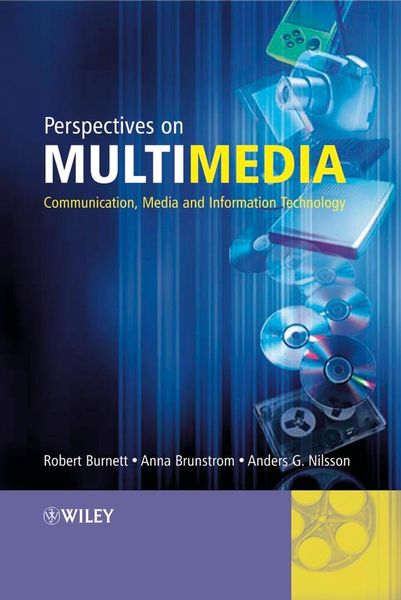
Produktbild: Perspectives on Multimedia

Perspectives on Multimedia Communication, Media and Information Technology

138,99 €

inkl. gesetzl. MwSt., Versandkostenfrei

Lieferung nach Hause

Beschreibung

Produktdetails

Einband

Gebundene Ausgabe

Erscheinungsdatum

21.05.2004

Herausgeber

Robert Burnett + weitere

Verlag

John Wiley & Sons Inc

Seitenzahl

250

Maße (L/B/H)

23,5/15,1/2 cm

Gewicht

494 g

Auflage

1. Auflage

Sprache

Deutsch, Englisch

ISBN

978-0-470-86863-8

Beschreibung

Rezension

"...There is most likely something for everyone in this book..." (Computer Bulletin, January 2005)

Produktdetails

Einband

Gebundene Ausgabe

Erscheinungsdatum

21.05.2004

Herausgeber

Verlag

John Wiley & Sons Inc

Seitenzahl

250

Maße (L/B/H)

23,5/15,1/2 cm

Gewicht

494 g

Auflage

1. Auflage

Sprache

Deutsch, Englisch

ISBN

978-0-470-86863-8

Herstelleradresse

Libri GmbH
Europaallee 1
36244 Bad Hersfeld
DE

Email: GPSR Kontakt

Noch keine Bewertungen vorhanden

Verfassen Sie die erste Bewertung zu diesem Artikel

Helfen Sie anderen Kundinnen und Kunden durch Ihre Meinung.

Kundinnen und Kunden meinen

Bewertungen (0)

  • Produktbild: Perspectives on Multimedia
  • Foreword.
     
    Preface.
     
    1. Multimedia: Back To The Future! (by Robert Burnett).
     
    1.1 Introduction.
     
    1.2 Multimedia as Art and Science.
     
    1.3 Secret History of Multimedia.
     
    1.4 Multimedia as Art and Performance.
     
    1.5 Summing Up.
     
    1.6 References.
     
    2. Alternative Approaches to Interface Technology (by Steve Gibson).
     
    2.1 Introduction.
     
    2.2 Cybernetic Systems.
     
    2.3 'Hands-free' Tracking Systems.
     
    2.4 MIDI Instruments as Visual Triggers.
     
    2.5 Conclusions.
     
    2.6 References.
     
    3. Transparency, Standardization and Servitude: the Paradoxes of Friendly Software (by Andreas Kitzmann).
     
    3.1 Introduction.
     
    3.2 Digital Promises.
     
    3.3 Find Where Everything Is.
     
    3.4 The Question of Practice.
     
    3.5 References.
     
    4. Business Modelling as a Foundation for Multimedia Development-Concerning Strategic, Process and Systems Levels in Organizations (by Anders G. Nilsson).
     
    4.1 Business Modelling-Some Needs in Practice.
     
    4.2 Business Modelling-Thre e Levels of Development Work.
     
    4.3 Business Modelling and Multimedia.
     
    4.4 Business Modelling-Systematic Work in Phases.
     
    4.5 Business Modelling of Values, Operations and Objects.
     
    4.6 Business Modelling for Multimedia-Main Messages.
     
    4.7 References.
     
    5. How Should Interactive Media Be Discussed For Successful Requirements Engineering? (by Lennart Molin and John S¨oren Pettersson).
     
    5.1 Specifying Requirements.
     
    5.2 Requirements Work In Multimedia Systems Development.
     
    5.3 Ozlab-A Simple Tool for Prototyping Interactivity.
     
    5.4 Challenges for Multimedia Requirements Work.
     
    5.5 Writing Requirements vs Visualizing Requirements.
     
    5.6 Requirements Specification By Content Professionals.
     
    5.7 Concluding Remarks.
     
    5.8 References.
     
    6. Evaluating Interactive Multimedia in an Inexpensive and Timesaving Way-Illustrated by Business Case Studies (by Louise Ulfhake).
     
    6.1 Background.
     
    6.2 The Multimedia Case Studies.
     
    6.3 Evaluation Methods.
     
    6.4 What to Evaluate.
     
    6.5 Evaluation of the Structure.
     
    6.6 Evaluation of the Interaction.
     
    6.7 Evaluation of the Usability.
     
    6.8 Evaluation of the Productivity.
     
    6.9 Conclusion.
     
    6.10 References.
     
    7. Conceptual Modelling for Creating Multimedia Databases (by Lars Erik Axelsson).
     
    7.1 Introduction.
     
    7.2 The ISO Report.
     
    7.3 Conceptual Modelling in a Multimedia Environment.
     
    7.4 Conclusions.
     
    7.5 References.
     
    8. Adding Security to QoS Architectures (by Stefan Lindskog and Erland Jonsson).
     
    8.1 Introduction.
     
    8.2 An Overview of QoS.
     
    8.3 Introducing Security in QoS Architectures.
     
    8.4 Further Readings.
     
    8.5 Concluding Remarks.
     
    8.6 Acknowledgments.
     
    8.7 References.
     
    9. Partially Reliable Multimedia Transport (by Katarina Asplund and Anna Brunstrom).
     
    9.1 Introduction.
     
    9.2 Transmission Control Protocol-TCP.
     
    9.3 Design of PRTP.
     
    9.4 Performance Evaluation.
     
    9.5 Further Reading.
     
    9.6 Concluding Remarks.
     
    9.7 References.
     
    10. Bit Error Tolerant Multimedia Transport (by Stefan Alfredsson and Anna Brunstrom).
     
    10.1 Introduction.
     
    10.3 Performance Evaluation.
     
    10.4 Experiment Results.
     
    10.5 Further Readings.
     
    10.6 Concluding Remarks.
     
    10.7 References.
     
    11. Transcodin