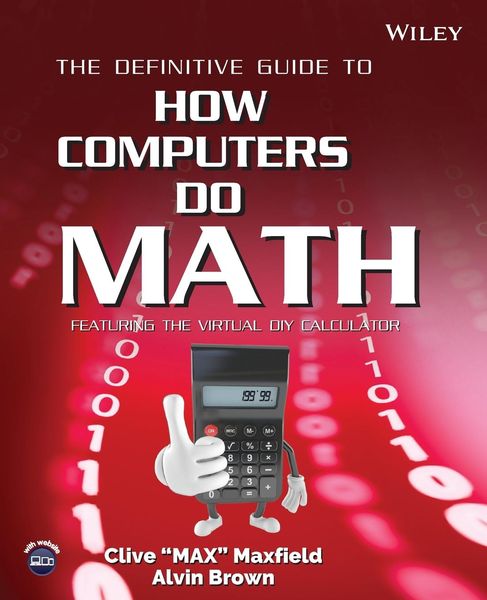
The Definitive Guide to How Computers Do Math Featuring the Virtual DIY Calculator
-
- Taschenbuch ausgewählt
- eBook
-
Sprache:Englisch
69,99 €
inkl. gesetzl. MwSt.,
Beschreibung
Produktdetails
Einband
Taschenbuch
Erscheinungsdatum
01.09.2005
Verlag
John Wiley & SonsSeitenzahl
480
Maße (L/B/H)
23,5/19,1/2,6 cm
Gewicht
870 g
Auflage
1. Auflage
Sprache
Englisch
ISBN
978-0-471-73278-5
The Basics of Computer Arithmetic Made Enjoyable and Accessible-Now With The PY-DIYCalculator for Hands-On Learning
"The combination of this book and its associated virtual computer is fantastic! Experience over the last fifty years has shown me that there's only one way to truly understand how computers work; and that is to learn one computer and its instruction set-no matter how simple or primitive-from the ground up. Once you fully comprehend how that simple computer functions, you can easily extrapolate to more complex machines."
-Fred Hudson, retired engineer/scientist
"This book-along with the virtual DIY Calculator-is an incredibly useful teaching and learning tool. The interesting trivia nuggets keep you turning the pages to see what's next. Students will have so much fun reading the text and performing the labs that they won't even realize they are learning."
-Michael Haghighi, Chairperson of the Business and Computer Information Systems Division, Calhoun Community College, Alabama
"At last, a book that presents an innovative approach to the teaching of computer architecture. Written with authority and verve, witty, superbly illustrated, and enhanced with many laboratory exercises, this book is a must for students and teachers alike."
-Dr. Albert Koelmans, Lecturer in Computer Engineering, University of Newcastle upon Tyne, UK, and the 2003 recipient of the EASIT-Eng. Gold Award for Innovative Teaching in Computer Engineering
Packed with nuggets of information and tidbits of trivia, How Computers Do Math provides an incredibly fun and interesting introduction to the way in which computers perform their magic in general and math in particular. The accompanying CD-ROM contains a virtual computer/calculator called the DIY Calculator, and the book's step-by-step interactive laboratories guide you in the creation of a simple program to run on your DIY Calculator.
How Computers Do Math can be enjoyed by non-technical individuals; students of computer science, electronics engineering, and mathematics; and even practicing engineers. All of the illustrations and interactive laboratories featured in the book are provided on the website for use by high school, college, and university educators as lecture notes and handouts.
The software will now install and run on Windows, MacOS 15 and above, DEBian Linux including the Raspberry Pi 5 with a minimum 1GB of Ram. The software is available to download from GitHUB at
Release v10.1.9 · alvinmb/DIYCalculator
Noch keine Bewertungen vorhanden
Verfassen Sie die erste Bewertung zu diesem Artikel
Helfen Sie anderen Kundinnen und Kunden durch Ihre Meinung.
Kurze Frage zu unserer Seite
Vielen Dank für dein Feedback
Wir nutzen dein Feedback, um unsere Produktseiten zu verbessern. Bitte habe Verständnis, dass wir dir keine Rückmeldung geben können. Falls du Kontakt mit uns aufnehmen möchtest, kannst du dich aber gerne an unseren Kund*innenservice wenden.
zum Kundenservice