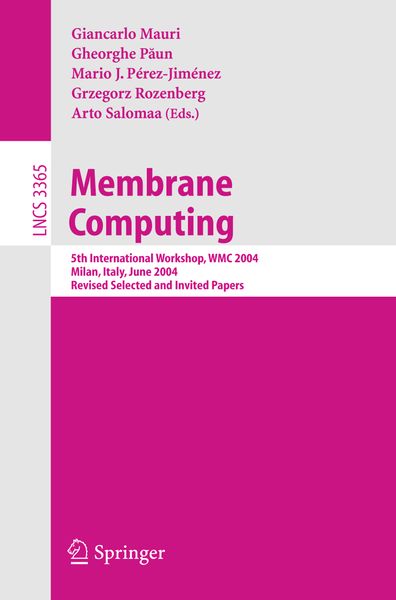
Membrane Computing 5th International Workshop, WMC 2004, Milan, Italy, June 14-16, 2004, Revised Selected and Invited Papers
-
- Hardcover
- Taschenbuch ausgewählt
- eBook
-
Sprache:Englisch
-
Verlag:Springer Berlin
- Springer 49,99 €
- Springer Berlin 49,99 € ausgewählt
49,99 €
inkl. gesetzl. MwSt.,
Lieferung nach Hause
Beschreibung
Produktdetails
Einband
Taschenbuch
Erscheinungsdatum
07.03.2005
Herausgeber
Giancarlo Mauri + weitereVerlag
Springer BerlinSeitenzahl
413
Maße (L/B/H)
23,5/15,5/2,4 cm
Gewicht
1330 g
Auflage
2005
Sprache
Englisch
ISBN
978-3-540-25080-7
Invited Lectures.- ?P Systems and Typed ?-Calculus.- P Automata.- Asynchronous P Systems and P Systems Working in the Sequential Mode.- Evolution and Oscillation in P Systems: Applications to Biological Phenomena.- An Approach to Computational Complexity in Membrane Computing.- LMNtal: A Language Model with Links and Membranes.- Regular Presentations.- Executable Specifications of P Systems.- On the Efficiency of P Systems with Active Membranes and Two Polarizations.- Communicative P Systems with Minimal Cooperation.- Ultimately Confluent Rewriting Systems. Parallel Multiset-Rewriting with Permitting or Forbidding Contexts.- Unstable P Systems: Applications to Linguistics.- A P System Description of the Sodium-Potassium Pump.- Inhibiting/De-inhibiting Rules in P Systems.- Time-Independent P Systems.- On Two-Dimensional Mesh Networks and Their Simulation with P Systems.- Exploring Computation Trees Associated with P Systems.- Approximating Non-discrete P Systems.- Reducing the Size of Extended Gemmating P Systems.- P Systems Generating Trees.- On Descriptive Complexity of P Systems.- P Systems with Symport/Antiport: The Traces of RBCs.- Conservative Computations in Energy-Based P Systems.- General Multi-fuzzy Sets and Fuzzy Membrane Systems.- Trading Polarization for Bi-stable Catalysts in P Systems with Active Membranes.- Modelling Dynamic Organization of Biology-Inspired Multi-agent Systems with Communicating X-Machines and Population P Systems.- On the Size of P Systems with Minimal Symport/Antiport.
Noch keine Bewertungen vorhanden
Verfassen Sie die erste Bewertung zu diesem Artikel
Helfen Sie anderen Kundinnen und Kunden durch Ihre Meinung.
Kurze Frage zu unserer Seite
Vielen Dank für dein Feedback
Wir nutzen dein Feedback, um unsere Produktseiten zu verbessern. Bitte habe Verständnis, dass wir dir keine Rückmeldung geben können. Falls du Kontakt mit uns aufnehmen möchtest, kannst du dich aber gerne an unseren Kund*innenservice wenden.
zum Kundenservice