• Produktbild: Wave and Scattering Methods for Numerical Simulation
  • Produktbild: Wave and Scattering Methods for Numerical Simulation

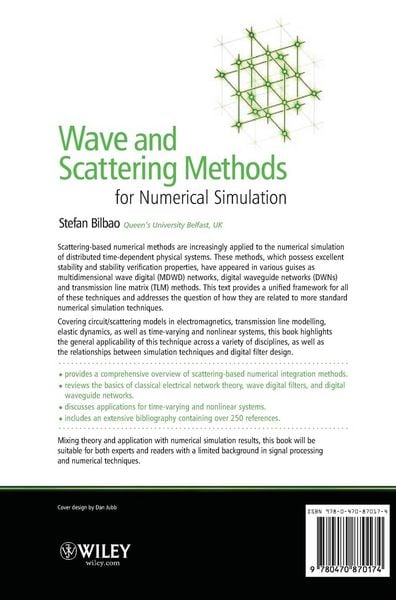
Wave and Scattering Methods for Numerical Simulation

209,99 €

inkl. gesetzl. MwSt., Versandkostenfrei


Beschreibung

Produktdetails

Einband

Gebundene Ausgabe

Erscheinungsdatum

16.06.2004

Verlag

John Wiley & Sons

Seitenzahl

384

Maße (L/B/H)

25/17,5/2,5 cm

Gewicht

839 g

Auflage

1. Auflage

Sprache

Englisch

ISBN

978-0-470-87017-4

Beschreibung

Rezension

"...remarkable...the book is to be highly recommended..." (International Journal of Numerical Modelling, Vol 18 (4) July 2005)

Produktdetails

Einband

Gebundene Ausgabe

Erscheinungsdatum

16.06.2004

Verlag

John Wiley & Sons

Seitenzahl

384

Maße (L/B/H)

25/17,5/2,5 cm

Gewicht

839 g

Auflage

1. Auflage

Sprache

Englisch

ISBN

978-0-470-87017-4

Herstelleradresse

Libri GmbH
Europaallee 1
36244 Bad Hersfeld
DE

Email: gpsr@libri.de

Noch keine Bewertungen vorhanden

Verfassen Sie die erste Bewertung zu diesem Artikel

Helfen Sie anderen Kundinnen und Kunden durch Ihre Meinung.

Kundinnen und Kunden meinen

Bewertungen (0)

  • Produktbild: Wave and Scattering Methods for Numerical Simulation
  • Produktbild: Wave and Scattering Methods for Numerical Simulation
  • Preface.
     
    Foreword.
     
    1. Introduction.
     
    1.1 An Overview of Scattering Methods.
     
    1.2 Questions.
     
    2. Wave Digital Filters.
     
    2.1 Classical Network Theory.
     
    2.2 Wave Digital Elements and Connections.
     
    2.3 Wave Digital Filters and Finite Differences.
     
    3. Multidimensional Wave Digital Filters.
     
    3.1 Symmetric Hyperbolic Systems.
     
    3.2 Coordinate Changes and Grid Generation.
     
    3.3 MD-passivity.
     
    3.4 MD Circuit Elements.
     
    3.5 The (1 +1)D Advection Equation.
     
    3.6 The (1 +1)D Transmission Line.
     
    3.7 The (2 +1)D Parallel-plate System.
     
    3.8 Finite-difference Interpretation.
     
    3.9 Initial Conditions.
     
    3.10 Boundary Conditions.
     
    3.11 Balanced Forms.
     
    3.12 Higher-order Accuracy.
     
    4. Digital Waveguide Networks.
     
    4.1 FDTD and TLM.

    4.2 Digital Waveguides.
     
    4.3 The (1 +1)D Transmission Line.
     
    4.4 The (2 +1)D Parallel-plate System.
     
    4.5 Initial Conditions.
     
    4.6 Music and Audio Applications of Digital Waveguides.
     
    5. Extensions of Digital Waveguide Networks.
     
    5.1 Alternative Grids in (2 +1)D.
     
    5.2 The (3 + 1)D Wave Equation and Waveguide Meshes.
     
    5.3 The Waveguide Mesh in General Curvilinear Coordinates.
     
    5.4 Interfaces between Grids.
     
    6. Incorporating the DWN into the MDWD Framework.
     
    6.1 The (1 +1)D Transmission Line Revisited.
     
    6.2 Alternative MDKC for the (2 + 1)D Parallel-plate System.
     
    6.3 Higher-order Accuracy Revisited.
     
    6.4 Maxwell's Equations.
     
    7. Applications to Vibrating Systems.
     
    7.1 Beam Dynamics.
     
    7.2 Plates.
     
    7.3 Cylindrical Shells.
     
    7.4 Elastic Solids.
     
    8. Time-varying and Nonlinear Systems.
     
    8.1 Time-varying and Nonlinear Circuit Elements.
     
    8.2 Linear Time-varying Distributed Systems.
     
    8.3 Lumped Nonlinear Systems in Musical Acoustics.
     
    8.4 From Wave Digital Principles to Relativity Theory.
     
    8.5 Burger's Equation.
     
    8.6 The Gas Dynamics Equations.
     
    9. Concluding Remarks.
     
    9.1 Answers.
     
    9.2 Questions.
     
    A. Finite Difference Schemes for the Wave Equation.
     
    A.1 Von Neumann Analysis of Difference Schemes.
     
    A.2 Finite Difference Schemes for the (2 + 1)D Wave Equation.
     
    A.3 Finite Difference Schemes for the (3 + 1)D Wave Equation.
     
    B. Eigenvalue and Steady State Problems.
     
    B.1 Introduction.
     
    B.2 Abstract Time Domain Models.
     
    B.3 Typical Eigenvalue Distribution of a Discretized PDE.
     
    B.4 Excitation and Filtering.
     
    B.5 Partial Similarity Transform.
     
    B.6 Steady State Problems.
     
    B.7 Generalization to Multiple Eigenvalues.
     
    B.8 Numerical Example.
     
    Bibliography.
     
    Index.