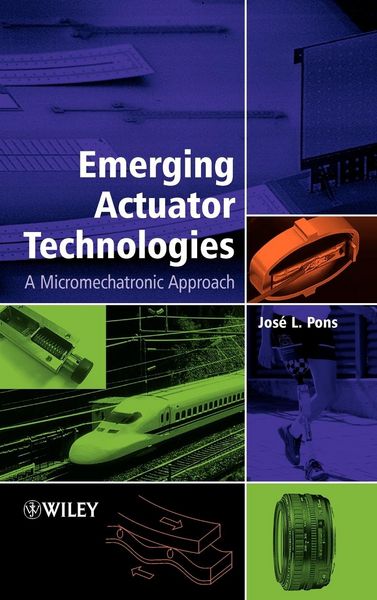
Produktbild: Emerging Actuator Technologies

Emerging Actuator Technologies A Micromechatronic Approach

161,99 €

inkl. gesetzl. MwSt., Versandkostenfrei


Beschreibung

Produktdetails

Einband

Gebundene Ausgabe

Erscheinungsdatum

20.04.2005

Verlag

John Wiley & Sons

Seitenzahl

306

Maße (L/B/H)

23,5/15,7/2,1 cm

Gewicht

598 g

Auflage

1. Auflage

Sprache

Englisch

ISBN

978-0-470-09197-5

Beschreibung

Produktdetails

Einband

Gebundene Ausgabe

Erscheinungsdatum

20.04.2005

Verlag

John Wiley & Sons

Seitenzahl

306

Maße (L/B/H)

23,5/15,7/2,1 cm

Gewicht

598 g

Auflage

1. Auflage

Sprache

Englisch

ISBN

978-0-470-09197-5

Herstelleradresse

Libri GmbH
Europaallee 1
36244 Bad Hersfeld
DE

Email: GPSR Kontakt

Noch keine Bewertungen vorhanden

Verfassen Sie die erste Bewertung zu diesem Artikel

Helfen Sie anderen Kundinnen und Kunden durch Ihre Meinung.

Kundinnen und Kunden meinen

Bewertungen (0)

Die Leseprobe wird geladen.
  • Produktbild: Emerging Actuator Technologies
  • Foreword.
     
    Preface.
     
    List of Figures.
     
    List of Tables.
     
    1 Actuators in motion control systems: mechatronics.
     
    1.1 What is an actuator?
     
    1.2 Transducing materials as a basis for actuator design.
     
    1.3 The role of the actuator in a control system: sensing, processing and acting.
     
    1.4 What is mechatronics? Principles and biomimesis.
     
    1.5 Concomitant actuation and sensing: smart structures.
     
    1.6 Figures of merit of actuator technologies.
     
    1.7 A classification of actuator technologies.
     
    1.8 Emerging versus traditional actuator technologies.
     
    1.9 Scope of the book: emerging actuators.
     
    1.10 Other actuator technologies.
     
    2 Piezoelectric actuators.
     
    2.1 Piezoelectricity and piezoelectric materials.
     
    2.2 Constitutive equations of piezoelectric materials.
     
    2.3 Resonant piezoelectric actuators.
     
    2.4 Nonresonant piezoelectric actuators.7
     
    2.5 Control aspects of piezoelectric motors.
     
    2.6 Figures of merit of piezoelectric actuators.
     
    2.7 Applications.
     
    3 Shape Memory Actuators (SMAs).
     
    3.1 Shape memory alloys.
     
    3.2 Design of shape memory actuators.
     
    3.3 Control of SMAs.
     
    3.4 Figures of merit of shape memory actuators.
     
    3.5 Applications.
     
    4 Electroactive polymer actuators (EAPs).
     
    4.1 Principles.
     
    4.2 Design issues.
     
    4.3 Control of EAPs.
     
    4.4 Figures of merit of EAPs.
     
    4.5 Applications.
     
    5 Magnetostrictive actuators (MSs).
     
    5.1 Principles of magnetostriction.
     
    5.2 Magnetostrictive materials: giant magnetostriction.
     
    5.3 Design of magnetostrictive actuators.
     
    5.4 Control of magnetostrictive actuators: vibration absorption.
     
    5.5 Figures of merit of MS actuators.
     
    5.6 Applications.
     
    6 Electro- and magnetorheological actuators (ERFs, MRFs).
     
    6.1 Active rheology: transducing materials.
     
    6.2 Mechatronic design concepts.
     
    6.3 Control of ERF and MRF.
     
    6.4 Figures of merit of ER and MR devices.
     
    6.5 Applications.
     
    7 Summary, conclusions and outlook.
     
    7.1 Brief summary.
     
    7.2 Comparative position of emerging actuators.
     
    7.3 Research trends and application trends.
     
    Bibliography.
     
    Index.