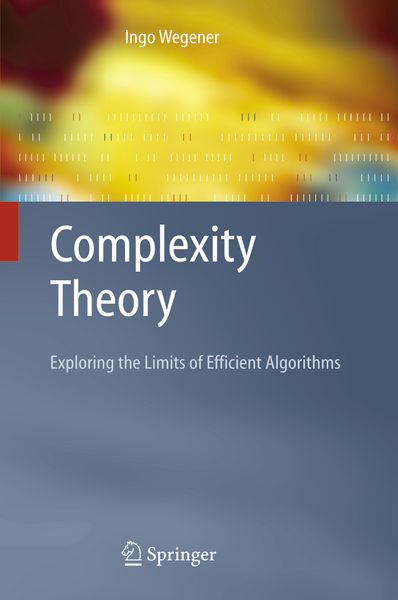
• Produktbild: Complexity Theory
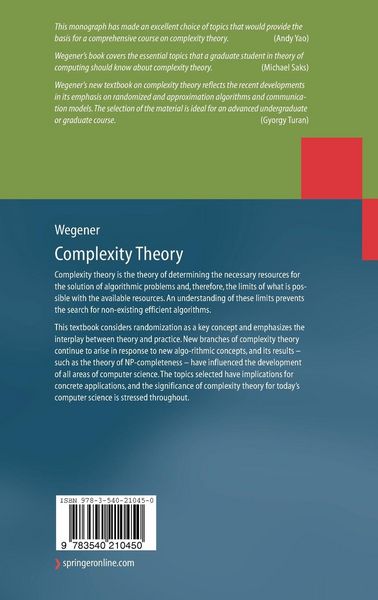
  • Produktbild: Complexity Theory
- 10%

Complexity Theory Exploring the Limits of Efficient Algorithms

1
10% sparen

76,99 € UVP 85,59 €

inkl. gesetzl. MwSt., Versandkostenfrei

Lieferung nach Hause

Beschreibung

Produktdetails

Einband

Gebundene Ausgabe

Erscheinungsdatum

11.04.2005

Abbildungen

w. mit 18 Illustrationen

Verlag

Springer Berlin

Seitenzahl

308

Maße (L/B/H)

24,1/16/2,4 cm

Gewicht

1390 g

Auflage

2005

Originaltitel

Komplexitätstheorie - Grenzen der Effizienz von Algorithmen

Übersetzt von

R. Pruim

Sprache

Englisch

ISBN

978-3-540-21045-0

Beschreibung

Rezension

From the reviews:


"This book should be important and useful for students of computer science as an introduction to complexity theory with an emphasis on randomized and approximation algorithms … . It contains 16 chapters and extends from the foundations of modern complexity theory to recent developments with implications for concrete applications. … The text is well written … and the translation is successful." (Gerhard Lischke, Mathematical Reviews, Issue 2006 j)


"Complexity theory is an extremely important and vivid field on the border of mathematics and computer science. … Ingo Wegener certainly created an appealing, well-written book that is a definite choice for the specialists and lecturers when an undergraduate or graduate student asks for guidance into this challenging new field of mathematics." (Péter Hajnal, Acta Scientiarum Mathematicarum, Vol. 71, 2005)

Produktdetails

Einband

Gebundene Ausgabe

Erscheinungsdatum

11.04.2005

Abbildungen

w. mit 18 Illustrationen

Verlag

Springer Berlin

Seitenzahl

308

Maße (L/B/H)

24,1/16/2,4 cm

Gewicht

1390 g

Auflage

2005

Originaltitel

Komplexitätstheorie - Grenzen der Effizienz von Algorithmen

Übersetzt von

R. Pruim

Sprache

Englisch

ISBN

978-3-540-21045-0

Herstelleradresse

Springer-Verlag KG
Sachsenplatz 4-6
1201 Wien
AT

Email: GPSR Kontakt

Kundinnen und Kunden meinen

Informationen zu Bewertungen

Zur Abgabe einer Bewertung ist eine Anmeldung im Konto notwendig. Die Authentizität der Bewertungen wird von uns nicht überprüft. Wir behalten uns vor, Bewertungstexte, die unseren Richtlinien widersprechen, entsprechend zu kürzen oder zu löschen.

Die Bewertungen sind nach Format, Anzahl Sterne und Datum sortiert.

  • Bewertung

    aus Radevormwald

    4/5

    24.08.2005

    Buch (Gebundene Ausgabe)

    nichts für Anfänger

    Am Fachwissen von Ingo Wegener ist nicht zu zweifeln, auch in diesem Buch über sein Forschungsgebiet Komplexitätstheorie nicht. Es ist eine Einführung in die NP-Vollständigkeitstheorie vorhanden, doch geht das Buch schnell und weit darüber hinaus und geht zu Approximationsalgorithmen, PCP-Theorem, Blackboxkomplexität und unteren Schranken für Schaltkreisgröße und -tiefe über. Wer also nur mal wissen möchte, was überhaupt die Klasse NP ist, sollte sich bei leichterer Literatur umschauen. Der Stil des Buches ist knapp. Es wird Wert auf die formale Korrektheit und die Beweisführung gelegt. Dementsprechend kann man das Buch nicht so einfach durchlesen, es ist schon eben eine Theorie, die "komplex" ist, wie der Titel es auch vermuten lässt. In Hinsicht und mit Rücksicht darauf ist das Buch gut geschrieben, allerdings sind die 18 Abbildungen auf 300 Seiten einfach etwas zu wenig, um sich das ganze Veranschaulichen zu können. Positiv ist, das Ingo Wegener eine Menge an Stoff in diesem Buch abdeckt.

Kundinnen und Kunden meinen

5

0

4

1

3

0

2

0

1

0

Bewertungen (1)

  • Produktbild: Complexity Theory
  • Produktbild: Complexity Theory
  • Algorithmic Problems & Their Complexity.- Fundamental Complexity Classes.- Reductions — Algorithmic Relationships Between Problems.- The Theory of NP-Completeness.- NP-complete and NP-equivalent Problems.- The Complexity Analysis of Problems.- The Complexity of Approximation Problems — Classical Results.- The Complexity of Black Box Problems.- Additional Complexity Classes and Relationships Between Complexity Classes.- Interactive Proofs.- The PCP Theorem and the Complexity of Approximation Problems.- Further Topics From Classical Complexity Theory.- The Complexity of Non-uniform Problems.- Communication Complexity.- The Complexity of Boolean Functions.