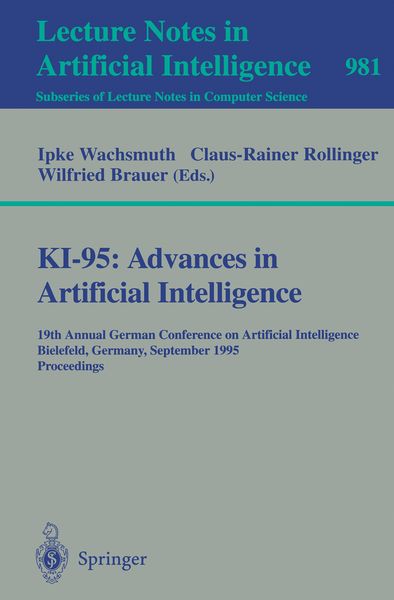
KI-95: Advances in Artificial Intelligence 19th Annual German Conference on Artificial Intelligence, Bielefeld, Germany, September 11-13, 1995. Proceedings
-
- Englisch ausgewählt
49,99 €
inkl. gesetzl. MwSt.,
Lieferung nach Hause
Beschreibung
Produktdetails
Einband
Taschenbuch
Erscheinungsdatum
04.09.1995
Herausgeber
Ipke Wachsmuth + weitereVerlag
Springer BerlinSeitenzahl
275
Maße (L/B/H)
23,5/15,5/1,5 cm
Gewicht
441 g
Auflage
1995
Sprache
Englisch
ISBN
978-3-540-60343-6
The volume opens with full versions of four invited papers devoted to the topic "From Intelligence Models to Intelligent Systems". The main part of the book consists of 17 refereed full papers carefully relected by the program committee; these papers are organized in sections on knowledge organization and optimization, logic and reasoning, nonmonotonicity, action and change, and spatial reasoning.
Noch keine Bewertungen vorhanden
Verfassen Sie die erste Bewertung zu diesem Artikel
Helfen Sie anderen Kundinnen und Kunden durch Ihre Meinung.
Kurze Frage zu unserer Seite
Vielen Dank für dein Feedback
Wir nutzen dein Feedback, um unsere Produktseiten zu verbessern. Bitte habe Verständnis, dass wir dir keine Rückmeldung geben können. Falls du Kontakt mit uns aufnehmen möchtest, kannst du dich aber gerne an unseren Kund*innenservice wenden.
zum Kundenservice