• Produktbild: Computer Safety, Reliability and Security
  • Produktbild: Computer Safety, Reliability and Security
Band 1698

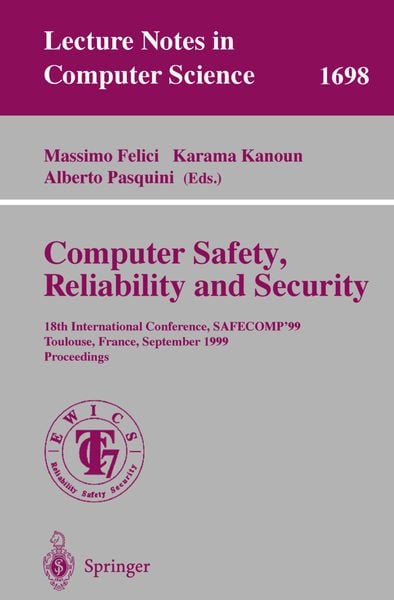
Computer Safety, Reliability and Security 18th International Conference, SAFECOMP '99, Toulouse, France, September 27-29, 1999. Proceedings

49,99 €

inkl. gesetzl. MwSt., Versandkostenfrei

Lieferung nach Hause

Beschreibung

Produktdetails

Einband

Taschenbuch

Erscheinungsdatum

15.09.1999

Herausgeber

Massimo Felici + weitere

Verlag

Springer Berlin

Seitenzahl

490

Maße (L/B/H)

23,5/15,5/2,7 cm

Gewicht

782 g

Auflage

1999

Sprache

Englisch

ISBN

978-3-540-66488-8

Beschreibung

Produktdetails

Einband

Taschenbuch

Erscheinungsdatum

15.09.1999

Herausgeber

Verlag

Springer Berlin

Seitenzahl

490

Maße (L/B/H)

23,5/15,5/2,7 cm

Gewicht

782 g

Auflage

1999

Sprache

Englisch

ISBN

978-3-540-66488-8

Herstelleradresse

Springer-Verlag KG
Sachsenplatz 4-6
1201 Wien
AT

Email: GPSR Kontakt

Noch keine Bewertungen vorhanden

Verfassen Sie die erste Bewertung zu diesem Artikel

Helfen Sie anderen Kundinnen und Kunden durch Ihre Meinung.

Kundinnen und Kunden meinen

Bewertungen (0)

  • Produktbild: Computer Safety, Reliability and Security
  • Produktbild: Computer Safety, Reliability and Security
  • Invited Talk.- Software Reliability Engineering in Industry.- Assessment and Certification.- A Systematic Approach to Safety Case Maintenance.- SQUALE Dependability Assessment Criteria.- Assessment and Certification of Safety-Critical Digital Architectures — the ACRuDA Project.- Safety Assessment and Human Factors (Poster Session).- Safety Evaluation of a Train Leader Telephone System.- Safety Analysis Techniques for Validating Formal Models during Verification.- Evaluating the Contribution of DesktopVR for Safety—Critical Applications.- Human Performance Reliability in the Design-for-Usability Life Cycle for Safety Human-Computer Interfaces.- The Impact of Different Media on Safety and Usability of Interactive ATC Applications.- Human Factors.- Patterns for Safer Human-Computer Interfaces.- Impact of Communication on Systems Dependability: Human Factors Perspectives.- A Method for Operator Error Detection Based on Plan Recognition.- Safety Assessment.- Hierarchically Performed Hazard Origin and Propagation Studies.- Hardware Redundant Vital Computers — Demonstration of Safety on the Basis of Current Standards.- Design for Safety (Poster Session).- System and Software Safety Analysis for the ERA Control Computer.- Safety Markup Language: Concept and Application.- Extendable Ground-to-Air Communication Architecture for CoDySa.- Hierarchical Reliability and Safety Models of Fault Tolerant Distributed Industrial Control Systems.- The Development of a Commercial “Shrink-Wrapped Application” to Safety Integrity Level 2: the DUST-EXPERT™ Story.- Verification and Testing.- Safety Verification of ADA95 Programs Using Software Fault Trees.- Programming Rule Static Verification for Reliable Software.- Automated Black-Box Testing with Abstract VDM Oracle.- Towards Statistical Control of an Industrial Test Process.- Design for Safety.- Choosing Effective Methods for Diversity — How to Progress from Intuition to Science.- A First Step Towards the Integration of Accident Reports and Constructive Design Documents.- A Holistic Design Concept to Improve Safety Related Control Systems.- Dependability Analysis and Evaluation.- Comparing Fault Trees and Bayesian Networks for Dependability Analysis.- FlexFi: A Flexible Fault Injection Environment for Microprocessor-Based Systems.- Structural Software Reliability Estimation.- Formal Methods and Security (Poster Session).- Hazard Analysis in Formal Specification.- Modeling Safety-Critical Systems with Z and Petri Nets.- On Formal Languages for Sequences of Authorization Transformations.- Scheduling Fault-Tolerant Programs on Multiple Processors to Maximize Schedule Reliability.- Formal Methods.- Forma Design of Distributed Control Systems with Lustre.- Formal Specification and Development of a Safety-Critical Train Management System.- Formal Validation of the GUARDS Inter-consistency Mechanism.- A Graphical Environment for the Specification and Verification of Reactive Systems.- Security.- Dependability Requirements and Security Architectures for the Healthcare/Medical Sector.- Three-Pass Hybrid Key Establishment Protocol Based on ESIGN Signature.- The Integration of Safety and Security Requirements.