KI-Beratung Beta

  • Produktbild: Adaptive Modelling, Estimation and Fusion from Data
  • Produktbild: Adaptive Modelling, Estimation and Fusion from Data
- 12%

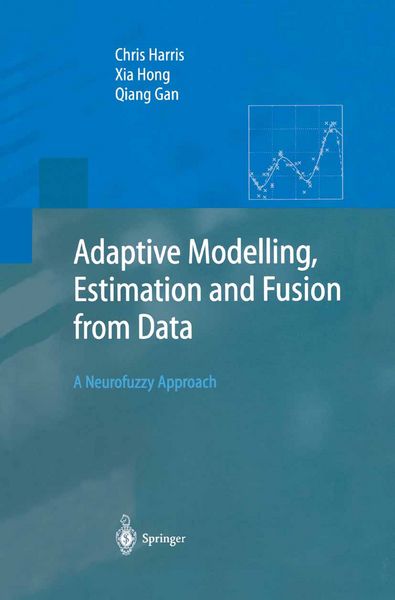
Adaptive Modelling, Estimation and Fusion from Data A Neurofuzzy Approach

12% sparen

93,99 € UVP 106,99 €

inkl. gesetzl. MwSt., Versandkostenfrei


Beschreibung

Produktdetails

Einband

Gebundene Ausgabe

Erscheinungsdatum

13.05.2002

Abbildungen

XVI, 323 p.

Verlag

Springer Berlin

Seitenzahl

323

Maße (L/B/H)

24,1/16/2,3 cm

Gewicht

676 g

Auflage

2002

Sprache

Englisch

ISBN

978-3-540-42686-8

Beschreibung

Rezension

From the reviews:


"This is an account of a major development by a research group in Southampton University on the extension of adaptive techniques to nonlinear and nonstationary environments. … There seems to be no doubt that this well-presented book is indispensable for anyone concerned with difficult nonlinear problems of control." (Alex M. Andrew, Robotica, Vol. 22, 2004)


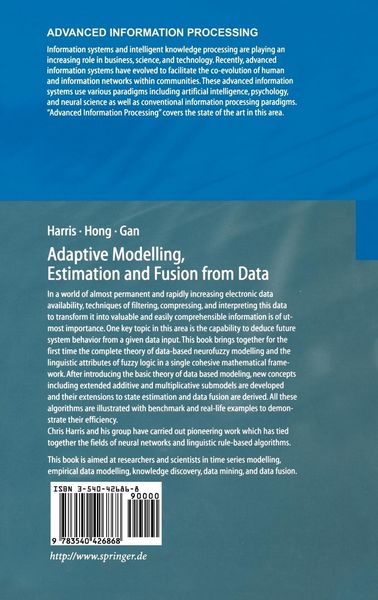
"This book brings together for the first time the complete theory of data-based neurofuzzy modelling and the linguistic attributes of fuzzy logic in a single cohesive mathematical framework. … This book is aimed at researchers and scientists in time series modelling, empirical data modelling, knowledge discovery, data mining, and data fusion." (Nikolay Yakovlevich Tikhonenko, Zentralblatt MATH, Vol. 1005, 2003)

Produktdetails

Einband

Gebundene Ausgabe

Erscheinungsdatum

13.05.2002

Abbildungen

XVI, 323 p.

Verlag

Springer Berlin

Seitenzahl

323

Maße (L/B/H)

24,1/16/2,3 cm

Gewicht

676 g

Auflage

2002

Sprache

Englisch

ISBN

978-3-540-42686-8

Herstelleradresse

Springer-Verlag KG
Sachsenplatz 4-6
1201 Wien
AT

Email: ProductSafety@springernature.com

Noch keine Bewertungen vorhanden

Verfassen Sie die erste Bewertung zu diesem Artikel

Helfen Sie anderen Kundinnen und Kunden durch Ihre Meinung.

Kundinnen und Kunden meinen

Bewertungen (0)

  • Produktbild: Adaptive Modelling, Estimation and Fusion from Data
  • Produktbild: Adaptive Modelling, Estimation and Fusion from Data
  • 1. An introduction to modelling and learning algorithms.- 1.1 Introduction to modelling.- 1.2 Modelling, control and learning algorithms.- 1.3 The learning problem.- 1.4 Book philosophy and contents overview.- 2. Basic concepts of data-based modelling.- 2.1 Introduction.- 2.2 State-space models versus input-output models.- 2.3 Nonlinear modelling by basis function expansion.- 2.4 Model parameter estimation.- 2.5 Model quality.- 2.6 Reproducing kernels and regularisation networks.- 2.7 Model selection methods.- 2.8 An example: time series modelling.- 3. Learning laws for linear-in-the-parameters networks.- 3.1 Introduction to learning.- 3.2 Error or performance surfaces.- 3.3 Batch learning laws.- 3.4 Instantaneous learning laws.- 3.5 Gradient noise and normalised condition numbers.- 3.6 Adaptive learning rates.- 4. Fuzzy and neurofuzzy modelling.- 4.1 Introduction to fuzzy and neurofuzzy systems.- 4.2 Fuzzy systems.- 4.3 Functional mapping and neurofuzzy models.- 4.4 Takagi-Sugeno local neurofuzzy model.- 4.5 Neurofuzzy modelling examples.- 5. Parsimonious neurofuzzy modelling.- 5.1 Iterative construction modelling.- 5.2 Additive neurofuzzy modelling algorithms.- 5.3 Adaptive spline modelling algorithm (ASMOD).- 5.4 Extended additive neurofuzzy models.- 5.5 Hierarchical neurofuzzy models.- 5.6 Regularised neurofuzzy models.- 5.7 Complexity reduction through orthogonal least squares.- 5.8 A-optimality neurofuzzy model construction (NeuDec).- 6. Local neurofuzzy modelling.- 6.1 Introduction.- 6.2 Local orthogonal partitioning algorithms.- 6.3 Operating point dependent neurofuzzy models.- 6.4 State space representations of operating point dependent neurofuzzy models.- 6.5 Mixture of experts modelling.- 6.6 Multi-input-Multi-output (MIMO) modelling via input variable selection.- 7. Delaunay input space partitioning modelling.- 7.1 Introduction.- 7.2 Delaunay triangulation of the input space.- 7.3 Delaunay input space partitioning for locally linear models.- 7.4 The Bézier-Bernstein modelling network.- 8. Neurofuzzy linearisation modelling for nonlinear state estimation.- 8.1 Introduction to linearisation modelling.- 8.2 Neurofuzzy local linearisation and the MASMOD algorithm.- 8.3 A hybrid learning scheme combining MASMOD and EM algorithms for neurofuzzy local linearisation.- 8.4 Neurofuzzy feedback linearisation (NFFL).- 8.5 Formulation of neurofuzzy state estimators.- 8.6 An example of nonlinear trajectory estimation.- 9. Multisensor data fusion using Kaiman filters based on neurofuzzy linearisation.- 9.1 Introduction.- 9.2 Measurement fusion.- 9.3 State-vector fusion.- 9.4 Hierarchical multisensor data fusion — trade-off between centralised and decentralised Architectures.- 9.5 Simulation examples.- 10. Support vector neurofuzzy models.- 10.1 Introduction.- 10.2 Support vector machines.- 10.3 Support vector regression.- 10.4 Support vector neurofuzzy networks.- 10.5 SUPANOVA.- 10.6 A comparison among neural network models.- 10.7 Conclusions.- References.