• Produktbild: Machine Learning: ECML-94
  • Produktbild: Machine Learning: ECML-94
Band 784

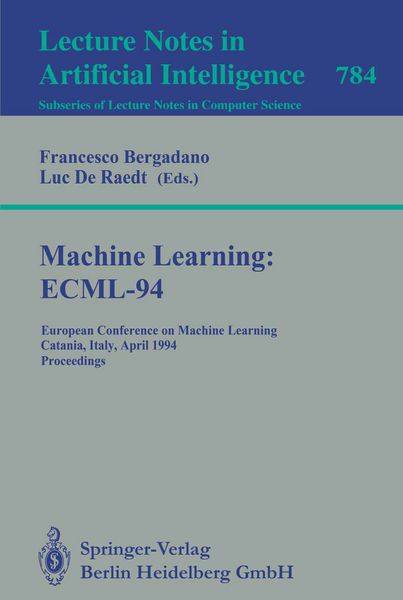
Machine Learning: ECML-94 European Conference on Machine Learning, Catania, Italy, April 6-8, 1994. Proceedings

49,99 €

inkl. gesetzl. MwSt., Versandkostenfrei


Beschreibung

Produktdetails

Einband

Taschenbuch

Erscheinungsdatum

22.03.1994

Abbildungen

XIII, 447 p.

Herausgeber

Francesco Bergadano + weitere

Verlag

Springer Berlin

Seitenzahl

447

Maße (L/B/H)

23,5/15,5/2,5 cm

Gewicht

692 g

Auflage

1994

Sprache

Englisch

ISBN

978-3-540-57868-0

Beschreibung

Produktdetails

Einband

Taschenbuch

Erscheinungsdatum

22.03.1994

Abbildungen

XIII, 447 p.

Herausgeber

Verlag

Springer Berlin

Seitenzahl

447

Maße (L/B/H)

23,5/15,5/2,5 cm

Gewicht

692 g

Auflage

1994

Sprache

Englisch

ISBN

978-3-540-57868-0

Herstelleradresse

Springer-Verlag KG
Sachsenplatz 4-6
1201 Wien
AT

Email: GPSR Kontakt

Noch keine Bewertungen vorhanden

Verfassen Sie die erste Bewertung zu diesem Artikel

Helfen Sie anderen Kundinnen und Kunden durch Ihre Meinung.

Kundinnen und Kunden meinen

Bewertungen (0)

  • Produktbild: Machine Learning: ECML-94
  • Produktbild: Machine Learning: ECML-94
  • Industrial applications of ML: Illustrations for the KAML dilemma and the CBR dream.- Knowledge representation in machine learning.- Inverting implication with small training sets.- A context similarity measure.- Incremental learning of control knowledge for nonlinear problem solving.- Characterizing the applicability of classification algorithms using meta-level learning.- Inductive learning of characteristic concept descriptions from small sets of classified examples.- FOSSIL: A robust relational learner.- A multistrategy learning system and its integration into an interactive floorplanning tool.- Bottom-up induction of oblivious read-once decision graphs.- Estimating attributes: Analysis and extensions of RELIEF.- BMWk revisited generalization and formalization of an algorithm for detecting recursive relations in term sequences.- An analytic and empirical comparison of two methods for discovering probabilistic causal relationships.- Sample PAC-learnability in model inference.- Averaging over decision stumps.- Controlling constructive induction in CIPF: An MDL approach.- Using constraints to building version spaces.- On the utility of predicate invention in inductive logic programming.- Learning problem-solving concepts by reflecting on problem solving.- Existence and nonexistence of complete refinement operators.- A hybrid nearest-neighbor and nearest-hyperrectangle algorithm.- Automated knowledge acquisition for Prospector-like expert systems.- On the role of machine learning in knowledge-based control.- Discovering dynamics with genetic programming.- A geometric approach to feature selection.- Identifying unrecognizable regular languages by queries.- Intensional learning of logic programs.- Partially isomorphic generalization and analogical reasoning.- Learning from recursive, tree structured examples.- Concept formation in complex domains.- An algorithm for learning hierarchical classifiers.- Learning belief network structure from data under causal insufficiency.- Cost-sensitive pruning of decision trees.- An instance-based learning method for databases: An information theoretic approach.- Early screening for gastric cancer using machine learning techniques.- DP1: Supervised and unsupervised clustering.- Using machine learning techniques to interpret results from discrete event simulation.- Flexible integration of multiple learning methods into a problem solving architecture.- Concept sublattices.- The piecewise linear classifier DIPOL92.- Complexity of computing generalized VC-dimensions.- Learning relations without closing the world.- Properties of Inductive Logic Programming in function-free Horn logic.- Representing biases for Inductive Logic Programming.- Biases and their effects in Inductive Logic Programming.- Inductive learning of normal clauses.