• Produktbild: Lie Groups and Lie Algebras I
  • Produktbild: Lie Groups and Lie Algebras I
Band 20

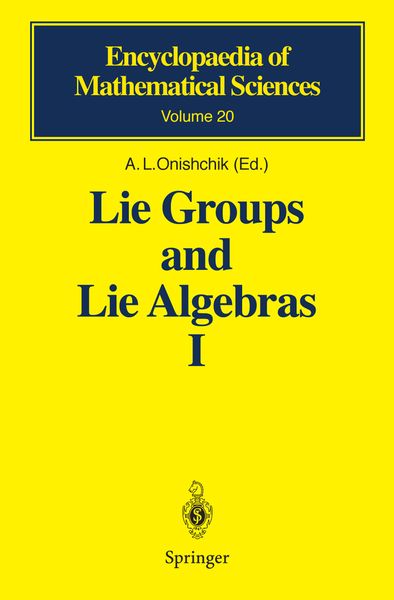
Lie Groups and Lie Algebras I Foundations of Lie Theory Lie Transformation Groups

97,99 €

inkl. gesetzl. MwSt., Versandkostenfrei

Lieferung nach Hause

Beschreibung

Produktdetails

Einband

Gebundene Ausgabe

Erscheinungsdatum

15.04.1993

Herausgeber

A.L. Onishchik

Verlag

Springer Berlin

Seitenzahl

238

Maße (L/B/H)

24,1/16/1,9 cm

Gewicht

547 g

Auflage

1993

Übersetzt von

T. Kozlowski

Sprache

Englisch

ISBN

978-3-540-18697-7

Beschreibung

Produktdetails

Einband

Gebundene Ausgabe

Erscheinungsdatum

15.04.1993

Herausgeber

A.L. Onishchik

Verlag

Springer Berlin

Seitenzahl

238

Maße (L/B/H)

24,1/16/1,9 cm

Gewicht

547 g

Auflage

1993

Übersetzt von

T. Kozlowski

Sprache

Englisch

ISBN

978-3-540-18697-7

Herstelleradresse

Springer-Verlag KG
Sachsenplatz 4-6
1201 Wien
AT

Email: [email protected]

Kundinnen und Kunden meinen

0 Bewertungen

Informationen zu Bewertungen

Zur Abgabe einer Bewertung ist eine Anmeldung im Konto notwendig. Die Authentizität der Bewertungen wird von uns nicht überprüft. Wir behalten uns vor, Bewertungstexte, die unseren Richtlinien widersprechen, entsprechend zu kürzen oder zu löschen.

Die Bewertungen sind nach Format, Anzahl Sterne und Datum sortiert.

Verfassen Sie die erste Bewertung zu diesem Artikel

Helfen Sie anderen Kund*innen durch Ihre Meinung

Kundinnen und Kunden meinen

0 Bewertungen filtern

  • Produktbild: Lie Groups and Lie Algebras I
  • Produktbild: Lie Groups and Lie Algebras I
  • I.Foundations of Lie Theory.- 1. Basic Notions.- 1. Lie Groups, Subgroups and Homomorphisms.- 1.1 Definition of a Lie Group.- 1.2 Lie Subgroups.- 1.3 Homomorphisms of Lie Groups.- 1.4 Linear Representations of Lie Groups.- 1.5 Local Lie Groups.- 2. Actions of Lie Groups.- 2.1 Definition of an Action.- 2.2 Orbits and Stabilizers.- 2.3 Images and Kernels of Homomorphisms.- 2.4 Orbits of Compact Lie Groups.- 3. Coset Manifolds and Quotients of Lie Groups.- 3.1 Coset Manifolds.- 3.2 Lie Quotient Groups.- 3.3 The Transitive Action Theorem and the Epimorphism Theorem.- 3.4 The Pre-image of a Lie Group Under a Homomorphism.- 3.5 Semidirect Products of Lie Groups.- 4. Connectedness and Simply-connectedness of Lie Groups.- 4.1 Connected Components of a Lie Group.- 4.2 Investigation of Connectedness of the Classical Lie Groups.- 4.3 Covering Homomorphisms.- 4.4 The Universal Covering Lie Group.- 4.5 Investigation of Simply-connectedness of the Classical Lie Groups.- 2. The Relation Between Lie Groups and Lie Algebras.- 1. The Lie Functor.- 1.1 The Tangent Algebra of a Lie Group.- 1.2 Vector Fields on a Lie Group.- 1.3 The Differential of a Homomorphism of Lie Groups.- 1.4 The Differential of an Action of a Lie Group.- 1.5 The Tangent Algebra of a Stabilizer.- 1.6 The Adjoint Representation.- 2. Integration of Homomorphisms of Lie Algebras.- 2.1 The Differential Equation of a Path in a Lie Group.- 2.2 The Uniqueness Theorem.- 2.3 Virtual Lie Subgroups.- 2.4 The Correspondence Between Lie Subgroups of a Lie Group and Subalgebras of Its Tangent Algebra.- 2.5 Deformations of Paths in Lie Groups.- 2.6 The Existence Theorem.- 2.7 Abelian Lie Groups.- 3. The Exponential Map.- 3.1 One-Parameter Subgroups.- 3.2 Definition and Basic Properties of the Exponential Map.- 3.3 The Differential of the Exponential Map.- 3.4 The Exponential Map in the Full Linear Group.- 3.5 Cartan’s Theorem.- 3.6 The Subgroup of Fixed Points of an Automorphism of a Lie Group.- 4. Automorphisms and Derivations.- 4.1 The Group of Automorphisms.- 4.2 The Algebra of Derivations.- 4.3 The Tangent Algebra of a Semi-Direct Product of Lie Groups.- 5. The Commutator Subgroup and the Radical.- 5.1 The Commutator Subgroup.- 5.2 The Maltsev Closure.- 5.3 The Structure of Virtual Lie Subgroups.- 5.4 Mutual Commutator Subgroups.- 5.5 Solvable Lie Groups.- 5.6 The Radical.- 5.7 Nilpotent Lie Groups.- 3. The Universal Enveloping Algebra.- 1. The Simplest Properties of Universal Enveloping Algebras.- 1.1 Definition and Construction.- 1.2 The Poincaré-Birkhoff-Witt Theorem.- 1.3 Symmetrization.- 1.4 The Center of the Universal Enveloping Algebra.- 1.5 The Skew-Field of Fractions of the Universal Enveloping Algebra.- 2. Bialgebras Associated with Lie Algebras and Lie Groups.- 2.1 Bialgebras.- 2.2 Right Invariant Differential Operators on a Lie Group.- 2.3 Bialgebras Associated with a Lie Group.- 3. The Campbell-Hausdorff Formula.- 3.1 Free Lie Algebras.- 3.2 The Campbell-Hausdorff Series.- 3.3 Convergence of the Campbell-Hausdorff Series.- 4. Generalizations of Lie Groups.- 1. Lie Groups over Complete Valued Fields.- 1.1 Valued Fields.- 1.2 Basic Definitions and Examples.- 1.3 Actions of Lie Groups.- 1.4 Standard Lie Groups over a Non-archimedean Field.- 1.5 Tangent Algebras of Lie Groups.- 2. Formal Groups.- 2.1 Definition and Simplest Properties.- 2.2 The Tangent Algebra of a Formal Group.- 2.3 The Bialgebra Associated with a Formal Group.- 3. Infinite-Dimensional Lie Groups.- 3.1 Banach Lie Groups.- 3.2 The Correspondence Between Banach Lie Groups and Banach Lie Algebras.- 3.3 Actions of Banach Lie Groups on Finite-Dimensional Manifolds.- 3.4 Lie-Fréchet Groups.- 3.5 ILB- and ILH-Lie Groups.- 4. Lie Groups and Topological Groups.- 4.1 Continuous Homomorphisms of Lie Groups.- 4.2 Hilbert’s 5-th Problem.- 5. Analytic Loops.- 5.1 Basic Definitions and Examples.- 5.2 The Tangent Algebra of an Analytic Loop.- 5.3 The Tangent Algebra of a Diassociative Loop.- 5.4 The Tangent Algebra of a Bol Loop.- References.- II. Lie Transformation Groups.- 1. Lie Group Actions on Manifolds.- 1. Introductory Concepts.- 1.1 Basic Definitions.- 1.2 Some Examples and Special Cases.- 1.3 Local Actions.- 1.4 Orbits and Stabilizers.- 1.5 Representation in the Space of Functions.- 2. Infinitesimal Study of Actions.- 2.1 Flows and Vector Fields.- 2.2 Infinitesimal Description of Actions and Morphisms.- 2.3 Existence Theorems.- 2.4 Groups of Automorphisms of Certain Geometric Structures.- 3. Fibre Bundles.- 3.1 Fibre Bundles with a Structure Group.- 3.2 Examples of Fibre Bundles.- 3.3 G-bundles.- 3.4 Induced Bundles and the Classification Theorem.- 2. Transitive Actions.- 1. Group Models.- 1.1 Definitions and Examples.- 1.2 Basic Problems.- 1.3 The Group of Automorphisms.- 1.4 Primitive Actions.- 2. Some Facts Concerning Topology of Homogeneous Spaces.- 2.1 Covering Spaces.- 2.2 Real Cohomology of Lie Groups.- 2.3 Subgroups with Maximal Exponent in Simple Lie Groups.- 2.4 Some Homotopy Invariants of Homogeneous Spaces.- 3. Homogeneous Bundles.- 3.1 Invariant Sections and Classification of Homogeneous Bundles.- 3.2 Homogeneous Vector Bundles. The Frobenius Duality.- 3.3 The Linear Isotropy Representation and Invariant Vector Fields.- 3.4 Invariant. A-structures.- 3.5 Invariant Integration.- 3.6 Karpelevich-Mostow Bundles.- 4. Inclusions Among Transitive Actions.- 4.1 Reductions of Transitive Actions and Factorization of Groups.- 4.2 The Natural Enlargement of an Action.- 4.3 Some Inclusions Among Transitive Actions on Spheres.- 4.4 Factorizations of Lie Groups and Lie Algebras.- 4.5 Factorizations of Compact Lie Groups.- 4.6 Compact Enlargements of Transitive Actions of Simple Lie Groups.- 4.7 Groups of Isometries of Riemannian Homogeneous Spaces of Simple Compact Lie Groups.- 4.8 Groups of Automorphisms of Simply Connected Homogeneous Compact Complex Manifolds.- 3. Actions of Compact Lie Groups.- 1. The General Theory of Compact Lie Transformation Groups.- 1.1 Proper Actions.- 1.2 Existence of Slices.- 1.3 Two Fiberings of an Equi-orbital G-space.- 1.4 Principal Orbits.- 1.5 Orbit Structure.- 1.6 Linearization of Actions.- 1.7 Lifting of Actions.- 2. Invariants and Almost-Invariants.- 2.1 Applications of Invariant Integration.- 2.2 Finiteness Theorems for Invariants.- 2.3 Finiteness Theorems for Almost Invariants.- 3. Applications to Homogeneous Spaces of Reductive Groups.- 3.1 Complexification of Homogeneous Spaces.- 3.2 Factorization of Reductive Algebraic Groups and Lie Algebras.- 4. Homogeneous Spaces of Nilpotent and Solvable Groups.- 1. Nilmanifolds.- 1.1 Examples of Nilmanifolds.- 1.2 Topology of Arbitrary Nilmanifolds.- 1.3 Structure of Compact Nilmanifolds.- 1.4 Compact Nilmanifolds as Towers of Principal Bundles with Fibre T1.- 2. Solvmanifolds.- 2.1 Examples of Solvmanifolds.- 2.2 Solvmanifolds and Vector Bundles.- 2.3 Compact Solvmanifolds (The Structure Theorem).- 2.4 The Fundamental Group of a Solvmanifold.- 2.5 The Tangent Bundle of a Compact Solvmanifold.- 2.6 Transitive Actions of Lie Groups on Compact Solvmanifolds.- 2.7 The Case of Discrete Stabilizers.- 2.8 Homogeneous Spaces of Solvable Lie Groups of Type (I).- 2.9 Complex Compact Solvmanifolds.- 5. Compact Homogeneous Spaces.- 1. Uniform Subgroups.- 1.1 Algebraic Uniform Subgroups.- 1.2 Tits Bundles.- 1.3 Uniform Subgroups of Semi-simple Lie Groups.- 1.4 Connected Uniform Subgroups.- 1.5 Reductions of Transitive Actions of Reductive Lie Groups.- 2. Transitive Actions on Compact Homogeneous Spaces with Finite Fundamental Groups.- 2.1 Three Lemmas on Transitive Actions.- 2.2 Radical Enlargements.- 2.3 A Sufficient Condition for the Radical to be Abelian.- 2.4 Passage from Compact Groups to Non-Compact Semi-simple Groups.- 2.5 Compact Homogeneous Spaces of Rank 1.- 2.6 Transitive Actions of Non-Compact Lie Groups on Spheres.- 2.7 Existence of Maximal and Largest Enlargements.- 3. The Natural Bundle.- 3.1 Orbits of the Action of a Maximal Compact Subgroup.- 3.2 Construction of the Natural Bundle and Its Properties.- 3.3 Some Examples of Natural Bundles.- 3.4 On the Uniqueness of the Natural Bundle.- 3.5 The Case of Low Dimension of Fibre and Basis.- 4. The Structure Bundle.- 4.1 Regular Transitive Actions of Lie Groups.- 4.2 The Structure of the Base of the Natural Bundle.- 4.3 Some Examples of Structure Bundles.- 5. The Fundamental Group.- 5.1 On the Concept of Commensurability of Groups.- 5.2 Embedding of the Fundamental Group in a Lie Group.- 5.3 Solvable and Semi-simple Components.- 5.4 Cohomological Dimension.- 5.5 The Euler Characteristic.- 5.6 The Number of Ends.- 6. Some Classes of Compact Homogeneous Spaces.- 6.1 Three Components of a Compact Homogeneous Space and the Case when Two of them Are Trivial.- 6.2 The Case of One Trivial Component.- 7. Aspherical Compact Homogeneous Spaces.- 7.1 Group Models of Aspherical Compact Homogeneous Spaces.- 7.2 On the Fundamental Group.- 8. Semi-simple Compact Homogeneous Spaces.- 8.1 Transitivity of a Semi-simple Subgroup.- 8.2 The Fundamental Group.- 8.3 On the Fibre of the Natural Bundle.- 9. Solvable Compact Homogeneous Spaces.- 9.1 Properties of the Natural Bundle.- 9.2 Elementary Solvable Homogeneous Spaces.- 10. Compact Homogeneous Spaces with Discrete Stabilizers.- 6. Actions of Lie Groups on Low-dimensional Manifolds.- 1. Classification of Local Actions.- 1.1 Notes on Local Actions.- 1.2 Classification of Local Actions of Lie Groups on ?1, ?1.- 1.3 Classification of Local Actions of Lie Groups on ?2 and ?2.- 2. Homogeneous Spaces of Dimension ?3.- 2.1 One-dimensional Homogeneous Spaces.- 2.2 Two-dimensional Homogeneous Spaces (Homogeneous Surfaces).- 2.3 Three-dimensional Manifolds.- 3. Compact Homogeneous Manifolds of Low Dimension.- 3.1 On Four-dimensional Compact Homogeneous Manifolds.- 3.2 Compact Homogeneous Manifolds of Dimension ?6.- 3.3 On Compact Homogeneous Manifolds of Dimension ?7.- References.