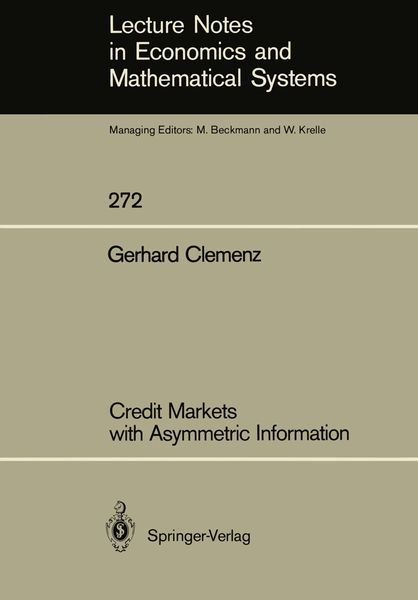
Credit Markets with Asymmetric Information
-
- Englisch ausgewählt
49,99 €
inkl. gesetzl. MwSt.,
Beschreibung
Produktdetails
Einband
Taschenbuch
Erscheinungsdatum
01.08.1986
Abbildungen
VIII, 212 p.
Verlag
Springer BerlinSeitenzahl
212
Maße (L/B/H)
24,4/17/1,3 cm
Gewicht
402 g
Auflage
Softcover reprint of the original 1st ed. 1986
Sprache
Englisch
ISBN
978-3-540-16778-5
Ch. 0: Introduction and General Overview.- 0.1 Subject and Scope.- 0.2 Summary of Contents.- Ch. 1: Approaches to Equilibrium Credit Rationing.- 1.1 A General Description of a Credit Market.- 1.2 Definition of Credit Rationing.- 1.3 Borrowers With Different Wealth Endowments.- 1.4 The Role of the Horizontal Integration of the Banking Firm.- 1.5 Implicit Contracts and Credit Rationing.- 1.6 Concluding Remarks.- Ch. 2: Adverse Selection, Moral Hazard, and Credit Rationing.- 2.1 The Basic Model.- 2.2 Projects of Different Riskiness.- 2.3 Borrowers of Different Honesty.- 2.4 Borrowers With Different Abilities.- 2.5 Unobservable Effort of Borrowers.- 2.6 Concluding Remarks.- Ch. 3: Credit Rationing in Multi-Period Models.- 3.1 Overview.- 3.2 Rationing as an Incentive Device.- 3.3 Experience Rating of Borrowers.- 3.4 Rationing With Endogenous Costs of Default.- 3.5 Bankruptcy as a Joint Decision of Bank and Borrower.- 3.6 Concluding Remarks.- Ch. 4: Screening vs. Rationing. The Role of Collateral.- 4.1 Overview.- 4.2 Projects of Different Riskiness.- 4.3 The Jaffee and Russell Model.- 4.4 Borrowers With Different Abilities.- 4.5 Borrowers With Unobservable Effort.- 4.6 Concluding Remarks.- Ch. 5: Loan Markets With Perfectly Divisible Projects.- 5.1 Overview.- 5.2 A Loan Market With Certain Returns.- 5.3 A Loan Market With Uncertain Returns.- 5.4 The Nash-Equilibrium With Borrowers of Different Abilities.- Ch. 6: Variable Loan Size, Signalling and Endogenous Information.- 6.1 Overview.- 6.2 Success-Failure Projects and Different Abilities.- 6.3 Strategic Stability of Credit Market Equilibria.- 6.4 Projects of Different Riskiness.- 6.5 Borrowers With Different Default Costs.- 6.6 Exchange of Information Between Banks.- 6.7 Concluding Remarks 173 Appendix.- Ch. 7: Variable LoanSize and Type II Rationing.- 7.1 Overview.- 7.2 The Basic Model.- 7.3 Loan Applicants With Different Default Costs.- 7.4 Loan Applicants With Different Abilities.- 7.5 Projects of Different Riskiness.- 7.6 The Role of Effort.- 7.7 Concluding Remarks.- Ch. 8: Epilogue: Whither Now.
Noch keine Bewertungen vorhanden
Verfassen Sie die erste Bewertung zu diesem Artikel
Helfen Sie anderen Kundinnen und Kunden durch Ihre Meinung.
Kurze Frage zu unserer Seite
Vielen Dank für dein Feedback
Wir nutzen dein Feedback, um unsere Produktseiten zu verbessern. Bitte habe Verständnis, dass wir dir keine Rückmeldung geben können. Falls du Kontakt mit uns aufnehmen möchtest, kannst du dich aber gerne an unseren Kund*innenservice wenden.
zum Kundenservice