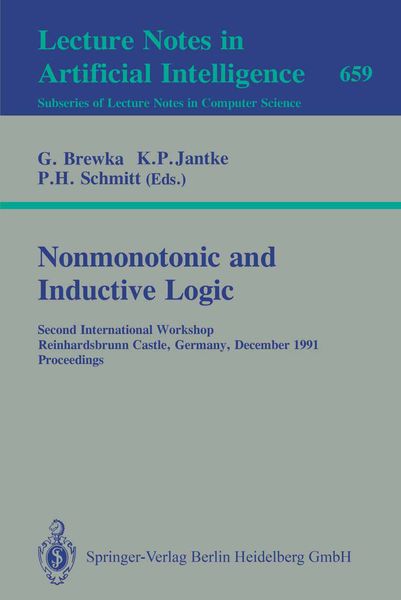
Nonmonotonic and Inductive Logic Second International Workshop, Reinhardsbrunn Castle, Germany, December 2-6, 1991. Proceedings
-
- Englisch ausgewählt
-
Auflage:1993
- 1993 49,99 € ausgewählt
- 1991 49,99 €
49,99 €
inkl. gesetzl. MwSt.,
Beschreibung
Produktdetails
Einband
Taschenbuch
Erscheinungsdatum
26.02.1993
Abbildungen
X, 338 p.
Herausgeber
Gerhard Brewka + weitereVerlag
Springer BerlinSeitenzahl
338
Maße (L/B/H)
23,5/15,5/1,9 cm
Gewicht
528 g
Auflage
1993
Sprache
Englisch
ISBN
978-3-540-56433-1
extended papers presented at the Second International
Workshop on Nonmonotonic and InductiveLogic, NIL '91, which
took place at Reinhardsbrunn Castle, December 2-6, 1991.
The volume opens with an extended version of a tutorial on
nonmonotonic logic by G. Brewka, J. Dix, and K. Konolige.
Fifteen selected papers follow, on a variety of topics. The
majority of papers belong either to the area of nonmonotonic
reasoning or to the field of inductive inference, but
some papers integrate research from both areas.
The first workshop in this series was held at the University
of Karlsruhe in December 1990 and its proceedings were
published as Lecture Notes in Artificial Intelligence Volume
543. The series of workshops was made possible by financial
support from Volkswagen Stiftung, Hannover. This workshop
was also supported by IBM Deutschland GmbH and Siemens AG.
Noch keine Bewertungen vorhanden
Verfassen Sie die erste Bewertung zu diesem Artikel
Helfen Sie anderen Kundinnen und Kunden durch Ihre Meinung.
Kurze Frage zu unserer Seite
Vielen Dank für dein Feedback
Wir nutzen dein Feedback, um unsere Produktseiten zu verbessern. Bitte habe Verständnis, dass wir dir keine Rückmeldung geben können. Falls du Kontakt mit uns aufnehmen möchtest, kannst du dich aber gerne an unseren Kund*innenservice wenden.
zum Kundenservice