• Produktbild: Algorithmic Learning Theory
  • Produktbild: Algorithmic Learning Theory

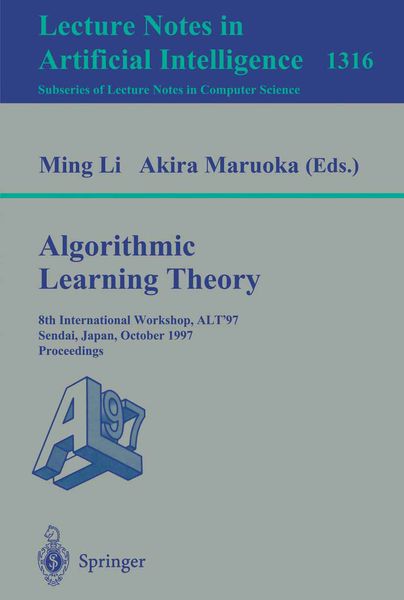
Algorithmic Learning Theory 8th International Workshop, Sendai, Japan, October 6-8, 1997

49,99 €

inkl. gesetzl. MwSt., Versandkostenfrei

Lieferung nach Hause

Beschreibung

Produktdetails

Einband

Taschenbuch

Erscheinungsdatum

17.09.1997

Herausgeber

Ming Li + weitere

Verlag

Springer Berlin

Seitenzahl

470

Maße (L/B/H)

23,5/15,5/2,5 cm

Gewicht

727 g

Auflage

1997

Sprache

Englisch

ISBN

978-3-540-63577-2

Beschreibung

Produktdetails

Einband

Taschenbuch

Erscheinungsdatum

17.09.1997

Herausgeber

Verlag

Springer Berlin

Seitenzahl

470

Maße (L/B/H)

23,5/15,5/2,5 cm

Gewicht

727 g

Auflage

1997

Sprache

Englisch

ISBN

978-3-540-63577-2

Herstelleradresse

Springer-Verlag KG
Sachsenplatz 4-6
1201 Wien
AT

Email: GPSR Kontakt

Noch keine Bewertungen vorhanden

Verfassen Sie die erste Bewertung zu diesem Artikel

Helfen Sie anderen Kundinnen und Kunden durch Ihre Meinung.

Kundinnen und Kunden meinen

Bewertungen (0)

  • Produktbild: Algorithmic Learning Theory
  • Produktbild: Algorithmic Learning Theory
  • Program error detection/correction: Turning PAC learning into Perfect learning.- Team learning as a game.- Inferability of recursive real-valued functions.- Learning of R.E. Languages from good examples.- Identifiability of subspaces and homomorphic images of zero-reversible languages.- On exploiting knowledge and concept use in learning theory.- Partial occam's razor and its applications.- Derandomized learning of boolean functions.- Learning DFA from simple examples.- PAC learning under helpful distributions.- PAC learning using Nadaraya-Watson estimator based on orthonormal systems.- Monotone extensions of boolean data sets.- Classical Brouwer-Heyting-Kolmogorov interpretation.- Inferring a system from examples with time passage.- Polynomial time inductive inference of regular term tree languages from positive data.- Synthesizing noise-tolerant language learners.- Effects of Kolmogorov complexity present in inductive inference as well.- Learning one-variable pattern languages very efficiently on average, in parallel, and by asking queries.- Oracles in ? 2 p are sufficient for exact learning.- Exact learning via teaching assistants (Extended abstract).- An efficient exact learning algorithm for ordered binary decision diagrams.- Probability theory for the Brier game.- Learning and revising theories in noisy domains.- A note on a scale-sensitive dimension of linear bounded functionals in Banach Spaces.- On the relevance of time in neural computation and learning.- A simple algorithm for predicting nearly as well as the best pruning labeled with the best prediction values of a decision tree.- Learning disjunctions of features.- Learning simple deterministic finite-memory automata.- Learning acyclic first-order horn sentences from entailment.- On learning disjunctions of zero-one threshold functions with queries.