Gutscheinbedingungen

**Gültig vom 07.09.2026 bis 09.09.2026 | Gültig für nicht preisgebundene fremdsprachige Bücher | Einzelne Artikel können ausgeschlossen sein | Online auf www.bücher.de einlösbar | Click & Collect nur mit Online-Zahlung (Paypal/Kreditkarte) vorab | Nicht kombinierbar mit anderen Gutscheinen oder Preisaktionen | Nur einmal pro Einkauf einlösbar | Gutschein wird auf max. 500€ Bestellwert angerechnet | Keine Barauszahlung | Nicht gültig für Versandkosten und Services

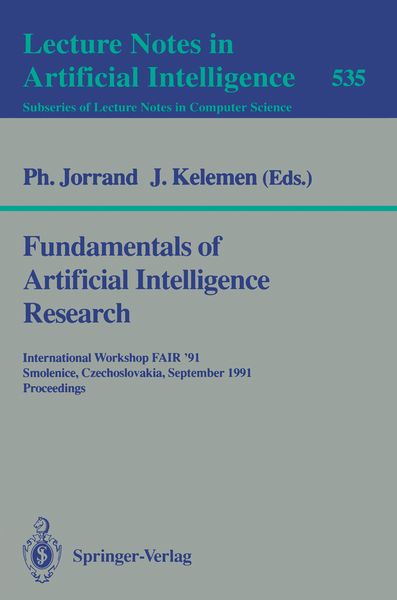
  • Produktbild: Fundamentals of Artificial Intelligence Research
  • Produktbild: Fundamentals of Artificial Intelligence Research
Band 535

Fundamentals of Artificial Intelligence Research International Workshop FAIR '91, Smolenice, Czechoslovakia, September 8-13, 1991. Proceedings

49,99 €

inkl. gesetzl. MwSt., Versandkostenfrei


Beschreibung

Produktdetails

Einband

Taschenbuch

Erscheinungsdatum

28.08.1991

Abbildungen

VIII, 260 p.

Herausgeber

Philippe Jorrand + weitere

Verlag

Springer Berlin

Seitenzahl

260

Maße (L/B/H)

23,5/15,5/1,5 cm

Gewicht

417 g

Auflage

1991

Sprache

Englisch

ISBN

978-3-540-54507-1

Beschreibung

Produktdetails

Einband

Taschenbuch

Erscheinungsdatum

28.08.1991

Abbildungen

VIII, 260 p.

Herausgeber

Verlag

Springer Berlin

Seitenzahl

260

Maße (L/B/H)

23,5/15,5/1,5 cm

Gewicht

417 g

Auflage

1991

Sprache

Englisch

ISBN

978-3-540-54507-1

Herstelleradresse

Springer-Verlag KG
Sachsenplatz 4-6
1201 Wien
AT

Email: ProductSafety@springernature.com

Noch keine Bewertungen vorhanden

Verfassen Sie die erste Bewertung zu diesem Artikel

Helfen Sie anderen Kundinnen und Kunden durch Ihre Meinung.

Kundinnen und Kunden meinen

Bewertungen (0)

  • Produktbild: Fundamentals of Artificial Intelligence Research
  • Produktbild: Fundamentals of Artificial Intelligence Research
  • User-oriented theorem proving with the ATINF graphic proof editor.- A modal analysis of possibility theory.- Making inconsistency respectable: A logical framework for inconsistency in reasoning, part I — A position paper.- Relational proof systems for some AI logics.- Formal grammars and cognitive architectures.- Efficient simulations of nondeterministic computations and their speed-up by the ring of cooperating machines.- A semantic characterization of disjunctive relations.- Execution of defeasible temporal clauses for building preferred models.- On the phenomenon of flattening “flexible prediction” concept hierarchy.- Possibilistic logic as a logical framework for min-max discrete optimisation problems and prioritized constraints.- An approach to data-driven learning.- Extending abduction from propositional to first-order logic.- Building in equational theories into the connection method.- Logical fiberings and polycontextural systems.- Automated deduction with associative commutative operators.- Towards a lattice of knowledge representation systems.- Inconsistencies handling: nonmonotonic and paraconsistent reasoning.- An approach to structural synthesis of data processing programs.- Negation as failure and intuitionistic three-valued logic.- Symbolic Computation and Artificial Intelligence.