• Produktbild: Business Cycles in the Contemporary World
  • Produktbild: Business Cycles in the Contemporary World
  • Produktbild: Business Cycles in the Contemporary World

Business Cycles in the Contemporary World Description, Causes, Aggregation, and Synchronization

48,99 €

inkl. gesetzl. MwSt., Versandkostenfrei

Lieferung nach Hause

Beschreibung

Produktdetails

Einband

Taschenbuch

Erscheinungsdatum

27.11.2002

Verlag

Physica

Seitenzahl

165

Maße (L/B/H)

23,5/15,5/1,1 cm

Gewicht

283 g

Auflage

1. Auflage

Sprache

Englisch

ISBN

978-3-7908-1532-0

Beschreibung

Produktdetails

Einband

Taschenbuch

Erscheinungsdatum

27.11.2002

Verlag

Physica

Seitenzahl

165

Maße (L/B/H)

23,5/15,5/1,1 cm

Gewicht

283 g

Auflage

1. Auflage

Sprache

Englisch

ISBN

978-3-7908-1532-0

Herstelleradresse

Physica Verlag
Tiergartenstr. 17
69121 Heidelberg
DE

Email: ProductSafety@springernature.com

Kundinnen und Kunden meinen

0 Bewertungen

Informationen zu Bewertungen

Zur Abgabe einer Bewertung ist eine Anmeldung im Konto notwendig. Die Authentizität der Bewertungen wird von uns nicht überprüft. Wir behalten uns vor, Bewertungstexte, die unseren Richtlinien widersprechen, entsprechend zu kürzen oder zu löschen.

Die Bewertungen sind nach Format, Anzahl Sterne und Datum sortiert.

Verfassen Sie die erste Bewertung zu diesem Artikel

Helfen Sie anderen Kund*innen durch Ihre Meinung

Kundinnen und Kunden meinen

0 Bewertungen filtern

  • Produktbild: Business Cycles in the Contemporary World
  • Produktbild: Business Cycles in the Contemporary World
  • Produktbild: Business Cycles in the Contemporary World
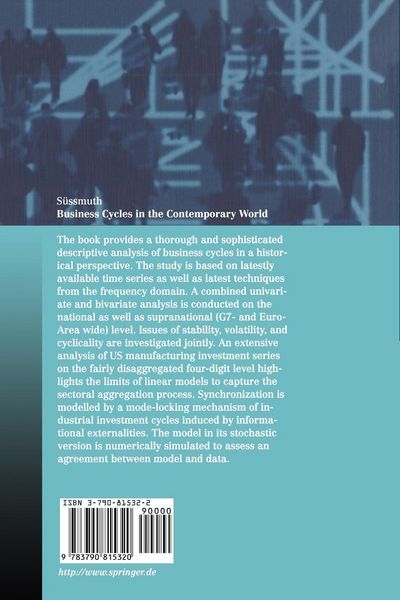
  • 1. Introduction.- 1.1 Business Cycle Research: 21st Century Perspective.- 1.1.1 The Classic View.- 1.1.2 From CBC to RBC School.- 1.2 Recent Empirical Findings in Favor of CBC.- 1.1.1 Aggregate Investment Fluctuations and Business Cycles.- 1.1.2 The Cyclicality of the Aggregate Investment Series.- 1.1.3 Investment, the RBC View and Disaggregated Dynamics.- I.Methodology.- 2. General Considerations and Historiography.- 2.1 Methodologies: Econometrics vs. Natural Sciences.- 2.2 The Econometric Approach to Time Series Analysis.- 3. The Analysis of Cyclical Dynamics.- 3.1 The Detrending Problem.- 3.2 Volatility and Spectral Analysis.- 3.2.1 Contribution-to-Variance Analysis.- 3.2.2 Spectral Analysis: The Univariate Case.- 3.2.3 The Analysis of Complex Roots.- 3.2.4 Spectral Analysis: The Multivariate Case.- II. National, Supra- and International Cycles.- 4. The G7 and Eurol5 Economies: 1960 - 2000.- 4.1 Data and Strategy.- 4.2 National Uni- and Bivariate Stylized Facts.- 4.2.1 General Salient Facts.- 4.2.2 Robust Univariate Stylized Facts: National Cycles.- 4.2.3 Robust Bivariate Stylized Facts: National Cycles.- 4.3 Supranational Bivariate Stylized Facts.- 5. Mode-Locking and the Global Cycle.- 5.1 Introduction and Motivation of the Discussion.- 5.2 Generalizing Economic Cycles’ Mode-Lock Modelling.- 5.3 A Model Incorporating Information Externalities.- 5.1.1 The Model without Information Externalities.- 5.1.2 Introducing Information Externalities.- 5.1.3 Calibration of the Model and Some Simulations.- 5.4 Outlook and Concluding Remark.- III. The Sectoral Constitution of Macro-Cycles.- 6. An Aggregation Problem for Linear Models?.- 6.1 Description of US Business Cycles.- 6.1.1 Business Cycles in Central US NIPA Time Series.- 6.1.2 Cycles in Disaggregated US Manufacturing Investment.- 6.2 Testing Autoregressivity and Aggregate Feedback.- 6.3 Linear Models of the Aggregation Process.- 6.4 Evaluation of Linear Models.- 7. The Synchronization of Sectoral Cycles.- 7.1 Definitions of Synchronization.- 7.2 A Recent Approach: Method and Findings.- 7.3 The “Shift-Win“-Approach: Method and Findings.- 8. A Non-Linear Synchronization Model.- 8.1 Theoretical Underpinning of the Model.- 8.1.1 The Medium-Term Investment Objective: Smoothing.- 8.1.2 The Short-Term Investment Objective: Herding.- 8.1.3 The Integrated Model: Smoothing and Herding.- 8.1.4 The Synchronization Mechanism.- 8.2 A Thorough Simulation Study.- 8.2.1 Calibration as an Alternative to Estimation.- 8.2.2 Setting Up the Simulation Strategy and Determining Priors.- 8.2.3. Monte Carlo Simulations of the Model Incorporating Shocks.- 8.2.4 Evaluation of the Model and Outlook.- 9. Conclusion.- Abbreviations.- References.