• Produktbild: Information Technology in Supplier Networks
  • Produktbild: Information Technology in Supplier Networks

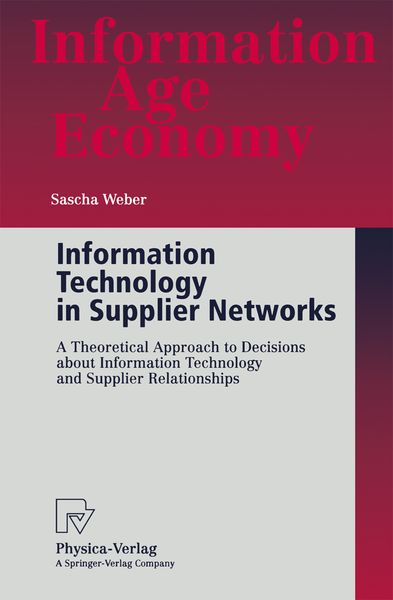
Information Technology in Supplier Networks A Theoretical Approach to Decisions about Information Technology and Supplier Relationships

Aus der Reihe Information Age Economy

48,99 €

inkl. gesetzl. MwSt., Versandkostenfrei

Lieferung nach Hause

Beschreibung

Produktdetails

Einband

Taschenbuch

Erscheinungsdatum

24.04.2001

Verlag

Physica

Seitenzahl

272

Maße (L/B/H)

23,5/15,5/1,6 cm

Gewicht

441 g

Auflage

1. Auflage

Sprache

Englisch

ISBN

978-3-7908-1395-1

Beschreibung

Produktdetails

Einband

Taschenbuch

Erscheinungsdatum

24.04.2001

Verlag

Physica

Seitenzahl

272

Maße (L/B/H)

23,5/15,5/1,6 cm

Gewicht

441 g

Auflage

1. Auflage

Sprache

Englisch

ISBN

978-3-7908-1395-1

Herstelleradresse

Physica Verlag
Tiergartenstr. 17
69121 Heidelberg
DE

Email: [email protected]

Kundinnen und Kunden meinen

0 Bewertungen

Informationen zu Bewertungen

Zur Abgabe einer Bewertung ist eine Anmeldung im Konto notwendig. Die Authentizität der Bewertungen wird von uns nicht überprüft. Wir behalten uns vor, Bewertungstexte, die unseren Richtlinien widersprechen, entsprechend zu kürzen oder zu löschen.

Die Bewertungen sind nach Format, Anzahl Sterne und Datum sortiert.

Verfassen Sie die erste Bewertung zu diesem Artikel

Helfen Sie anderen Kund*innen durch Ihre Meinung

Kundinnen und Kunden meinen

0 Bewertungen filtern

  • Produktbild: Information Technology in Supplier Networks
  • Produktbild: Information Technology in Supplier Networks
  • 1 Introduction.- 1.1 Research motivation.- 1.2 Research objectives.- 1.3 Research benefits.- 1.4 Structure of the thesis.- 2 Supplier Relationships.- 2.1 Basic aspects of supplier relationships.- 2.1.1 Supplier relationships and procurement.- 2.1.2 Procurement in the value chain of an organization.- 2.1.3 Institutionalizing the management of supplier relationships.- 2.1.4 Contracts in supplier relationships.- 2.1.4.1 Purchasing contracts in theory.- 2.1.4.2 Purchasing contracts in practice.- 2.1.5 Phases of supplier relationships.- 2.1.5.1 Evaluation phase.- 2.1.5.2 Settlement phase.- 2.2 Assessment of supplier relationships.- 2.2.1 Transaction costs.- 2.2.1.1 Asset specificity.- 2.2.1.2 Uncertainty in terms of transaction and behavior.- 2.2.1.3 Complexity of transaction and good.- 2.2.1.4 Frequency of a transaction.- 2.2.1.5 Fundamental transformation.- 2.2.2 Production costs.- 2.2.2.1 Economies of scale.- 2.2.2.2 Capacity utilization.- 2.2.2.3 Efficiency gains by specialization.- 2.2.2.4 Arbitrage between industrial sectors and/or geographical locations.- 2.2.2.5 Opportunity costs of suboptimal capital allocation.- 2.2.3 Optimal governance structure.- 3 Information Technology.- 3.1 Basic aspects of information technology.- 3.1.1 Theory of network effects.- 3.1.2 Standards.- 3.1.2.1 Compatibility standards.- 3.1.2.2 Quality standards.- 3.1.2.3 De jure standards.- 3.1.2.4 De facto standards.- 3.2 Information technology for the support of supplier relationships.- 3.2.1 Procurement applications.- 3.2.2 Supplier search and electronic catalogs.- 3.2.3 Information technology in the negotiation phase.- 3.2.3.1 Electronic auctions.- 3.2.3.2 Negotiation support systems.- 3.2.4 Standards for structuring the communication process in the settlement phase.- 3.2.4.1 Open-EDI.- 3.2.4.2 Interorganizational Procedures (InterProcs).- 3.2.4.3 Open Applications Group Integration Specifications (OAGIS).- 3.2.4.4 Open Trading Protocol (OTP).- 3.2.4.5 Open Buying on the Internet (OBI).- 3.2.5 Standards for structuring communication objects.- 3.2.5.1 The syntactic level: languages for the specification of standards.- 3.2.5.2 Standards on the semantic level.- 3.2.6 Information technology and transaction costs.- 3.2.6.1 Evaluation cost reductions.- 3.2.6.2 Settlement cost reductions.- 3.3 Information technology and changing supplier relationships.- 3.3.1 The move to the market hypothesis.- 3.3.2 The move to the middle hypothesis.- 3.3.3 Provisional results.- 4 Decisions about Supplier Relationships and Information Technology.- 4.1 The progress of information technology and the state preference approach.- 4.2 The basic model of supplier selection decisions.- 4.2.1 Acquisition and evaluation costs.- 4.2.2 Settlement costs.- 4.2.3 Costs of keeping the current transaction partner.- 4.2.4 Properties of the basic model.- 4.2.4.1 Marginal evaluation costs.- 4.2.4.2 Transaction volume.- 4.2.4.3 Riskiness of the price distribution.- 4.2.4.4 Mean value of the price distribution.- 4.2.4.5 Initialization costs.- 4.2.4.6 Adaptation costs.- 4.2.4.7 Frequency of a transaction.- 4.2.4.8 Costs of exchanging the goods.- 4.2.5 Decisions in the basic model.- 4.2.5.1 Transaction partner selection.- 4.2.5.2 Outsourcing.- 4.2.5.3 Determining the optimal contract duration.- 4.3 Extending the basic model: the selection of information technology.- 4.3.1 Modeling the selection of information technology.- 4.3.2 Properties of the extended model.- 4.3.3 Decisions in the extended model.- 4.3.3.1 The duration of supplier contracts under the condition of changing technology diffusion.- 4.3.3.2 The selection of information technology under the condition of newly emerging solutions.- 5 Conclusion.- 5.1 Summary.- 5.1.1 Information technology and transaction costs.- 5.1.2 Reduced transaction costs and the design of supplier contracts.- 5.1.3 Growing dissemination of information technology and the duration of supplier contracts.- 5.1.4 The adoption of new information technology.- 5.2 Implications for the management of supplier relationships.- 5.3 Outlook.- 6 References.- 7 Appendices.- 8 List of Figures.- 9 List of Tables.- 10 List of Used Symbols.- 11 List of Abbreviations.