KI-Beratung Beta

  • Produktbild: Weakly Connected Neural Networks
  • Produktbild: Weakly Connected Neural Networks
Band 126 - 13%

Weakly Connected Neural Networks

13% sparen

129,99 € UVP 149,79 €

inkl. gesetzl. MwSt., Versandkostenfrei


Beschreibung

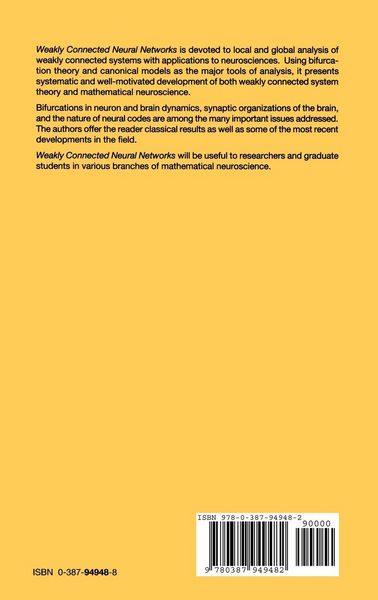
This book is devoted to an analysis of general weakly connected neural networks (WCNNs) that can be written in the form (0.1) m Here, each Xi E IR is a vector that summarizes all physiological attributes of the ith neuron, n is the number of neurons, Ii describes the dynam ics of the ith neuron, and...

Beschreibung

This book is devoted to an analysis of general weakly connected neural networks (WCNNs) that can be written in the form (0.1) m Here, each Xi E IR is a vector that summarizes all physiological attributes of the ith neuron, n is the number of neurons, Ii describes the dynam ics of the ith neuron, and gi describes the interactions between neurons. The small parameter € indicates the strength of connections between the neurons. Weakly connected systems have attracted much attention since the sec ond half of seventeenth century, when Christian Huygens noticed that a pair of pendulum clocks synchronize when they are attached to a light weight beam instead of a wall. The pair of clocks is among the first weakly connected systems to have been studied. Systems of the form (0.1) arise in formal perturbation theories developed by Poincare, Liapunov and Malkin, and in averaging theories developed by Bogoliubov and Mitropolsky.

Rezension

From the reviews:


"...After the introduction, written according to the authors in ordinary language, and well readable even for laymen, follows a nicely written Chapter 2 on bifurcations in neuron dynamics which must be read. Here also spiking and bursting phenomena are clearly described. Chapter 3 contains a short sketch of nonhyperbolic (when the Jacobian matrix of (1) has at least one eigenvalue with zero real part) neural networks. The remaining part of the book is mainly devoted to canonical models (Chapter 4), their derivation (Chapters 6--9), and their analysis (Chapters 10--12). The term canonical model is not precisely defined here. The authors say that a model is canonical if there is a continuous change of variables that transforms any other model from a given class into this one. As the method of deriving the canonical models, the authors exploit the normal form theory. Canonical models treated in the book have only restricted value: They provide information about local behavior of (1) when there is an exponentially stable limit cycle but they say nothing about global behavior of (1), including the transients. The last Chapter 13 describes the relationship between synaptic organizations and dynamical properties of networks of neural oscillators. In other words, the problem of learning and memorization of phase information in the weakly connected network of oscillators corresponding to multiple Andronov-Hopf bifurcation is treated analytically.
Surprisingly the book ends without any conclusions. Also there are no appendices to the book. The references are representative and sufficiently cover the problematics treated in the book."  (Ladislav Andrey, Mathematical Reviews) 

Produktdetails

Einband

Gebundene Ausgabe

Erscheinungsdatum

10.07.1997

Abbildungen

XVI, 402 p.

Verlag Springer Us

Produktdetails

Einband

Gebundene Ausgabe

Erscheinungsdatum

10.07.1997

Abbildungen

XVI, 402 p.

Verlag Springer Us
Seitenzahl

402

Maße (L/B/H)

24,1/16,1/2,5 cm

Gewicht

726 g

Auflage

1997 edition

Sprache

Englisch

ISBN

978-0-387-94948-2

Herstelleradresse

Libri GmbH
Europaallee 1
36244 Bad Hersfeld
DE

Email: gpsr@libri.de

Noch keine Bewertungen vorhanden

Verfassen Sie die erste Bewertung zu diesem Artikel

Helfen Sie anderen Kundinnen und Kunden durch Ihre Meinung.

Kundinnen und Kunden meinen

Bewertungen (0)

  • Produktbild: Weakly Connected Neural Networks
  • Produktbild: Weakly Connected Neural Networks
  • 1 Introduction.- 2 Bifurcations in Neuron Dynamics.- 3 Neural Networks.- 4 Introduction to Canonical Models.- 5 Local Analysis of WCNNs.- 6 Local Analysis of Singularly Perturbed WCNNs.- 7 Local Analysis of Weakly Connected Maps.- 8 Saddle-Node on a Limit Cycle.- 9 Weakly Connected Oscillators.- 10 Multiple Andronov-Hopf Bifurcation.- 11 Multiple Cusp Bifurcation.- 12 Quasi-Static Bifurcations.- 13 Synaptic Organizations of the Brain.- References.