Gutscheinbedingungen

**Gültig vom 15.06.2026 bis 17.06.2026 | Gültig für nicht preisgebundene fremdsprachige Bücher | Einzelne Artikel können ausgeschlossen sein | Maximaler rabattfähiger Warenkorbwert 500 € | Nicht kombinierbar mit weiteren Aktionen | Nur einmal pro Person einlösbar | Nur solange der Vorrat reicht

  • Produktbild: Depth From Defocus: A Real Aperture Imaging Approach
  • Produktbild: Depth From Defocus: A Real Aperture Imaging Approach
- 12%

Depth From Defocus: A Real Aperture Imaging Approach A Real Aperture Imaging Approach

12% sparen

93,99 € UVP 106,99 €

inkl. gesetzl. MwSt., Versandkostenfrei

Lieferung nach Hause

Beschreibung

Produktdetails

Einband

Gebundene Ausgabe

Erscheinungsdatum

26.03.1999

Verlag

Springer Us

Seitenzahl

172

Maße (L/B/H)

24,1/16/1,5 cm

Gewicht

465 g

Auflage

1999

Sprache

Englisch

ISBN

978-0-387-98635-7

Beschreibung

Produktdetails

Einband

Gebundene Ausgabe

Erscheinungsdatum

26.03.1999

Verlag

Springer Us

Seitenzahl

172

Maße (L/B/H)

24,1/16/1,5 cm

Gewicht

465 g

Auflage

1999

Sprache

Englisch

ISBN

978-0-387-98635-7

Herstelleradresse

Springer-Verlag GmbH
Tiergartenstr. 17
69121 Heidelberg
DE

Email: ProductSafety@springernature.com

Kundinnen und Kunden meinen

0 Bewertungen

Informationen zu Bewertungen

Zur Abgabe einer Bewertung ist eine Anmeldung im Konto notwendig. Die Authentizität der Bewertungen wird von uns nicht überprüft. Wir behalten uns vor, Bewertungstexte, die unseren Richtlinien widersprechen, entsprechend zu kürzen oder zu löschen.

Die Bewertungen sind nach Format, Anzahl Sterne und Datum sortiert.

Verfassen Sie die erste Bewertung zu diesem Artikel

Helfen Sie anderen Kund*innen durch Ihre Meinung

Kundinnen und Kunden meinen

0 Bewertungen filtern

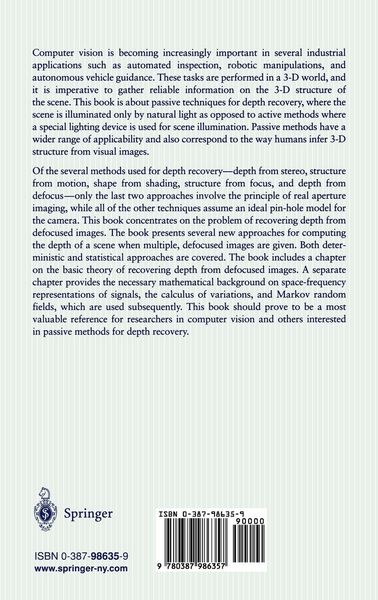
  • Produktbild: Depth From Defocus: A Real Aperture Imaging Approach
  • Produktbild: Depth From Defocus: A Real Aperture Imaging Approach
  • 1 Passive Methods for Depth Recovery.- 1.1 Introduction.- 1.2 Different Methods of Depth Recovery.- 1.2.1 Depth from Stereo.- 1.2.2 Structure from Motion.- 1.2.3 Shape from Shading.- 1.2.4 Range from Focus.- 1.2.5 Depth from Defocus.- 1.3 Difficulties in Passive Ranging.- 1.4 Organization of the Book.- 2 Depth Recovery from Defocused Images.- 2.1 Introduction.- 2.2 Theory of Depth from Defocus.- 2.2.1 Real Aperture Imaging.- 2.2.2 Modeling the Camera Defocus.- 2.2.3 Depth Recovery.- 2.2.4 Sources of Errors.- 2.3 Related Work.- 2.4 Summary of the Book.- 3 Mathematical Background.- 3.1 Introduction.- 3.2 Time-Frequency Representation.- 3.2.1 The Complex Spectrogram.- 3.2.2 The Wigner Distribution.- 3.3 Calculus of Variations.- 3.4 Markov Random Fields and Gibbs Distributions.- 3.4.1 Theory of MRF.- 3.4.2 Gibbs Distribution.- 3.4.3 Incorporating Discontinuities.- 4 Depth Recovery with a Block Shift-Variant Blur Model.- 4.1 Introduction.- 4.2 The Block Shift-Variant Blur Model.- 4.2.1 Estimation of Blur.- 4.2.2 Special Cases.- 4.3 Experimental Results.- 4.4 Discussion.- 5 Space-Variant Filtering Models for Recovering Depth.- 5.1 Introduction.- 5.2 Space-Variant Filtering.- 5.3 Depth Recovery Using the Complex Spectrogram.- 5.4 The Pseudo-Wigner Distribution for Recovery of Depth.- 5.5 Imposing Smoothness Constraint.- 5.5.1 Regularized Solution Using the Complex Spectrogram..- 5.5.2 The Pseudo-Wigner Distribution and Regularized Solution.- 5.6 Experimental Results.- 5.7 Discussion.- 6 ML Estimation of Depth and Optimal Camera Settings.- 6.1 Introduction.- 6.2 Image and Observation Models.- 6.3 ML-Based Recovery of Depth.- 6.4 Computation of the Likelihood Function.- 6.5 Optimality of Camera Settings.- 6.5.1 The Cramér-Rao Bound.- 6.5.2 Optimality Criterion.- 6.6 Experimental Results.- 6.7 Discussion.- 7 Recursive Computation of Depth from Multiple Images.- 7.1 Introduction.- 7.2 Blur Identification from Multiple Images.- 7.3 Minimization by Steepest Descent.- 7.4 Recursive Algorithm for Computing the Likelihood Function.- 7.4.1 Single Observation.- 7.4.2 Two Observations.- 7.4.3 General Case of M Observations.- 7.5 Experimental Results.- 7.6 Discussion.- 8 MRF Model-Based Identification of Shift-Variant PSF.- 8.1 Introduction.- 8.2 A MAP-MRF Approach.- 8.3 The Posterior Distribution and Its Neighborhood.- 8.4 MAP Estimation by Simulated Annealing.- 8.5 Experimental Results.- 8.6 Discussion.- 9 Simultaneous Depth Recovery and Image Restoration.- 9.1 Introduction.- 9.2 Depth Recovery and Restoration using MRF Models.- 9.3 Locality of the Posterior Distribution.- 9.4 Parameter Estimation.- 9.5 Experimental Results.- 9.6 Discussion.- 10 Conclusions.- A Partial Derivatives of Various Quantities in CRB.- References.