• Produktbild: A Guided Tour of Relational Databases and Beyond
  • Produktbild: A Guided Tour of Relational Databases and Beyond

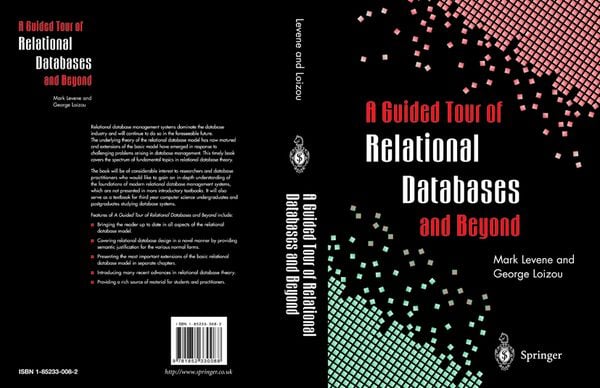
A Guided Tour of Relational Databases and Beyond

82,99 €

inkl. gesetzl. MwSt., Versandkostenfrei


Beschreibung

Produktdetails

Einband

Taschenbuch

Erscheinungsdatum

28.05.1999

Abbildungen

XIV, 625 p. 3 illus.

Verlag

Springer London

Seitenzahl

625

Maße (L/B/H)

23,5/15,5/3,5 cm

Gewicht

955 g

Auflage

Softcover reprint of the original 1st ed. 1999

Sprache

Englisch

ISBN

978-1-85233-008-8

Beschreibung

Produktdetails

Einband

Taschenbuch

Erscheinungsdatum

28.05.1999

Abbildungen

XIV, 625 p. 3 illus.

Verlag

Springer London

Seitenzahl

625

Maße (L/B/H)

23,5/15,5/3,5 cm

Gewicht

955 g

Auflage

Softcover reprint of the original 1st ed. 1999

Sprache

Englisch

ISBN

978-1-85233-008-8

Herstelleradresse

Springer-Verlag GmbH
Tiergartenstr. 17
69121 Heidelberg
DE

Email: ProductSafety@springernature.com

Noch keine Bewertungen vorhanden

Verfassen Sie die erste Bewertung zu diesem Artikel

Helfen Sie anderen Kundinnen und Kunden durch Ihre Meinung.

Kundinnen und Kunden meinen

Bewertungen (0)

  • Produktbild: A Guided Tour of Relational Databases and Beyond
  • Produktbild: A Guided Tour of Relational Databases and Beyond
  • An Introductory Example.- What is a Database?.- Why do we Need Database Management Systems?.- The Three Levels of Data Abstraction.- What is a Database Management System?.- The Concept of Data Independence.- What is a Data Model?.- Discussion.- Background Material.- Exercises.- The Entity-Relationship Model.- Graphs.- The Building Blocks of an Entity-Relationship Diagram (ERD).- Recursive Relationships.- Weak Entity Types.- The Steps Needed for Constructing an ERD.- Discussion.- Exercises.- The Relational Data Model.- The Data Structure of the Relational Model.- Query and Update Languages for the Relational Model.- The Equivalence of Query Languages for the Relational Model.- Integrity Constraints in Relational Databases.- Inference of Integrity Constraints.- Data Dependencies.- Domain and Cardinality Constraints.- The View Update Problem.- Discussion.- Exercises.- Relational Database Design.- Update Anomalies in Relational Databases.- Desirable Properties of Database Decompositions.- The Synthesis Versus Decomposition Approaches to Relational Database Design.- Normal Forms.- Horizontal Decompositions.- Algorithms for Converting a Relation Schema into Normal Form.- Converting an ERD into a Relational Database Schema in IDNF.- Discussion.- Exercises.- Incomplete Information in the Relational Data Model.- Different Types of Null Value.- The Open and Closed World Assumptions.- Introducing Order into the Domain.- Extending the Relational Algebra with Null Values.- Extending Integrity Constraints with Null Values.- The Or-sets Approach.- The Fuzzy Sets Approach.- The Rough Sets Approach.- The Default Values Approach.- Updating Incomplete Relations.- Discussion.- Exercises.- Computable Database Queries and the Expressiveness of the Relational Algebra.- What is a Computable Database Query?.- Formalising Computable Database Queries.- Subclasses of Computable Database Queries.- An Equivalence Relation on Computable Queries.- Computational Query Completeness.- The Expressive Power of the Relational Algebra.- Adding a Looping Mechanism to the Relational Algebra.- Discussion.- Exercises.- Temporal Relational Databases.- The Importance of Modelling Time.- A Taxonomy of Time in Databases.- Historical Relations.- A Historical Relational Algebra.- Historical Relational Completeness.- TSQL2.- Historical Key Dependencies.- Schema Evolution.- Discussion.- Exercises.- Concurrency Control.- Manifestations of Concurrency Control.- Serialisability.- Locking.- Deadlock.- Lock Granularity and Lock Manager.- Lock Manager Implementation.- Timestamp Ordering.- Serialisation Graph Testing.- Discussion.- Exercises.- Deductive Databases.- Model-theoretic Semantics of Datalog.- Expressive Power of Datalog.- Equivalence Between Datalog Programs.- Datalog Not-Equal.- Updates in Deductive Databases.- Integrity Constraints in Deductive Databases.- Discussion.- Exercises.- Extensions to the Relational Data Model and Recent Directions.- Nested Relational Databases.- Object-Oriented Databases.- Graph-Based Databases.- Active Databases.- Hypertext Databases.- Semistructured Databases.- Knowledge Discovery and Data Mining.- Other Areas.- What Lies Beyond?.- Exercises.- 577.- 609.