Gutscheinbedingungen

**Gültig bis 10.06.2026 / Gültig für gebrauchte Bücher / Mindestbestellwert 20,00 € / Einzelne Artikel können ausgeschlossen sein / Online auf www.bücher.de.de / Nicht kombinierbar mit anderen Gutscheinen oder Preisaktionen / Nur einmal pro Einkauf einlösbar / Gutschein wird auf max. 500€ Bestellwert angerechnet / Keine Barauszahlung / Nicht gültig für Versandkosten und Services

  • Produktbild: Logic for Applications
  • Produktbild: Logic for Applications
- 11%

Logic for Applications

11% sparen

131,99 € UVP 149,79 €

inkl. gesetzl. MwSt., Versandkostenfrei

Lieferung nach Hause

Beschreibung

Produktdetails

Einband

Gebundene Ausgabe

Erscheinungsdatum

17.01.1997

Abbildungen

2nd ed. XVII, w. mit 66 Illustrationen 24 cm

Verlag

Springer Us

Seitenzahl

456

Maße (L/B/H)

23,5/15,5/3,1 cm

Gewicht

875 g

Auflage

Second Edition 1997

Sprache

Englisch

ISBN

978-0-387-94893-5

Beschreibung

Rezension

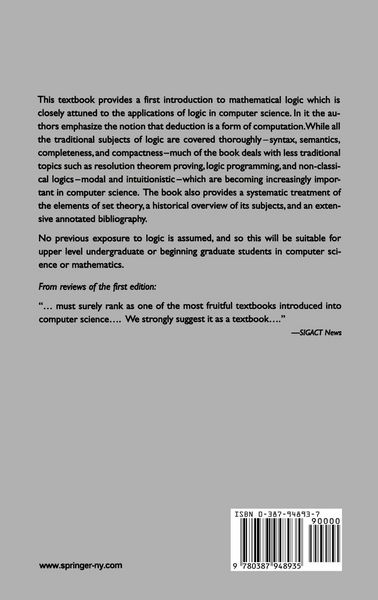
From reviews of the first edition: "... must surely rank as one of the most fruitful textbooks introduced into computer science ... We strongly suggest it as a textbook ..." SIGACT News


From the reviews of the second edition:


"…the book achieves its goal of being a unified introduction into classical logic, logic programming and certain non-classical logics. …the book succeeded in presenting a uniform framework for describing different logics. The author’s thorough approach to describing logic programming, via introduction of resolution-based refutations and subsequent study of different kinds of resolutions allows the reader to gradually switch from the study of logic to the study of logical programming paradigm and provides a lot of intuition about the behavior of logic programs.


As such the book can be recommended both as a textbook for senior/graduate course in logic/logic programming, and as a reading or reference for graduate students in the areas related to discrete mathematics."


(Alexander Dekhtyar, William Gasarch’s Book Review Column, SIGACT News)

Produktdetails

Einband

Gebundene Ausgabe

Erscheinungsdatum

17.01.1997

Abbildungen

2nd ed. XVII, w. mit 66 Illustrationen 24 cm

Verlag

Springer Us

Seitenzahl

456

Maße (L/B/H)

23,5/15,5/3,1 cm

Gewicht

875 g

Auflage

Second Edition 1997

Sprache

Englisch

ISBN

978-0-387-94893-5

Herstelleradresse

Springer-Verlag GmbH
Tiergartenstr. 17
69121 Heidelberg
DE

Email: ProductSafety@springernature.com

Kundinnen und Kunden meinen

0 Bewertungen

Informationen zu Bewertungen

Zur Abgabe einer Bewertung ist eine Anmeldung im Konto notwendig. Die Authentizität der Bewertungen wird von uns nicht überprüft. Wir behalten uns vor, Bewertungstexte, die unseren Richtlinien widersprechen, entsprechend zu kürzen oder zu löschen.

Die Bewertungen sind nach Format, Anzahl Sterne und Datum sortiert.

Verfassen Sie die erste Bewertung zu diesem Artikel

Helfen Sie anderen Kund*innen durch Ihre Meinung

Kundinnen und Kunden meinen

0 Bewertungen filtern

  • Produktbild: Logic for Applications
  • Produktbild: Logic for Applications
  • I Propositional Logic.- 1 Orders and Trees.- 2 Propositions, Connectives and Truth Tables.- 3 Truth Assignments and Valuations.- 4 Tableau Proofs in Propositional Calculus.- 5 Soundness and Completeness of Tableau Proofs.- 6 Deductions from Premises and Compactness.- 7 An Axiomatic Approach*.- 8 Resolution.- 9 Refining Resolution.- 10 Linear Resolution, Horn Clauses and PROLOG.- II Predicate Logic.- 1 Predicates and Quantifiers.- 2 The Language: Terms and Formulas.- 3 Formation Trees, Structures and Lists.- 4 Semantics: Meaning and Truth.- 5 Interpretations of PROLOG Programs.- 6 Proofs: Complete Systematic Tableaux.- 7 Soundness and Completeness of Tableau Proofs.- 8 An Axiomatic Approach*.- 9 Prenex Normal Form and Skolemization.- 10 Herbrand’s Theorem.- 11 Unification.- 12 The Unification Algorithm.- 13 Resolution.- 14 Refining Resolution: Linear Resolution.- III PROLOG.- 1 SLD-Resolution.- 2 Implementations: Searching and Backtracking.- 3 Controlling the Implementation: Cut.- 4 Termination Conditions for PROLOG Programs.- 5 Equality.- 6 Negation as Failure.- 7 Negation and Nonmonotonic Logic.- 8 Computability and Undecidability.- IV Modal Logic.- 1 Possibility and Necessity; Knowledge or Belief.- 2 Frames and Forcing.- 3 Modal Tableaux.- 4 Soundness and Completeness.- 5 Modal Axioms and Special Accessibility Relations.- 6 An Axiomatic Approach*.- V Intuitionistic Logic.- 1 Intuitionism and Constructivism.- 2 Frames and Forcing.- 3 Intuitionistic Tableaux.- 4 Soundness and Completeness.- 5 Decidability and Undecidability.- 6 A Comparative Guide.- VI Elements of Set Theory.- 1 Some Basic Axioms of Set Theory.- 2 Boole’s Algebra of Sets.- 3 Relations, Functions and the Power Set Axiom.- 4 The Natural Numbers, Arithmetic and Infinity.- 5 Replacement, Choice and Foundation.- 6 Zermelo-Fraenkel Set Theory in Predicate Logic.- 7 Cardinality: Finite and Countable.- 8 Ordinal Numbers.- 9 Ordinal Arithmetic and Transfinite Induction.- 10 Transfinite Recursion, Choice and the Ranked Universe.- 11 Cardinals and Cardinal Arithmetic.- Appendix A: An Historical Overview.- 1 Calculus.- 2 Logic.- 3 Leibniz’s Dream.- 4 Nineteenth Century Logic.- 5 Nineteenth Century Foundations of Mathematics.- 6 Twentieth Century Foundations of Mathematics.- 7 Early Twentieth Century Logic.- 8 Deduction and Computation.- 9 Recent Automation of Logic and PROLOG.- 10 The Future.- Appendix B: A Genealogical Database.- Index of Symbols.- Index of Terms.