Gutscheinbedingungen

**Gültig vom 20.07.2026 bis 22.07.2026 | Gültig für nicht preisgebundene fremdsprachige Bücher | Einzelne Artikel können ausgeschlossen sein | Nicht kombinierbar mit anderen Gutscheinen oder Preisaktionen | Nur einmal pro Einkauf einlösbar | Gutschein wird auf max. 500€ Bestellwert angerechnet | Keine Barauszahlung | Nicht gültig für Versandkosten und Services

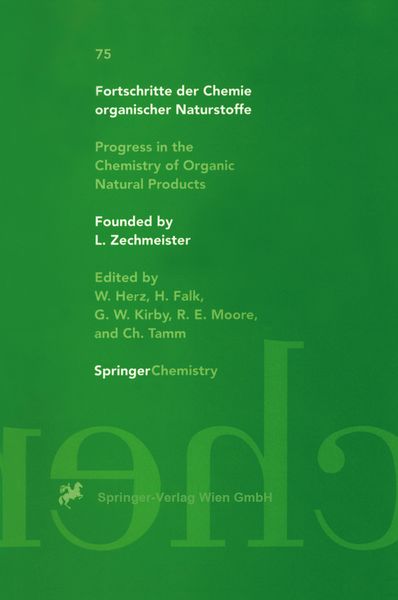
Produktbild: Fortschritte der Chemie organischer Naturstoffe / Progress in the Chemistry of Organic Natural Products
Band 75

Fortschritte der Chemie organischer Naturstoffe / Progress in the Chemistry of Organic Natural Products

167,99 €

inkl. gesetzl. MwSt., Versandkostenfrei

Lieferung nach Hause

Beschreibung

Produktdetails

Einband

Gebundene Ausgabe

Erscheinungsdatum

30.06.1998

Verlag

Springer Wien

Seitenzahl

228

Maße (L/B/H)

23,5/15,7/1,9 cm

Gewicht

452 g

Auflage

1998

Sprache

Englisch

ISBN

978-3-211-83053-6

Beschreibung

Produktdetails

Einband

Gebundene Ausgabe

Erscheinungsdatum

30.06.1998

Verlag

Springer Wien

Seitenzahl

228

Maße (L/B/H)

23,5/15,7/1,9 cm

Gewicht

452 g

Auflage

1998

Sprache

Englisch

ISBN

978-3-211-83053-6

Herstelleradresse

Springer Wien
Prinz-Eugen-Str. 8-10
1040 Wien
AT
buchhandel-buch@springer.com

Noch keine Bewertungen vorhanden

Verfassen Sie die erste Bewertung zu diesem Artikel

Helfen Sie anderen Kundinnen und Kunden durch Ihre Meinung.

Kundinnen und Kunden meinen

Bewertungen (0)

  • Produktbild: Fortschritte der Chemie organischer Naturstoffe / Progress in the Chemistry of Organic Natural Products
  • Cyclopeptide Alkaloids.- 1. Introduction.- 2. Classification.- 3. Structure Elucidation — Stereochemistry.- 3.1. NMR Spectroscopy.- 3.2. UV, IR, CD Spectroscopy.- 3.3. MS.- 4. MS Fragmentation of Cyclopeptide Alkaloids and Related Compounds.- 4.1. Fragmentation of 4(14)-Frangulanine- and -Integerrine-Type Cyclopeptide Alkaloids.- 4.2. Fragmentation of 4(14)-Pandamine-Type Cyclopeptide Alkaloids.- 4.3. Fragmentation of 5(13)-Zizyphine-A- and 5(14)-Amphibine-B-Type Cyclopeptide Alkaloids.- 4.4. Fragmentation of 5(14)-Scutianine-A-Type Cyclopeptide Alkaloids (Hymenocardine included).- 4.5. Fragmentation of 4(14)-Amphibine-F-Type Cyclopeptide Alkaloids.- 4.6. Fragmentation of 4(13)-Nummularine-C-Type Cyclopeptide Alkaloids.- 4.7. Fragmentation of 4(15)-Mucronine-A-Type Cyclopeptide Alkaloids.- 4.8. Fragmentation of Linear Peptide Alkaloids.- 4.9. Fragmentation of Neutral Compounds Related to Cyclopeptide Alkaloids.- 4.10. Miscellaneous.- 4.11. Common Fragments.- 5. Identification Strategy.- 6. Physical and Spectral Data of Cyclopeptide Alkaloids and Related Compounds.- 7. Synthesis.- 8. Biological Activity.- 8.1. Sedative Activity.- 8.2. Antibacterial Activity.- 8.3. Antifungal Activity.- 9. Biosynthesis — Tissue Culture.- 10. Conclusions.- 11. General Tables.- Table 7. Cyclopeptide Alkaloids and Related Compounds in Order of Increasing Molecular Weight.- Table 8. Alphabetical List of Cyclopeptide Alkaloids and Related Compounds.- Table 9. Plant Index.- Addendum.- References.- Naturally Occurring 6-Substituted 5,6-Dihydro-?-Pyrones.- 1. Introduction.- 2. 6-Alkyl-5,6-dihydro-?-pyrones.- 3. 6-Alkenyl-5,6-dihydro-?-pyrones.- 4. 6-Aryl-5,6-dihydro-?-pyrones.- 5. Physical Methods of Structure Determination.- References.- Author Index.