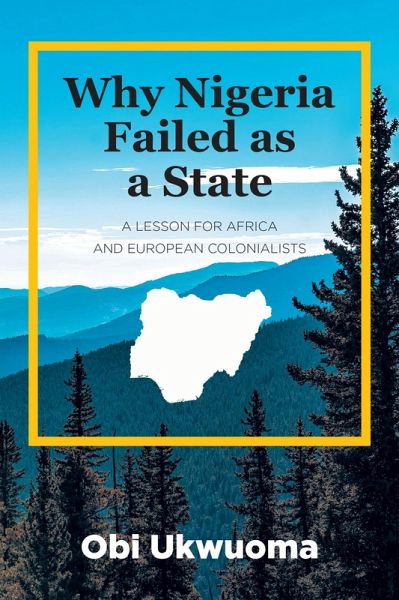
Why Nigeria Failed as a State (eBook, ePUB)
A Lesson for Africa and European Colonialists

PAYBACK Punkte
4 °P sammeln!

With an approximate population of around 220 million people, Nigeria remains the most populous country in Africa and the seventh most populous country in the world. The formation of the Southern and Northern Protectorates by the British as a business venture and joining them together was what constitutes today the paradox of Nigeria's false marriage. Nigeria has around fifty languages, 250 dialects, and is divided about evenly in religion, with 48 percent Muslim in the North, 47 percent Christian in the South, and 5 percent of other faiths that include traditional and Jewish faiths in the Sout...
With an approximate population of around 220 million people, Nigeria remains the most populous country in Africa and the seventh most populous country in the world. The formation of the Southern and Northern Protectorates by the British as a business venture and joining them together was what constitutes today the paradox of Nigeria's false marriage. Nigeria has around fifty languages, 250 dialects, and is divided about evenly in religion, with 48 percent Muslim in the North, 47 percent Christian in the South, and 5 percent of other faiths that include traditional and Jewish faiths in the South. On October 1, 1960, Nigeria gained its independence from Britain, and from July 1967âEUR"January 1970, the Nigerian Civil War was fought between Nigeria and the Republic of Biafra. What followed after the civil war was that the people of the Eastern Region were systematically marginalized in every sector of human and material endeavors, disregarding their no victor, no vanquished adage, and failed in their Three R's: Reintegration, Rehabilitation, and Reconstruction.
"Since 1914, the British Government has been trying to make Nigeria into one country, but the Nigerians people themselves are historically different in their backgrounds, in their religious beliefs and customs and do not show themselves any signs of willingness to unite" (Tafawa Belewa, 1948). "Nigerians are corrupt because the system they live under today makes corruption easy and profitable. They will cease to be corrupt when corruption is made difficult and unattractive. The leadership in Nigeria is using the nation's wealth to corrupt, really to destroy the country so no improvement or change can happen. Corruption in Nigeria has passed the alarming and entered the fatal stage, and Nigeria will die if we continue to pretend that the country is only slightly indisposed" (Chinua Achebe, The Trouble With Nigeria). Failure to restructure, coupled with rampant insecurity and other social, economic, and political ills, Nigeria has set itself on a journey of no return.
"Since 1914, the British Government has been trying to make Nigeria into one country, but the Nigerians people themselves are historically different in their backgrounds, in their religious beliefs and customs and do not show themselves any signs of willingness to unite" (Tafawa Belewa, 1948). "Nigerians are corrupt because the system they live under today makes corruption easy and profitable. They will cease to be corrupt when corruption is made difficult and unattractive. The leadership in Nigeria is using the nation's wealth to corrupt, really to destroy the country so no improvement or change can happen. Corruption in Nigeria has passed the alarming and entered the fatal stage, and Nigeria will die if we continue to pretend that the country is only slightly indisposed" (Chinua Achebe, The Trouble With Nigeria). Failure to restructure, coupled with rampant insecurity and other social, economic, and political ills, Nigeria has set itself on a journey of no return.
Dieser Download kann aus rechtlichen Gründen nur mit Rechnungsadresse in A, D ausgeliefert werden.
Andere Kunden interessierten sich für