Why Models Fail (eBook, ePUB)
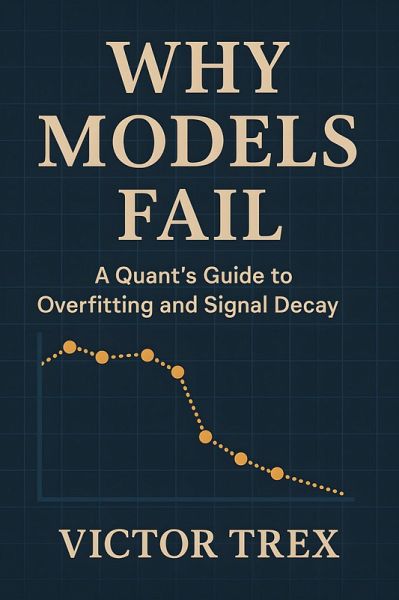
A Quant's Guide to Overfitting and Signal Decay

PAYBACK Punkte
0 °P sammeln!

"Why Models Fail: A Quant's Guide to Overfitting and Signal Decay" In modern quantitative finance, the real danger is rarely a missing factor or a clever new model-it is the quiet, systematic ways in which we fool ourselves. This book is written for quantitative researchers, portfolio managers, data scientists, and risk professionals who build or rely on systematic trading and investment strategies. It speaks to practitioners who have seen glowing backtests fade in production and want a rigorous, engineering-grade framework for understanding why. Anchored in probability, time-series analysis, ...
"Why Models Fail: A Quant's Guide to Overfitting and Signal Decay"
In modern quantitative finance, the real danger is rarely a missing factor or a clever new model-it is the quiet, systematic ways in which we fool ourselves. This book is written for quantitative researchers, portfolio managers, data scientists, and risk professionals who build or rely on systematic trading and investment strategies. It speaks to practitioners who have seen glowing backtests fade in production and want a rigorous, engineering-grade framework for understanding why.
Anchored in probability, time-series analysis, and robust performance measurement, the book develops a complete toolkit for diagnosing overfitting and signal decay in live trading. You will learn how to construct truly point-in-time datasets, identify data leakage, and design credible backtests. The text covers time-aware cross-validation, false discovery control, and Sharpe ratio deflation, then connects these to regime shifts, concept drift, portfolio construction, capacity limits, and execution frictions. Finally, it embeds models within a governance and monitoring lifecycle, turning model risk into a managed process rather than an unpleasant surprise.
The presentation assumes comfort with basic statistics, linear algebra, and Python or a similar language, but it is self-contained in its treatment of more advanced topics. Written with a systematic, LaTeX-driven structure, it is suitable both as a practical handbook for active practitioners and as a teaching text for graduate-level courses in quantitative finance or financial
In modern quantitative finance, the real danger is rarely a missing factor or a clever new model-it is the quiet, systematic ways in which we fool ourselves. This book is written for quantitative researchers, portfolio managers, data scientists, and risk professionals who build or rely on systematic trading and investment strategies. It speaks to practitioners who have seen glowing backtests fade in production and want a rigorous, engineering-grade framework for understanding why.
Anchored in probability, time-series analysis, and robust performance measurement, the book develops a complete toolkit for diagnosing overfitting and signal decay in live trading. You will learn how to construct truly point-in-time datasets, identify data leakage, and design credible backtests. The text covers time-aware cross-validation, false discovery control, and Sharpe ratio deflation, then connects these to regime shifts, concept drift, portfolio construction, capacity limits, and execution frictions. Finally, it embeds models within a governance and monitoring lifecycle, turning model risk into a managed process rather than an unpleasant surprise.
The presentation assumes comfort with basic statistics, linear algebra, and Python or a similar language, but it is self-contained in its treatment of more advanced topics. Written with a systematic, LaTeX-driven structure, it is suitable both as a practical handbook for active practitioners and as a teaching text for graduate-level courses in quantitative finance or financial
Dieser Download kann aus rechtlichen Gründen nur mit Rechnungsadresse in A, B, BG, CY, CZ, D, DK, EW, E, FIN, F, GR, H, IRL, I, LT, L, LR, M, NL, PL, P, R, S, SLO, SK ausgeliefert werden.
Andere Kunden interessierten sich für