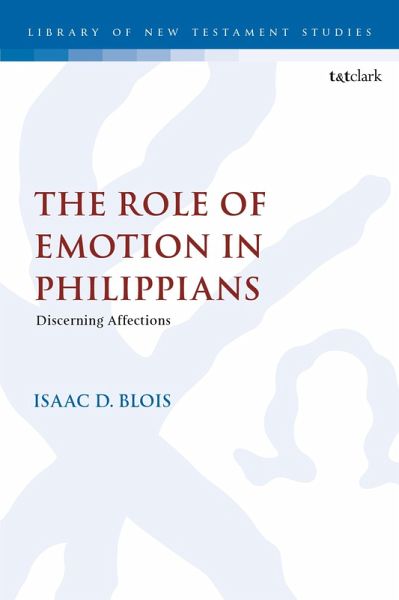
The Role of Emotion in Philippians (eBook, ePUB)
Discerning Affections
Versandkostenfrei!
Erscheint vor. 19.02.26
74,95 €
inkl. MwSt.
Unser Service für Vorbesteller - dein Vorteil ohne Risiko:
Sollten wir den Preis dieses Artikels vor dem Erscheinungsdatum senken, werden wir dir den Artikel bei der Auslieferung automatisch zum günstigeren Preis berechnen.
Weitere Ausgaben:

PAYBACK Punkte
37 °P sammeln!

Isaac D. Blois demonstrates the many ways that Paul attempted to shape the emotional orientation of his friends at Philippi, thereby constructing a multifaceted Christian identity that went beyond mere doctrinal content. While Paul famously instructs the Philippian believers to "think" among themselves the same thing that is also "in Christ", Blois suggests that English translations have missed crucial aspects by focusing too much on the logo-centric, intellectual elements of the key term phroneo, while missing the emotional resonance behind this concept. Rather, in order to guide their behavi...
Isaac D. Blois demonstrates the many ways that Paul attempted to shape the emotional orientation of his friends at Philippi, thereby constructing a multifaceted Christian identity that went beyond mere doctrinal content. While Paul famously instructs the Philippian believers to "think" among themselves the same thing that is also "in Christ", Blois suggests that English translations have missed crucial aspects by focusing too much on the logo-centric, intellectual elements of the key term phroneo, while missing the emotional resonance behind this concept. Rather, in order to guide their behaviour, Paul first had to form their affections, training them to feel appropriately toward Christ and his world, so that then they might be able to believe rightly and act correctly within it.
Blois analyses six key emotions arising within the discourse: three positive emotions (joy, pride, and hope), and then three negative emotions (grief, shame, and fear). By situating each emotion within its Greco-Roman cultural context, along with highlighting its Scriptural resonances, the versatility of the apostle emerges, in that Paul could both draw on common cultural scripts while simultaneously changing them so as to morph them around the new and radical Christ paradigm. Ultimately, Blois stresses that Paul deftly weaves together a tapestry of emotions that unifies the Philippian believers around a shared way of feeling, enabling them to first experience Christ communally and then present him powerfully and winsomely to the pagan world around them.
Blois analyses six key emotions arising within the discourse: three positive emotions (joy, pride, and hope), and then three negative emotions (grief, shame, and fear). By situating each emotion within its Greco-Roman cultural context, along with highlighting its Scriptural resonances, the versatility of the apostle emerges, in that Paul could both draw on common cultural scripts while simultaneously changing them so as to morph them around the new and radical Christ paradigm. Ultimately, Blois stresses that Paul deftly weaves together a tapestry of emotions that unifies the Philippian believers around a shared way of feeling, enabling them to first experience Christ communally and then present him powerfully and winsomely to the pagan world around them.
Andere Kunden interessierten sich für