The Persepolis Inheritance: The Mirror of the Narenj (eBook, ePUB)

PAYBACK Punkte
0 °P sammeln!

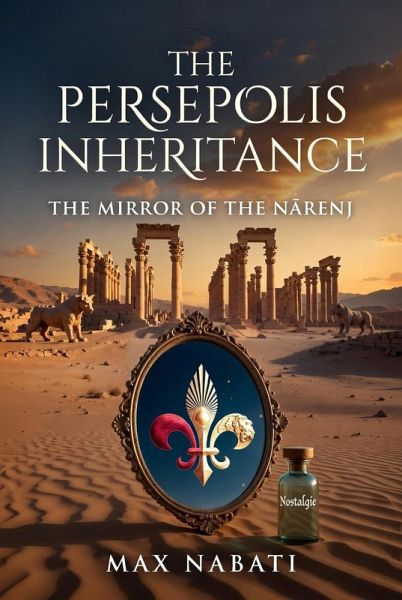
In the sweltering haze of a Tehran summer, Amir Hossein returns from his studies in Paris, feeling like a stranger in his homeland. His European education has reshaped him, leaving his Persian roots tangled with foreign influences, his mind a battlefield of clashing cultures. Drawn by a cryptic invitation on luxurious paper embossed with a peculiar hybrid crest-merging the Persian Lion and Sun with French floral motifs-he ventures to the opulent yet decaying mansion of Mirza Ahmad Khan, a reclusive Qajar aristocrat known for his obsession with France and his dealings in antiquities.The mansion...
In the sweltering haze of a Tehran summer, Amir Hossein returns from his studies in Paris, feeling like a stranger in his homeland. His European education has reshaped him, leaving his Persian roots tangled with foreign influences, his mind a battlefield of clashing cultures. Drawn by a cryptic invitation on luxurious paper embossed with a peculiar hybrid crest-merging the Persian Lion and Sun with French floral motifs-he ventures to the opulent yet decaying mansion of Mirza Ahmad Khan, a reclusive Qajar aristocrat known for his obsession with France and his dealings in antiquities.
The mansion, hidden behind mud-brick walls in the old Sanglaj quarter, is a world unto itself: a stagnant pool of time where rosewater mingles with stale tobacco and an earthy, mineral scent. At its heart lies the Mirror Hall, a dizzying chamber clad in Venetian-style mirrors framed in intricate Isfahani inlay, creating infinite reflections that fracture reality into a kaleidoscope of selves. Here, Mirza Ahmad, an elderly figure carved from ancient walnut with pale blue eyes hinting at distant ancestry, receives Amir. Dressed in a traditional qaba of French brocade and sporting a Breguet pocket watch, he embodies the very cultural fusion that haunts Amir.
Their conversation unfolds like a duel of memories, bridging two Parises: Mirza's nostalgic Second Empire city, preserved in amber with its wine shops and cobblestone patterns, and Amir's modern Third Republic, bustling with change. They sip deep red Burgundy, its ruby glow multiplying in the mirrors, symbolizing the blood of lands divided by logic and poetry. Mirza speaks of identity as a congress of quarrelsome souls, of loving the foreign not to betray the self but to uncover hidden facets within. As talk turns to Iran's humiliations-the Tobacco Regie, foreign concessions eroding sovereignty like claws in a dying lion-Mirza's bitterness reveals a deeper quest: harnessing the phantoms of history, awakening a sleeping army from the past.
Driven by unnamed melancholy, Mirza recounts his journey to Persepolis, not as an archaeologist but as a seeker of echoes. Amid the desolate beauty of the ruins-the Apadana's grand staircase, towering columns casting shadows like ghostly Immortals-he encounters Professor Émile Laurent, a brisk French archaeologist excavating with scientific precision. A competitive camaraderie forms between the Persian noble and the European savant, united by shared language yet divided by perspectives: one sees glory to reclaim, the other a puzzle to dissect.
On the eve of opening a sealed chamber near the Treasury, a startling revelation emerges through photographs and lithographs, hinting at intertwined lineages across continents-a watch chain linking families in unexpected ways. The discovery in the chamber, an anachronistic artifact defying time's layers, shatters assumptions, forcing both men to confront a reality where past and present graft in secret beneath history's soil.
"The Persepolis Inheritance: The Mirror of the Narenj" is a richly woven tale of cultural duality, where mirrors reflect not just faces but fragmented identities, and ancient ruins whisper secrets that blur the boundaries between heritage and haunting. Max Nabati masterfully blends historical detail with philosophical depth, exploring how empires' echoes resonate in personal lives, inviting readers into a labyrinth of self-discovery amid the sands of time.
The mansion, hidden behind mud-brick walls in the old Sanglaj quarter, is a world unto itself: a stagnant pool of time where rosewater mingles with stale tobacco and an earthy, mineral scent. At its heart lies the Mirror Hall, a dizzying chamber clad in Venetian-style mirrors framed in intricate Isfahani inlay, creating infinite reflections that fracture reality into a kaleidoscope of selves. Here, Mirza Ahmad, an elderly figure carved from ancient walnut with pale blue eyes hinting at distant ancestry, receives Amir. Dressed in a traditional qaba of French brocade and sporting a Breguet pocket watch, he embodies the very cultural fusion that haunts Amir.
Their conversation unfolds like a duel of memories, bridging two Parises: Mirza's nostalgic Second Empire city, preserved in amber with its wine shops and cobblestone patterns, and Amir's modern Third Republic, bustling with change. They sip deep red Burgundy, its ruby glow multiplying in the mirrors, symbolizing the blood of lands divided by logic and poetry. Mirza speaks of identity as a congress of quarrelsome souls, of loving the foreign not to betray the self but to uncover hidden facets within. As talk turns to Iran's humiliations-the Tobacco Regie, foreign concessions eroding sovereignty like claws in a dying lion-Mirza's bitterness reveals a deeper quest: harnessing the phantoms of history, awakening a sleeping army from the past.
Driven by unnamed melancholy, Mirza recounts his journey to Persepolis, not as an archaeologist but as a seeker of echoes. Amid the desolate beauty of the ruins-the Apadana's grand staircase, towering columns casting shadows like ghostly Immortals-he encounters Professor Émile Laurent, a brisk French archaeologist excavating with scientific precision. A competitive camaraderie forms between the Persian noble and the European savant, united by shared language yet divided by perspectives: one sees glory to reclaim, the other a puzzle to dissect.
On the eve of opening a sealed chamber near the Treasury, a startling revelation emerges through photographs and lithographs, hinting at intertwined lineages across continents-a watch chain linking families in unexpected ways. The discovery in the chamber, an anachronistic artifact defying time's layers, shatters assumptions, forcing both men to confront a reality where past and present graft in secret beneath history's soil.
"The Persepolis Inheritance: The Mirror of the Narenj" is a richly woven tale of cultural duality, where mirrors reflect not just faces but fragmented identities, and ancient ruins whisper secrets that blur the boundaries between heritage and haunting. Max Nabati masterfully blends historical detail with philosophical depth, exploring how empires' echoes resonate in personal lives, inviting readers into a labyrinth of self-discovery amid the sands of time.
Dieser Download kann aus rechtlichen Gründen nur mit Rechnungsadresse in A, B, CY, CZ, D, DK, EW, E, FIN, F, GR, H, IRL, I, LT, L, LR, M, NL, PL, P, R, S, SLO, SK ausgeliefert werden.
Andere Kunden interessierten sich für