

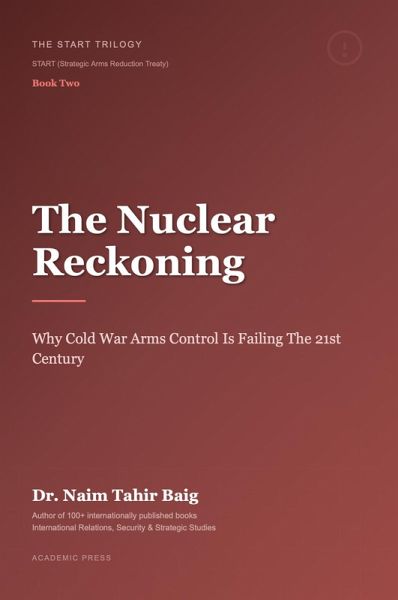
The Nuclear Reckoning: Why Cold War Arms Control Is Failing the 21st Century (The START Trilogy START (Strategic Arms Reduction Treaty), #2) (eBook, ePUB)

PAYBACK Punkte
0 °P sammeln!

BOOK DESCRIPTIONThe Nuclear Reckoning: Why Cold War Arms Control Is Failing the 21st CenturyBook 2 of The START TrilogyThe frameworks that prevented nuclear catastrophe during the Cold War are crumbling. On February 21, 2023, Russian President Vladimir Putin suspended the New Strategic Arms Reduction Treaty (New START)the last remaining agreement limiting the world's two largest nuclear arsenals. This suspension was not merely a diplomatic setback; it marked the acceleration of a structural collapse that had been building for over a decade. From the death of the Intermediate-Range Nuclear Forc...
BOOK DESCRIPTION
The Nuclear Reckoning: Why Cold War Arms Control Is Failing the 21st Century
Book 2 of The START Trilogy
The frameworks that prevented nuclear catastrophe during the Cold War are crumbling. On February 21, 2023, Russian President Vladimir Putin suspended the New Strategic Arms Reduction Treaty (New START)the last remaining agreement limiting the world's two largest nuclear arsenals. This suspension was not merely a diplomatic setback; it marked the acceleration of a structural collapse that had been building for over a decade. From the death of the Intermediate-Range Nuclear Forces Treaty in 2019 to the abandonment of the Open Skies Treaty in 2020, the architecture of strategic stability has been systematically dismantled. What remains is a dangerous vacuum: for the first time since 1972, the world faces the prospect of unconstrained great power nuclear competition.
Drawing on newly declassified documents, exclusive interviews with current and former officials, and meticulous analysis of strategic doctrines across three nuclear powers, Dr. Baig exposes the layered crises facing contemporary arms control. Hypersonic glide vehicles like Russia's Avangard and China's DF-ZF evade early warning systems and challenge the very concept of mutual assured destruction that underpinned Cold War stability. The digitization of nuclear command and control creates vulnerabilities that didn't exist when treaties were draftedwhat happens when a cyber attack masquerading as a Russian operation triggers a nuclear response? Artificial intelligence systems, deployed to manage information overload, threaten to create "flash war" scenarios where algorithmic decisions outpace human judgment.
Perhaps most critically, Dr. Baig examines what he terms "the China challenge"Beijing's expansion from an estimated 400+ nuclear warheads toward potential parity with the United States and Russia, combined with its categorical refusal to enter START-style negotiations. The book reveals why trilateral arms control talks attempted between 2019 and 2020 failed, and why cultural, strategic, and political factors make Chinese participation in traditional verification regimes highly unlikely. This creates what strategists call the "strategic triangle instability": three nuclear superpowers with incompatible doctrines, asymmetric arsenals, and no common framework for crisis management.
The economic dimensions are equally stark. Dr. Baig documents the trillion-dollar modernization programs underway in all three nationsthe United States' $1.5 trillion nuclear infrastructure overhaul, Russia's dependence on weapons exports to sustain its deterrent, and China's massive expansion of missile silos detected by commercial satellites in 2021. These investments create powerful constituencies resistant to disarmament: defense contractors, congressional districts hosting nuclear facilities, and military-industrial complexes that profit from perpetual modernization. Arms control, in this analysis, isn't merely a technical or diplomatic challengeit's a political economy problem where billions in contracts depend on treaty failure.
As New START approaches its 2026 expiration with no successor in sight, and as hypersonic missiles, cyber weapons, and AI systems proliferate globally, The Nuclear Reckoning offers the most comprehensive examination available of why twentieth-century arms control is failing and what twenty-first-century alternatives might look like. This is essential reading for anyone seeking to understand the strategic forces shaping our most dangerous decade since the Cuban Missile Crisis.
Series Context: The START Trilogy examines strategic arms control from verification mechanics (Book 1) through policy failure and adaptation (Book 2) to future scenarios and recommendations (Book 3).
The Nuclear Reckoning: Why Cold War Arms Control Is Failing the 21st Century
Book 2 of The START Trilogy
The frameworks that prevented nuclear catastrophe during the Cold War are crumbling. On February 21, 2023, Russian President Vladimir Putin suspended the New Strategic Arms Reduction Treaty (New START)the last remaining agreement limiting the world's two largest nuclear arsenals. This suspension was not merely a diplomatic setback; it marked the acceleration of a structural collapse that had been building for over a decade. From the death of the Intermediate-Range Nuclear Forces Treaty in 2019 to the abandonment of the Open Skies Treaty in 2020, the architecture of strategic stability has been systematically dismantled. What remains is a dangerous vacuum: for the first time since 1972, the world faces the prospect of unconstrained great power nuclear competition.
Drawing on newly declassified documents, exclusive interviews with current and former officials, and meticulous analysis of strategic doctrines across three nuclear powers, Dr. Baig exposes the layered crises facing contemporary arms control. Hypersonic glide vehicles like Russia's Avangard and China's DF-ZF evade early warning systems and challenge the very concept of mutual assured destruction that underpinned Cold War stability. The digitization of nuclear command and control creates vulnerabilities that didn't exist when treaties were draftedwhat happens when a cyber attack masquerading as a Russian operation triggers a nuclear response? Artificial intelligence systems, deployed to manage information overload, threaten to create "flash war" scenarios where algorithmic decisions outpace human judgment.
Perhaps most critically, Dr. Baig examines what he terms "the China challenge"Beijing's expansion from an estimated 400+ nuclear warheads toward potential parity with the United States and Russia, combined with its categorical refusal to enter START-style negotiations. The book reveals why trilateral arms control talks attempted between 2019 and 2020 failed, and why cultural, strategic, and political factors make Chinese participation in traditional verification regimes highly unlikely. This creates what strategists call the "strategic triangle instability": three nuclear superpowers with incompatible doctrines, asymmetric arsenals, and no common framework for crisis management.
The economic dimensions are equally stark. Dr. Baig documents the trillion-dollar modernization programs underway in all three nationsthe United States' $1.5 trillion nuclear infrastructure overhaul, Russia's dependence on weapons exports to sustain its deterrent, and China's massive expansion of missile silos detected by commercial satellites in 2021. These investments create powerful constituencies resistant to disarmament: defense contractors, congressional districts hosting nuclear facilities, and military-industrial complexes that profit from perpetual modernization. Arms control, in this analysis, isn't merely a technical or diplomatic challengeit's a political economy problem where billions in contracts depend on treaty failure.
As New START approaches its 2026 expiration with no successor in sight, and as hypersonic missiles, cyber weapons, and AI systems proliferate globally, The Nuclear Reckoning offers the most comprehensive examination available of why twentieth-century arms control is failing and what twenty-first-century alternatives might look like. This is essential reading for anyone seeking to understand the strategic forces shaping our most dangerous decade since the Cuban Missile Crisis.
Series Context: The START Trilogy examines strategic arms control from verification mechanics (Book 1) through policy failure and adaptation (Book 2) to future scenarios and recommendations (Book 3).
Dieser Download kann aus rechtlichen Gründen nur mit Rechnungsadresse in A, B, CY, CZ, D, DK, EW, E, FIN, F, GR, H, IRL, I, LT, L, LR, M, NL, PL, P, R, S, SLO, SK ausgeliefert werden.