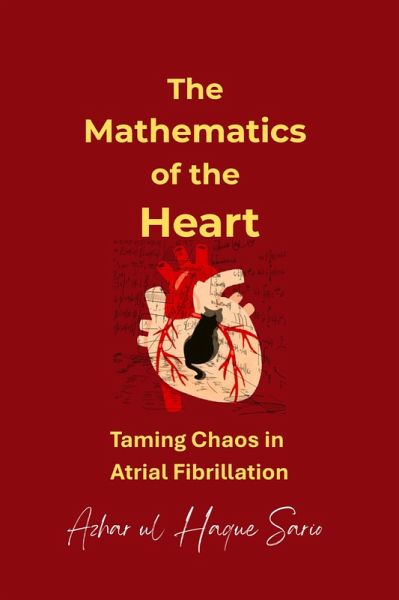
The Mathematics of the Heart (eBook, ePUB)
Taming Chaos in Atrial Fibrillation

PAYBACK Punkte
0 °P sammeln!

Discover the Hidden Math Behind a Beating HeartHey there, if you've ever wondered why hearts go haywire in atrial fibrillation (AF), this book breaks it down like a friendly chat over coffee. It starts with the basics: the heart as a biological oscillator gone chaotic. We dive into the monodomain equation that models electrical waves in cardiac tissue. Anisotropy in fiber directions stabilizes those tricky scroll waves. Ionic currents like sodium and potassium drive the nonlinear reactions. Patient-specific meshes from MRI scans bring virtual atria to life. Fractional diffusion handles fibroti...
Discover the Hidden Math Behind a Beating Heart
Hey there, if you've ever wondered why hearts go haywire in atrial fibrillation (AF), this book breaks it down like a friendly chat over coffee. It starts with the basics: the heart as a biological oscillator gone chaotic. We dive into the monodomain equation that models electrical waves in cardiac tissue. Anisotropy in fiber directions stabilizes those tricky scroll waves. Ionic currents like sodium and potassium drive the nonlinear reactions. Patient-specific meshes from MRI scans bring virtual atria to life. Fractional diffusion handles fibrotic delays better than standard models. Inverse problems map conductivity to spot slow zones. Ablation tweaks boundaries to shrink reentry areas. Restitution curves explain why fast rates lead to wavebreaks. Slopes over 1 trigger alternans and rotors. Dynamic pacing builds slope maps in the lab. Drugs flatten curves to prevent chaos. Phase singularities define rotor cores with topological charge. Hilbert transforms extract phases from signals. Filaments in 3D twist through walls. Eikonal equations approximate wavefront speeds with curvature effects. Fast marching methods simulate activations quickly. Entropy quantifies signal disorder in complex electrograms. High entropy flags rotor pivots. Frequency hierarchies reveal dominant drivers via Fourier analysis. Gradients show mother rotors overdriving tissue. Drift equations predict rotor movement toward scars. Percolation theory explains fibrosis thresholds for zig-zag conduction. Fractal dimensions measure scar roughness for anchoring risks. Graph theory finds minimum cuts to break circuits. Hopf bifurcations model triggers like early afterdepolarizations. Bioheat equations govern ablation heating. Bayesian inference guides decisions under uncertainty. Optimization minimizes ablation costs. Digital twins integrate multi-physics for personalized sims.
What sets this book apart is its laser focus on math as the cure, not just a tool-other books skim the surface with biology or procedures, but here we connect equations directly to clinical wins, like using topology to pinpoint rotors or percolation to homogenize scars. No fluff; it's a roadmap from chaos theory to bedside, filling gaps in fragmented texts by weaving non-linear dynamics, simulations, and real-world apps into one cohesive story. You'll get why empirical ablations fail and how computational engineering triumphs, with fresh insights from recent models that outdated books miss.
This book is independently produced under nominative fair use. The author has no affiliation with any board or entity mentioned.
Hey there, if you've ever wondered why hearts go haywire in atrial fibrillation (AF), this book breaks it down like a friendly chat over coffee. It starts with the basics: the heart as a biological oscillator gone chaotic. We dive into the monodomain equation that models electrical waves in cardiac tissue. Anisotropy in fiber directions stabilizes those tricky scroll waves. Ionic currents like sodium and potassium drive the nonlinear reactions. Patient-specific meshes from MRI scans bring virtual atria to life. Fractional diffusion handles fibrotic delays better than standard models. Inverse problems map conductivity to spot slow zones. Ablation tweaks boundaries to shrink reentry areas. Restitution curves explain why fast rates lead to wavebreaks. Slopes over 1 trigger alternans and rotors. Dynamic pacing builds slope maps in the lab. Drugs flatten curves to prevent chaos. Phase singularities define rotor cores with topological charge. Hilbert transforms extract phases from signals. Filaments in 3D twist through walls. Eikonal equations approximate wavefront speeds with curvature effects. Fast marching methods simulate activations quickly. Entropy quantifies signal disorder in complex electrograms. High entropy flags rotor pivots. Frequency hierarchies reveal dominant drivers via Fourier analysis. Gradients show mother rotors overdriving tissue. Drift equations predict rotor movement toward scars. Percolation theory explains fibrosis thresholds for zig-zag conduction. Fractal dimensions measure scar roughness for anchoring risks. Graph theory finds minimum cuts to break circuits. Hopf bifurcations model triggers like early afterdepolarizations. Bioheat equations govern ablation heating. Bayesian inference guides decisions under uncertainty. Optimization minimizes ablation costs. Digital twins integrate multi-physics for personalized sims.
What sets this book apart is its laser focus on math as the cure, not just a tool-other books skim the surface with biology or procedures, but here we connect equations directly to clinical wins, like using topology to pinpoint rotors or percolation to homogenize scars. No fluff; it's a roadmap from chaos theory to bedside, filling gaps in fragmented texts by weaving non-linear dynamics, simulations, and real-world apps into one cohesive story. You'll get why empirical ablations fail and how computational engineering triumphs, with fresh insights from recent models that outdated books miss.
This book is independently produced under nominative fair use. The author has no affiliation with any board or entity mentioned.
Dieser Download kann aus rechtlichen Gründen nur mit Rechnungsadresse in A, B, BG, CY, CZ, D, DK, EW, E, FIN, F, GR, H, IRL, I, LT, L, LR, M, NL, PL, P, R, S, SLO, SK ausgeliefert werden.
Andere Kunden interessierten sich für