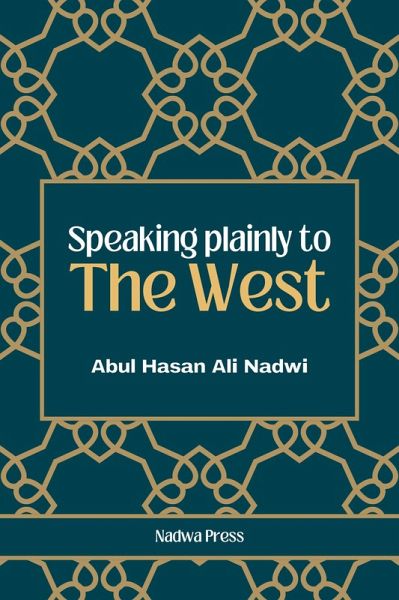
Speaking plainly to the West (eBook, ePUB)

PAYBACK Punkte
1 °P sammeln!

In this groundbreaking collection of addresses, Sayyid Abul Hasan Ali Nadwi speaks with unusual candor and clarity to Western audiences about the spiritual crisis at the heart of modern civilization. Delivered at prestigious European universitiesLondon, Berlin, and Leedsduring the transformative 1960s and 1970s, these speeches represent one of the twentieth century's most important Muslim contributions to civilizational dialogue.
Nadwi, recipient of the King Faisal International Prize and widely recognized as one of the leading Islamic scholars of his era, confronts the paradox of Western ...
In this groundbreaking collection of addresses, Sayyid Abul Hasan Ali Nadwi speaks with unusual candor and clarity to Western audiences about the spiritual crisis at the heart of modern civilization. Delivered at prestigious European universitiesLondon, Berlin, and Leedsduring the transformative 1960s and 1970s, these speeches represent one of the twentieth century's most important Muslim contributions to civilizational dialogue.
Nadwi, recipient of the King Faisal International Prize and widely recognized as one of the leading Islamic scholars of his era, confronts the paradox of Western civilization: spectacular technological achievement combined with moral and spiritual exhaustion. He shows how the modern West, despite conquering nature and accumulating unprecedented wealth, has failed to answer the fundamental questions of human lifepurpose, belonging, inner peace, and ultimate meaning.
What sets this work apart is Nadwi's third-path approach. He refuses both apologetic attempts to bend Islam to Western norms and reactionary rejection of everything Western. Instead, he offers honest, faith-rooted critique that acknowledges the West's strengths while exposing the limits of its materialistic foundations. He argues that the separation of faith from knowledgewith religion pushed to the margins of private life while public life runs on purely secular assumptionshas produced world wars, nuclear weapons, social breakdown, and pervasive anxiety.
To Muslim audiences, Nadwi speaks with equally direct frankness. He challenges the intellectual dependency of Muslim elites, who imitate Western models while losing touch with their own religious tradition and communities. He calls instead for intellectual independence, cultural authenticity, and deep spiritual renewal. His message to Muslim students in the West remains strikingly current: excel in modern disciplines without surrendering your Islamic identity and worldview.
The continuing power of Speaking Plainly to the West lies in its relevance to today's debates about Islam and modernity, secularism, Muslim minorities in Western societies, and the possibility of genuine dialogue between civilizations. Nadwi demonstrates that real engagement requires neither self-hate nor hostility, but moral courage, spiritual confidence, and a willingness to speak the trutheven when it is uncomfortable.
This volume is essential reading for students and scholars of Islamic thought, comparative religion, postcolonial studies, and philosophy, as well as thoughtful general readers seeking a serious, insider perspective on the encounter between Islam and the modern West. It preserves Nadwi's powerful voice and far-seeing insight for a new generation facing many of the same civilizational challenges he diagnosed decades ago.
Nadwi, recipient of the King Faisal International Prize and widely recognized as one of the leading Islamic scholars of his era, confronts the paradox of Western civilization: spectacular technological achievement combined with moral and spiritual exhaustion. He shows how the modern West, despite conquering nature and accumulating unprecedented wealth, has failed to answer the fundamental questions of human lifepurpose, belonging, inner peace, and ultimate meaning.
What sets this work apart is Nadwi's third-path approach. He refuses both apologetic attempts to bend Islam to Western norms and reactionary rejection of everything Western. Instead, he offers honest, faith-rooted critique that acknowledges the West's strengths while exposing the limits of its materialistic foundations. He argues that the separation of faith from knowledgewith religion pushed to the margins of private life while public life runs on purely secular assumptionshas produced world wars, nuclear weapons, social breakdown, and pervasive anxiety.
To Muslim audiences, Nadwi speaks with equally direct frankness. He challenges the intellectual dependency of Muslim elites, who imitate Western models while losing touch with their own religious tradition and communities. He calls instead for intellectual independence, cultural authenticity, and deep spiritual renewal. His message to Muslim students in the West remains strikingly current: excel in modern disciplines without surrendering your Islamic identity and worldview.
The continuing power of Speaking Plainly to the West lies in its relevance to today's debates about Islam and modernity, secularism, Muslim minorities in Western societies, and the possibility of genuine dialogue between civilizations. Nadwi demonstrates that real engagement requires neither self-hate nor hostility, but moral courage, spiritual confidence, and a willingness to speak the trutheven when it is uncomfortable.
This volume is essential reading for students and scholars of Islamic thought, comparative religion, postcolonial studies, and philosophy, as well as thoughtful general readers seeking a serious, insider perspective on the encounter between Islam and the modern West. It preserves Nadwi's powerful voice and far-seeing insight for a new generation facing many of the same civilizational challenges he diagnosed decades ago.
Dieser Download kann aus rechtlichen Gründen nur mit Rechnungsadresse in A, D ausgeliefert werden.
Andere Kunden interessierten sich für