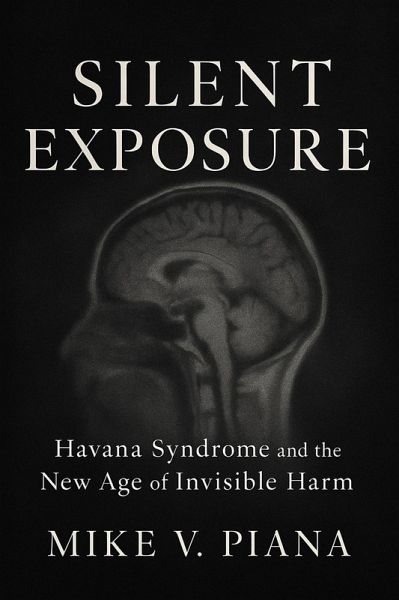
Silent Exposure - Havana Syndrome and the New Age of Invisible Harm (eBook, ePUB)

PAYBACK Punkte
0 °P sammeln!

When U.S. diplomats and intelligence personnel around the world began reporting sudden neurological symptoms-disorientation, balance loss, cognitive impairment, and unexplained auditory sensations-the incidents were initially dismissed as stress, coincidence, or psychological anomaly. Over time, the pattern refused to disappear.This book examines what has come to be known as Havana Syndrome through a careful hybrid of documented cases, medical research, government reporting, and investigative analysis. Rather than offering easy conclusions, it traces the limits of existing explanations and exp...
When U.S. diplomats and intelligence personnel around the world began reporting sudden neurological symptoms-disorientation, balance loss, cognitive impairment, and unexplained auditory sensations-the incidents were initially dismissed as stress, coincidence, or psychological anomaly. Over time, the pattern refused to disappear.
This book examines what has come to be known as Havana Syndrome through a careful hybrid of documented cases, medical research, government reporting, and investigative analysis. Rather than offering easy conclusions, it traces the limits of existing explanations and explores why modern forms of harm may no longer announce themselves with visible force.
Drawing on peer-reviewed studies, institutional assessments, and public reporting, the narrative follows how an unexplained injury challenged medicine, security doctrine, and accountability itself. It asks uncomfortable but necessary questions: What happens when harm leaves no obvious trace? When uncertainty becomes institutional policy? And when technology evolves faster than our ability to recognize its consequences?
This is not a book about speculation. It is about patterns, plausibility, and the human cost of silence. It documents what can be responsibly said, separates evidence from hypothesis, and examines why ambiguity can be strategically useful in an era of gray-zone conflict.
For readers interested in investigative nonfiction, modern security threats, and the uneasy intersection of science and power, this work offers a restrained, deeply researched examination of a phenomenon that remains unresolved-but impossible to ignore.
This book examines what has come to be known as Havana Syndrome through a careful hybrid of documented cases, medical research, government reporting, and investigative analysis. Rather than offering easy conclusions, it traces the limits of existing explanations and explores why modern forms of harm may no longer announce themselves with visible force.
Drawing on peer-reviewed studies, institutional assessments, and public reporting, the narrative follows how an unexplained injury challenged medicine, security doctrine, and accountability itself. It asks uncomfortable but necessary questions: What happens when harm leaves no obvious trace? When uncertainty becomes institutional policy? And when technology evolves faster than our ability to recognize its consequences?
This is not a book about speculation. It is about patterns, plausibility, and the human cost of silence. It documents what can be responsibly said, separates evidence from hypothesis, and examines why ambiguity can be strategically useful in an era of gray-zone conflict.
For readers interested in investigative nonfiction, modern security threats, and the uneasy intersection of science and power, this work offers a restrained, deeply researched examination of a phenomenon that remains unresolved-but impossible to ignore.
Dieser Download kann aus rechtlichen Gründen nur mit Rechnungsadresse in A, B, CY, CZ, D, DK, EW, E, FIN, F, GR, H, IRL, I, LT, L, LR, M, NL, PL, P, R, S, SLO, SK ausgeliefert werden.
Andere Kunden interessierten sich für