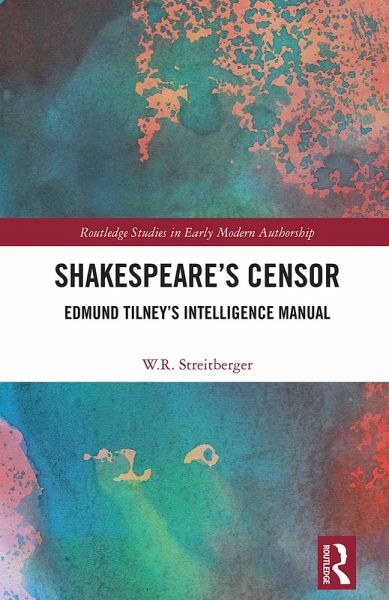
Shakespeare's Censor (eBook, ePUB)
Edmund Tilney's Intelligence Manual
Versandkostenfrei!
Erscheint vor. 12.02.26
153,95 €
inkl. MwSt.
Unser Service für Vorbesteller - dein Vorteil ohne Risiko:
Sollten wir den Preis dieses Artikels vor dem Erscheinungsdatum senken, werden wir dir den Artikel bei der Auslieferung automatisch zum günstigeren Preis berechnen.
Weitere Ausgaben:

PAYBACK Punkte
77 °P sammeln!

This study situates Tilney's intelligence manual in the emerging genre that developed around intelligence gathering in the late sixteenth century and attempts to explain how he reconciled the tension between his admiration for the aims of humanist history and his political and religious beliefs, matters directly relevant to understanding the sensibilities he brought to his duties and censor of plays and as a producer of plays for the court.The study focuses on those subjects by placing them in the broader context of a European culture that came increasingly to believe that the effective analys...
This study situates Tilney's intelligence manual in the emerging genre that developed around intelligence gathering in the late sixteenth century and attempts to explain how he reconciled the tension between his admiration for the aims of humanist history and his political and religious beliefs, matters directly relevant to understanding the sensibilities he brought to his duties and censor of plays and as a producer of plays for the court.
The study focuses on those subjects by placing them in the broader context of a European culture that came increasingly to believe that the effective analysis and deployment of historical evidence would establish a reliable version of the past that could be used to resolve contemporary problems. But the new humanist methods of historical analysis and argument exacerbated rather than resolved disputes. The techniques developed to analyse evidence and argue causality themselves were used to challenge the intellectual, political, and religious establishments they were originally devised to strengthen. As both Protestant and Catholic reformers throughout Europe became more assertive in using historical arguments to defend their confessional beliefs and to apply political pressure on governments to act on their behalf, politics and religion became inseparably intertwined. The polarization that developed from the impasse in debate eventually took the form of political and military alliances, plunging Northern Europe into a period of almost unceasing religious, political, and military conflict. Tilney's manual reflects the tension produced by that conflict. He attempted to defend the interests of England, Elizabeth I, and the Reformed Religion that she patronized in historical arguments in which politics, religion, and military action reinforced one another. Tilney's manual provides valuable insights into his understanding of some of the key political and religious issues of the period. Since he was a client of his more famous relative, Lord Admiral Charles Howard, the manual also provides insights into the politico-religious ideas acceptable within the network of one of Elizabeth I's more prominent privy councillors. While it does not provide a blueprint for the conduct of Tilney's duties as censor, the manual does provide insights into the humanist outlook he brought to his duties as licenser of plays for public performance and as producer of plays for the court. It also suggests how these ideas were disseminated and became part of the social fabric of English culture.
The study focuses on those subjects by placing them in the broader context of a European culture that came increasingly to believe that the effective analysis and deployment of historical evidence would establish a reliable version of the past that could be used to resolve contemporary problems. But the new humanist methods of historical analysis and argument exacerbated rather than resolved disputes. The techniques developed to analyse evidence and argue causality themselves were used to challenge the intellectual, political, and religious establishments they were originally devised to strengthen. As both Protestant and Catholic reformers throughout Europe became more assertive in using historical arguments to defend their confessional beliefs and to apply political pressure on governments to act on their behalf, politics and religion became inseparably intertwined. The polarization that developed from the impasse in debate eventually took the form of political and military alliances, plunging Northern Europe into a period of almost unceasing religious, political, and military conflict. Tilney's manual reflects the tension produced by that conflict. He attempted to defend the interests of England, Elizabeth I, and the Reformed Religion that she patronized in historical arguments in which politics, religion, and military action reinforced one another. Tilney's manual provides valuable insights into his understanding of some of the key political and religious issues of the period. Since he was a client of his more famous relative, Lord Admiral Charles Howard, the manual also provides insights into the politico-religious ideas acceptable within the network of one of Elizabeth I's more prominent privy councillors. While it does not provide a blueprint for the conduct of Tilney's duties as censor, the manual does provide insights into the humanist outlook he brought to his duties as licenser of plays for public performance and as producer of plays for the court. It also suggests how these ideas were disseminated and became part of the social fabric of English culture.
Dieser Download kann aus rechtlichen Gründen nur mit Rechnungsadresse in A, B, BG, CY, CZ, D, DK, EW, E, FIN, F, GR, HR, H, IRL, I, LT, L, LR, M, NL, PL, P, R, S, SLO, SK ausgeliefert werden.
Andere Kunden interessierten sich für