
Reset Patterns: How the Financial Architecture of 1666 Reappears in the 21st Century (eBook, ePUB)

PAYBACK Punkte
0 °P sammeln!

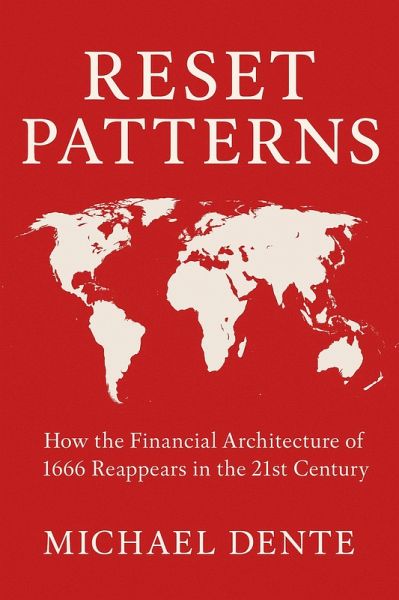
RESET PATTERNS: How the Financial Architecture of 1666 Reappears in the 21st CenturyHistory does not repeat itself-but financial architecture does.In 1666, following a convergence of crisis, fire, war, debt saturation, and institutional collapse, a new financial order quietly emerged. Sovereign debt was restructured. Land ownership shifted. Insurance became institutionalized. Centralized credit mechanisms took form. What appeared as recovery was, in fact, redesign.RESET PATTERNS examines how the structural logic of that moment did not disappear-but became the template for modern financial syst...
RESET PATTERNS: How the Financial Architecture of 1666 Reappears in the 21st Century
History does not repeat itself-but financial architecture does.
In 1666, following a convergence of crisis, fire, war, debt saturation, and institutional collapse, a new financial order quietly emerged. Sovereign debt was restructured. Land ownership shifted. Insurance became institutionalized. Centralized credit mechanisms took form. What appeared as recovery was, in fact, redesign.
RESET PATTERNS examines how the structural logic of that moment did not disappear-but became the template for modern financial systems.
This book traces the hidden continuity between the 17th-century reset and today's global transition, revealing how periods of systemic stress are repeatedly used to reorganize power, ownership, and trust. Rather than focusing on personalities or ideology, it follows mechanisms: debt instruments, ledgers, insurance frameworks, land revaluation, banking consolidation, and institutional gatekeeping.
You will explore:
The book then bridges centuries, comparing 1666 with the present era of digital finance, blockchain ledgers, real estate transitions, and global banking consolidation. It shows how technology changes the tools-but not the logic.
Rather than predicting outcomes, RESET PATTERNS offers a framework for recognition. By understanding the stages through which resets unfold, readers gain clarity on what is happening beneath headlines and narratives.
This is not a book about fear or speculation. It is a book about pattern literacy-about seeing how financial systems reorganize themselves when existing structures can no longer hold.
For readers interested in economic history, global finance, institutional power, and systemic change, RESET PATTERNS provides a grounded, comparative lens on one of the most important transitions of the modern era.
History does not repeat itself-but financial architecture does.
In 1666, following a convergence of crisis, fire, war, debt saturation, and institutional collapse, a new financial order quietly emerged. Sovereign debt was restructured. Land ownership shifted. Insurance became institutionalized. Centralized credit mechanisms took form. What appeared as recovery was, in fact, redesign.
RESET PATTERNS examines how the structural logic of that moment did not disappear-but became the template for modern financial systems.
This book traces the hidden continuity between the 17th-century reset and today's global transition, revealing how periods of systemic stress are repeatedly used to reorganize power, ownership, and trust. Rather than focusing on personalities or ideology, it follows mechanisms: debt instruments, ledgers, insurance frameworks, land revaluation, banking consolidation, and institutional gatekeeping.
You will explore:
- How debt crises historically justify structural redesign rather than reform
- Why insurance emerges as a control layer after collapse
- How land, property, and assets are reclassified during resets
- The role of ledgers-then and now-in defining sovereignty
- Why crises accelerate transitions already architected in advance
The book then bridges centuries, comparing 1666 with the present era of digital finance, blockchain ledgers, real estate transitions, and global banking consolidation. It shows how technology changes the tools-but not the logic.
Rather than predicting outcomes, RESET PATTERNS offers a framework for recognition. By understanding the stages through which resets unfold, readers gain clarity on what is happening beneath headlines and narratives.
This is not a book about fear or speculation. It is a book about pattern literacy-about seeing how financial systems reorganize themselves when existing structures can no longer hold.
For readers interested in economic history, global finance, institutional power, and systemic change, RESET PATTERNS provides a grounded, comparative lens on one of the most important transitions of the modern era.
Dieser Download kann aus rechtlichen Gründen nur mit Rechnungsadresse in A, B, CY, CZ, D, DK, EW, E, FIN, F, GR, H, IRL, I, LT, L, LR, M, NL, PL, P, R, S, SLO, SK ausgeliefert werden.
Andere Kunden interessierten sich für