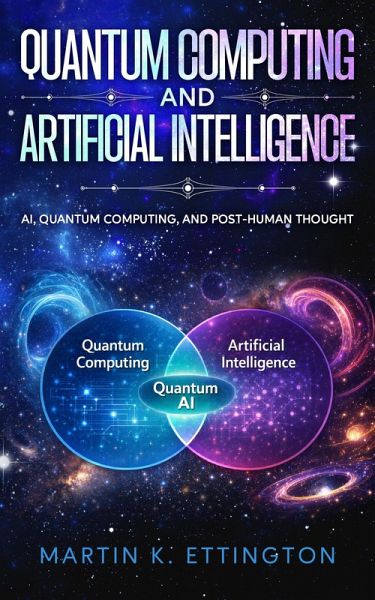
Quantum Computing and Artificial Intelligence (eBook, ePUB)
Sofort per Download lieferbar
8,99 €
inkl. MwSt.

PAYBACK Punkte
0 °P sammeln!

Intelligence is the most powerful force ever to emerge in the universe.Today, intelligence is undergoing its most radical transformation since the emergence of the human mind.Artificial intelligence has moved from theory into daily life. Algorithms now diagnose disease, generate art, predict markets, and converse with humans in natural language. Yet beneath these achievements lies a deeper truth: most contemporary AI remains constrained by the limits of classical computation. It excels at pattern recognition but struggles with genuine understanding, intuition, and creativity. It scales, but it...
Intelligence is the most powerful force ever to emerge in the universe.
Today, intelligence is undergoing its most radical transformation since the emergence of the human mind.
Artificial intelligence has moved from theory into daily life. Algorithms now diagnose disease, generate art, predict markets, and converse with humans in natural language. Yet beneath these achievements lies a deeper truth: most contemporary AI remains constrained by the limits of classical computation. It excels at pattern recognition but struggles with genuine understanding, intuition, and creativity. It scales, but it does not truly think.
At the same time, a second revolution is quietly unfoldingone that challenges our deepest assumptions about computation itself. Quantum computing does not merely make calculations faster; it operates on principles fundamentally different from classical logic. Superposition, entanglement, and probabilistic collapse allow quantum systems to explore vast landscapes of possibilities simultaneously. These machines do not step through solutions one at a timethey sample reality in a way that resembles intuition more than calculation.
When artificial intelligence and quantum computing converge, intelligence itself changes form.
This book explores that convergenceand the consequences that follow.
Today, intelligence is undergoing its most radical transformation since the emergence of the human mind.
Artificial intelligence has moved from theory into daily life. Algorithms now diagnose disease, generate art, predict markets, and converse with humans in natural language. Yet beneath these achievements lies a deeper truth: most contemporary AI remains constrained by the limits of classical computation. It excels at pattern recognition but struggles with genuine understanding, intuition, and creativity. It scales, but it does not truly think.
At the same time, a second revolution is quietly unfoldingone that challenges our deepest assumptions about computation itself. Quantum computing does not merely make calculations faster; it operates on principles fundamentally different from classical logic. Superposition, entanglement, and probabilistic collapse allow quantum systems to explore vast landscapes of possibilities simultaneously. These machines do not step through solutions one at a timethey sample reality in a way that resembles intuition more than calculation.
When artificial intelligence and quantum computing converge, intelligence itself changes form.
This book explores that convergenceand the consequences that follow.
Dieser Download kann aus rechtlichen Gründen nur mit Rechnungsadresse in A, B, CY, CZ, D, DK, EW, E, FIN, F, GR, H, IRL, I, LT, L, LR, M, NL, PL, P, R, S, SLO, SK ausgeliefert werden.
Andere Kunden interessierten sich für